Africa Great Lakes Democracy Watch


Welcome to
Africa Great Lakes Democracy Watch Blog. Our objective is to promote the institutions of democracy,social justice,Human Rights,Peace, Freedom of Expression, and Respect to humanity in Rwanda,Uganda,DR Congo, Burundi,Sudan, Tanzania, Kenya,Ethiopia, and Somalia. We strongly believe that Africa will develop if only our presidents stop being rulers of men and become leaders of citizens. We support Breaking the Silence Campaign for DR Congo since we believe the democracy in Rwanda means peace in DRC. Follow this link to learn more about the origin of the war in both Rwanda and DR Congo:http://www.rwandadocumentsproject.net/gsdl/cgi-bin/library


Showing posts with label RWANDA-UNITED NATIONS. Show all posts

Sunday, October 17, 2010

Two Sides to Every Story: Congo and the Rwandan Genocide


Two Sides to Every Story: Congo and the Rwandan Genocide
By Katherine Iliopoulos
 SIURCE:Crimes Of War
Narratives on the 1990s in Rwanda focus invariably on the country’s darkest hour: the genocide perpetrated by the Hutu against the Tutsi. It seems to many as if the story began shortly before April, 6, 1994, when the incumbent President’s plane was shot down on approach to Kigali airport, unleashing a wave of mass violence that claimed 800,000 lives.
There are scholars such as Mahmood Mamdani who have sought to go beyond popular understanding, by contextualising the genocide in terms of colonial history and developments in neighbouring countries and moving away from the popular understanding that the genocide was simply the product of ethnic hatred. Without wishing to trivialise the 1994 genocide, argue ”moral equivalence” or promote the so-called ”double genocide theory,” most would agree that it is important to recognise that mass violence was committed by both sides. Furthermore, the 1994 genocide needs to be placed in the context of the Rwandan Civil War that began in 1990.
The question of the Rwandan genocide has never really disappeared from the media and popular discourse, but it has been in the spotlight in recent weeks after a draft UN report on the most serious violations of human rights in the Democratic Republic of Congo over an eleven-year period (1993-2003) was leaked to the French newspaper Le Monde.
The lengthy report states that after the Rwandan Patriotic Front's (RPF) takeover of Rwanda in 1994, it proceeded to carry out “systematic and widespread attacks” against Hutu refugees who had fled Rwanda to neighbouring Zaire (now the Democratic Republic of the Congo) as well as against the Hutu civilian population of Zaire in general.  It concludes that the pattern of these attacks “reveal[s] a number of damning elements that, if they were proven before a competent court, could be classified as crimes of genocide.” Luc Côté, a war crimes prosecutor from Montreal who led the investigation and co-authored the report, told Agence France Presse that the evidence of genocide includes speeches in which Hutus were targeted for elimination, systematic and repetitive killings, the burning of corpses and attempts to bar outsiders from visiting massacre sites.
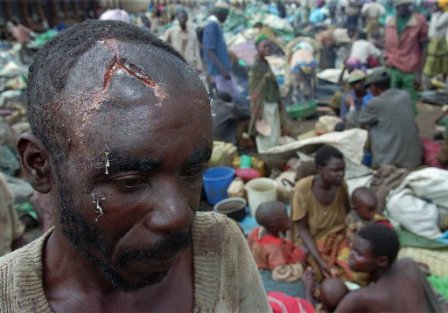
A Hutu refugee with open machete wounds on his head stands amidst a group of hundreds of fellow refugees who were surrounded by the Tutsi Army Thursday April 27, 1995, in the school compound of Kibeho, southern Rwanda. At least 2,000 people were killed by army gunfire or trampled in a stampede the previous week while the Rwandan army was trying to close the camp, which the government considered a center for extremist Hutu militias. (AP Photo/Jean-Marc Bouju)

This is not the first "public" revelation of RPF crimes. In 1994, Robert Gersony, an employee of the U.S. Agency for International Development then attached to the UN High Commissioner for Refugees, had been dispatched to survey the situation inside Rwanda to determine if conditions were right for a return of the Hutu refugees who had fled the RPF.  Instead, he found that the RPF had been committing systematic massacres of the Hutu population in Rwanda starting in April 1994 and continuing through the date of his oral presentation to the UN Commission of Experts on Rwanda on October 11 of that year.
With the RPF sweeping through the country, the Hutu génocidaires - including politicians, priests and militias - fled to neighbouring Zaire where they hid among more than a million genuine Hutu refugees. When they regrouped to continue their resistance, RPF leader Paul Kagame – the current President of Rwanda - ordered an invasion of eastern Zaire in 1996 marking the beginning of the First Congo War. This triggered a conflict that drew in six additional countries (Burundi, Uganda, Angola, Zimbabwe, Namibia and the Central African Republic) and led to the deaths of about 4 million people.
The leaked UN report, based on interviews with 1,280 individuals and review of more than 1,500 documents, raises deep and troubling questions about the use of the word ‘genocide’.
The common understanding of RPF aggression was that it was directed at those responsible for the genocide committed against the Tutsis; however, the UN report states that the majority of the incidents reported indicate that the Hutus were targeted as such, illustrated by the numerous targeted attacks against non-refugee Congolese Hutus. The report identifies the systematic use of barriers by the RPF, particularly in South Kivu, which “enabled them to identify people of Hutu origin by their name or village of origin and thus to eliminate them”.
This tendency to target all Hutus as such is, according to the report, also supported by evidence of declarations made during RPF “awareness-raising speeches” in certain places, “according to which any Hutu still present in Zaire must necessarily be a perpetrator of genocide, since the ‘real’ refugees had already returned to Rwanda.” These speeches were considered to have possibly constituted incitement for the population to look for, kill or help kill Rwandan Hutu refugees, whom they called “pigs”.
According to the definition of the international crime of genocide, certain genocidal acts such as the murder of those belonging to a particular ethnic group need to have been committed with the specific intent to destroy a particular group as such. It is this element that is the most difficult to prove in a court of law.
One of the most important issues in international criminal law is whether a genocidal policy or plan is an element of the crime of genocide. According to the jurisprudence of the ad hoc tribunals, the existence of a genocidal plan is simply one factor from which such intent can be inferred. The draft UN report opens the possibility that a court could deduce the existence of a genocidal plan from “the behaviour of certain elements of the RPF in respect of the Hutu refugees and Hutu populations settled in Zaire at this time,” which seems to equate to “a manifest pattern of similar conduct directed against that group”.
But the UN report also sets out some facts that may cause a court to hesitate in making a finding of genocide against the RPF.
One of the most significant factors that may be at odds with any portrayal of a genocidal RPF is that as of November, 15, 1996, at the beginning of the First Congo War, several tens of thousands of Rwandan Hutu refugees were repatriated to Rwanda with the help of the RPF and that hundreds of thousands of Rwandan Hutu refugees were able to return to Rwanda with the consent of the Rwandan authorities prior to the start of the First Congo War, which ended when Zairean President Mobutu Sese Seko – who was supporting Hutu extremists - was overthrown with the support of Uganda and Rwanda.
Without doubt the report presents a challenge to Rwanda's President, Paul Kagame, who was recently elected to a second seven-year term in office.  Kagame rejected the draft report and threatened to withdraw Rwanda’s peacekeeping forces from the Darfur region of Sudan and other African countries should the United Nations publish the report in its current form. UN Secretary-General Ban Ki-Moon rushed to Kigali shortly afterwards to urge him to reconsider in light of Sudan’s 2011 referendum on succession.
This is not the first time that Rwanda has threatened to withdraw its forces from Darfur. A similar threat was made in 2008 in response to the indictment issued by Spanish Investigative Judge Andreu Merelles against UNAMID (UN Assistance Mission in Darfur) deputy commander Karake Karenzi along with 39 other Rwandan officers for genocide, crimes against humanity, war crimes and terrorism perpetrated over a period of 12 years, from 1990 to 2002, against the civilian population, primarily against members of the Hutu ethnic group.
The Spanish investigation was prompted by complaints from families of nine Spaniards who were killed, harmed or ”disappeared” during the relevant period, but the indictment was subsequently expanded to include crimes committed against Rwandan and Congolese victims, based on the doctrine of universal jurisdiction.
The Spanish proceedings revealed prima facie evidence that from October 1990, a political-military structured group, heavily armed and well organised, engaged in a series of criminal activities which were carried out in Uganda against the territory of Rwanda. The indictment, based on the testimony of 22 witnesses, identified a “large extremist group of Rwandan Tutsis based in Uganda called the Rwandan Patriotic Front (RPF), which was created in order to achieve three purposes: 1) To eliminate the largest number of persons of the Hutu ethnic group, the ethnic group predominant in their country of origin; 2) To seize power by force; and 3) To form a strategic alliance with the Tutsi ethnic group and other Western allies, to terrorise firstly the population of Rwanda and then all the Great Lakes area in order to increase their sphere of power, control and influence and to invade Zaire, taking and using as their own the rich natural resources of the country”.
According to the indictment, on October 1, 1990, the RPF crossed the Ugandan border into Rwanda “with the purpose of invading, killing certain civilians and causing massive internal displacement.” The indictment then describes in detail a series of massacres, attacks and acts of terrorism against the civilian population in Rwanda that took place over the next four years.
In turn, Rwandan President Habyarimana’s party created its own militias, which would come be known as the Interahamwe. They launched numerous attacks against Rwanda’s Tutsi population, and were the ones who would later carry out the 1994 genocide.
The indictment goes on to describe how, in March 1994, “in order to begin the definite assault to power and to create a situation of civil conflict,” several meetings were attended by the leaders of the RPF with the purpose of preparing an attack to assassinate the President. The last of these meetings took place on March 31, 1994, and was attended by General Paul Kagame and other high-ranking officials. Arrangements for the attack were made to determine the place from where the surface-to-air missiles would be launched and the composition of the command that would carry out the attack. On April 6, 1994, the President’s plane was shot down, killing all those on board and sparking the genocide. In the following months, the RPF continued to launch attacks against civilians in Rwanda.
On July 17, 1994, the RPF seized power. Consequently, hundreds of thousands of Hutus headed for camps for internally displaced persons mainly in the western areas of Rwanda, while over a million sought refuge in neighbouring countries, especially Zaire. The indictment then details more RPF massacres and attacks against refugees and civilians in Zaire/DR Congo through to 1997, the end of the First Congo War, as well as from 1998-2002 (the Second Congo War). The draft UN report says that “the entire period [1996-1998] was characterised by the relentless pursuit of Hutu refugees and ex-Interahamwe by [RPF forces] across the entire Congolese territory.” It contains a catalogue of atrocities perpetrated by the RPF, along with forces from Uganda and Burundi, against the civilian population in DR Congo during the Second Congo War, including sexual violence and the use of child soldiers. But it does not make explicit mention of violence committed against Hutus during this period.
The majority of the victims during the wave of terror, according to the Spanish indictment, were Rwandan Hutu refugees or Congolese Hutu civilians. The Spanish judge did not indict Kagame, because as head of state, he has immunity from prosecution, even though many of the incidents clearly imply criminal involvement on his part.
But it was French judge Jean-Louis Bruguière who issued an indictment on November 17, 2006, against Kagame alleging that he was responsible for ordering the downing of Habyarimana’s plane in April 1994. A week later, Kigali severed diplomatic relations with Paris. The incident will be re-investigated by a team of experts later this month, with a view to determining from where the missiles were fired as a possible indicator of who was behind the attack.
The question of genocide aside, the UN findings are expected to lay the foundation for potential prosecutions for war crimes and crimes against humanity against senior Rwandan figures such as Colonel James Kabarebe, who led Rwanda's military operations in DR Congo and now heads the Rwandan forces. Kabarebe is also one of ten Rwandan officials accused by Bruguière of involvement in the assassination of Habyarimana.
The International Criminal Tribunal for Rwanda (ICTR) would have the authority to try these crimes if they were committed in 1994, because its jurisdiction extends beyond the territory of Rwanda to include “Rwandan citizens responsible for such violations committed in the territory of neighbouring States between 1 January 1994 and 31 December 1994.”
It would however be unable to prosecute individuals for crimes committed before or after 1994. Ordinarily, prosecutions for crimes committed outside 1994 would rest with the Congolese judicial system. However, the draft UN report identifies a multitude of shortcomings such as the judiciary’s lack of independence, military interference in judicial affairs and a severe lack of resources.
It is clear that the system lacks the legitimacy needed to make the smallest inroads into ending impunity in DR Congo. Justice sector reform has been recommended as one component – with others including truth and reparation-seeking mechanisms – of a ”transitional justice” solution for the country.
The ICTR has been in possession of evidence that could be used in prosecutions of senior members of the RPF, however, so far it has only prosecuted Hutu defendants.
Former ICTY and ICTR Chief Prosecutor Carla del Ponte writes in her 2009 memoir Madame Prosecutor: Confrontations with Humanity’s Worst Criminals and the Culture of Impunity, that she was eventually removed from her ICTR post after she refused to yield to pressure from the then U.S. ambassador-at-large for war crimes, Pierre Prosper, to sign away investigations of allegations against the RPF.
That was not her first confrontation with blackmail, she writes. Earlier, Kagame’s government was obstructing justice by sabotaging the ICTR trials of Hutu génocidaires by introducing measures to restrict the movement of witnesses travelling to Tanzania to testify.
In a meeting with Kagame on June 28, 2002, Del Ponte requested the military prosecutor’s files relating to the killings of the archbishop and other clergymen by RPF in Kabgayi in June 1994, the only RPF incident that she wished to investigate, at least initially.
President Kagame refused to hand over the files. “You are destroying Rwanda,” he said. “If you investigate, people will believe there were two genocides”.
The President’s desire to prevent any such perception within Rwanda may be said to be one of the reasons behind the country’s ”genocide ideology” laws. Ostensibly, the laws have been created to encourage unity and restrict speech that could promote hatred, given the central role that hate speech played in the 1994 genocide. However, rights groups such as Amnesty International have criticised the legislation saying it violates the freedom of expression and is being misused to criminalise criticism of the government and legitimate dissent, including suppressing calls for the prosecution of RPF war crimes.
The final version of the UN report is due for release on October 1. It remains to be seen whether, after the Rwandan backlash, any reference to “genocide” against the Hutus goes on the record.
At the very least, war crimes and crimes against humanity committed in the DR Congo need to be exposed and addressed. As Carla Del Ponte wrote, “a victim is a victim ... [and] irrespective of the identity or ethnicity or the political ideas of the person who committed it ... a crime is a crime”
Enhanced by Zemanta

Thursday, October 14, 2010

Justice Still Remote for Victims of Atrocities in DRC

SOURCE:Potent
London, Oct 13, 2010 (UN Integrated Regional Information Networks/All Africa Global Media via COMTEX) -- The authors of the UN "mapping report" detailing more than 600 "serious violations of human rights and international humanitarian law" committed in the Democratic Republic of Congo (DRC) between March 1993 and June 2003 see the landmark document as an important step in delivering justice to victims of the atrocities.
While the report made no claim to meet the evidentiary standards required in a courtroom, it has prompted widespread discussion about what should happen next regarding the alleged abuses attributed to troops from Rwanda, Burundi, Uganda, Chad, Zimbabwe and Angola.
IRIN evaluates the options.
Congolese judicial system
Under DRC law only military courts can try international crimes, as the civil criminal code has no provisions relating to war crimes, crimes against humanity or genocide. Military judges have handed down some verdicts in war crimes cases, citing the 1998 Rome Statute of the International Criminal Court, but the system functions poorly and judges reportedly often succumb to political interference.
As the UN report points out, the civil system is barely equipped to deliver justice at any level. It lacks adequate funding personnel, transportation, training, professional development, witness protection and judicial independence.
While most countries spend 2-6 percent of their national budget on justice, the DRC spent an average of 0.6 percent a year between 2004 and 2009, according to the UN report.
The International Criminal Court (ICC)
The Hague-based court was established to hear cases of war crimes, crimes against humanity and genocide committed after July 2002. Some crimes committed in Ituri do fall within the ICC's mandate. However, most incidents in the report occurred from July 1996 to January 2000, during the first and second DRC wars, ruling out the ICC as a legal recourse. The court's Trust Fund for Victims, which provides reparations for war crimes' victims even without judicial verdicts, is also unlikely to help for the same reason. "The Trust Fund typically becomes involved once the ICC has substantively become involved in the situation concerned. It would not get involved in other crimes in Congo that pre-date the Rome Statute," said Carla Ferstman, the director of Redress, a human rights group working with victims of war crimes in DRC.
Three cases involving crimes allegedly committed in DRC are currently before the ICC, including that of Callixte Mbarushimana, a leader of a Rwandan rebel group who was arrested in Paris on October 11. He faces five counts of crimes against humanity (murder, torture, rape, inhumane acts and persecution) and six counts of war crimes (attacks against the civilian population, destruction of property, murder, torture, rape and inhuman treatment).
The International Criminal Tribunal for Rwanda (ICTR)
As with the ICC, the ICTR is also limited by its mandate. This includes trying crimes, including genocide committed in Rwanda, or by Rwandans in neighbouring countries, but only in 1994. The tribunal is also due to close next year. "The ICTR is overloaded and trying to close its doors," said Phil Clark, research fellow at the Centre for Socio-Legal Studies at the University of Oxford.
The International Court of Justice, ICJ
The ICJ settles disputes between states. In 2005 in ruled in favour of DRC in a case brought against Uganda over the illegal exploitation of natural resources during the second war. Uganda has yet to pay the billions of dollars of reparations ordered by the court.
Both parties to a dispute must be willing participants in any ICJ case. While all UN member states are party to the Court, not all adhere to the principal of compulsory jurisdiction, i.e. of having to answer to charges brought by another state.
For example, a case the DRC hoped to bring against Rwanda was never heard by the ICJ.
Given Rwanda's blanket dismissal of the UN report, it (and other named states) are unlikely to agree to appear before the ICJ.
The recent rapprochement between Kinshasa and Kigali also reduces the chances of an inter-state court case.
New ad-hoc international tribunal
A request by DRC for the UN to establish an ad-hoc tribunal similar to the ICTR and International Criminal Tribunal for the former Yugoslavia came to nought.
There is a need for a judicial mechanism, but the process has to come from the Congolese people
Generally set up outside the country where the crimes were committed, such courts have been criticized as slow and expensive in relation to the number of trials and too distant from the victims of the crimes being prosecuted.
"These crimes took place in Congo so it wouldn't be good if the whole process of justice took place outside," said Carina Tertsakian, the senior Rwanda researcher at Human Rights Watch (HRW).
Hybrid court
Crimes committed in Sierra Leone, East Timor and Kosovo are, or have been, tried in a family of international judicial entities known as hybrid courts - "hybrid" because they involve staff and apply legislation that is both international and domestic.
Like international tribunals their efficacy is affected by the need for international cooperation and judicial assistance by states and international organizations.
The UN plays a leading role in all existing hybrid courts.
Mixed chamber
HRW, as well as the report's authors, advocate a so-called "mixed chamber" embedded in the DRC justice system with local and international judges and prosecutors working together. Cheaper and quicker to set up than an international tribunal, it would apply Congolese laws and procedures, but would temporarily include non-Congolese staff.
The Bosnian war crimes chamber in Sarajevo could be the model. Tertsakian believes a mixed chamber would give Congolese a sense of "ownership" of the justice process which would also benefit from international involvement.
"We think there needs to be an international component to the process to strengthen and build up the capacity of the Congolese justice system and also provide the process with a degree of additional credibility and to combat political interference," she said.
"Any case that reaches the trial stage will be politically sensitive, and there is likely to be pressure from various quarters, and to guard against that it would be important to have some international personnel working alongside Congolese judges and prosecutors."
A mixed chamber, however, would struggle to arrest non-Congolese suspects. Both Rwanda and Angola forbid extradition of their nationals, meaning serious support from the African Union, regional governments and the international community would be essential to avoid the problems already being experienced by the ICC which is unable to execute the majority of its arrest warrants because of lack of cooperation from member states. (Unlike the tribunals for Rwanda and Yugoslavia, the ICC has no personnel with powers of arrest).
Photo: IRIN
The report focuses on atrocities committed by foreign troops in the DRC (file photo)
Universal jurisdiction
The principle of universal jurisdiction allows suspects of serious international crimes to be prosecuted by third party states.
Belgium, the Netherlands and Spain have in the past prosecuted people from DRC and Rwanda under the principle of universal jurisdiction.
While suspects' governments may be unable to halt such prosecutions, such cases are very likely to create diplomatic rows over purported infringements of sovereignty.
Truth and reconciliation commission
The UN report says more than 30 commissions have already been set up, in particular in Argentina, Chile, South Africa, Peru, Ghana, Morocco, El Salvador, Guatemala, East Timor and Sierra Leone.
However, a previous DRC truth commission with the ambitious mandate of examining all political, economic and social crimes committed between 1960 and 2003 never really got off the ground.
It collected no witness statements nor opened a single enquiry. Commissioners were drawn from the warring groups and some were involved in the crimes they should have been investigating.
The University of Oxford's Phil Clark is sceptical that another would work much better.
"I think there is an argument that there is a need for a truth commission, but it needs to be better organized and structured and it can't involve commissioners from the main protagonists in the conflict. My sense is horse may have bolted on that front," he said.
Nothing happens ever
The crimes outlined in the UN report have been known for many years and well documented by a variety of local and international human rights and civil society organizations. Some say the reasons nothing was done then - the size of the DRC, the sheer number of crimes committed, the countries involved, the devastation of DRC's infrastructure - still exist today and that no substantive action will be taken on the report.
Clark believes the "international community" has Congolese justice fatigue. "Unfortunately I am quite pessimistic on the justice side of things that we are going to see any accountability for the crimes that have been identified by the mapping report," he said.
"There is a sense that so much has been done for this region and the results to date have been fairly patchy so the idea of wading back into the Great Lakes with a new type of institution I think is going to be a fairly unattractive possibility for most global policymakers."
That's a view shared by Mauro De Lorenzo, fellow at the American Enterprise Institute. He doubts the "international community" is willing to put at risk improving relations between DRC and its neighbours.
"It's hard to see people being enthusiastic about putting into jeopardy progress that has been made in the region," he said.
Nothing happens yet
De Lorenzo urges patience. "There's a time and place. We're just now having trials in Cambodia. It's not for us to rush and decide for the Congolese how they should do it," he said.
The International Centre for Transitional Justice's DRC head Sharanjeet Parmar agrees Congolese views are essential in determining the next steps. "There is a need for a judicial mechanism, but the process has to come from the Congolese people," she said.
Parmar, however, says some consensus is needed internationally and that doing nothing is not an option. "These are some of the worst atrocities seen on the continent in recent history, and if the international community can't work out the diplomatic and political intricacies to deliver on justice then that's a poor reflection on these international bodies we've invested decades in building."
Theme(s): Gender Issues, Governance, Human Rights, Conflict,
Countries
Photo
Film & TV
Women sit together and practice their literacy skills at the Heal Africa Transit Center for women victims of sexual violence in DRC
Our Bodies, Their Battleground
MORE REPORTS
AFRICA: Thinking big on climate change modelling
HEALTH: "Encouraging" drop in maternal deaths
DRC: Displacement and discrimination - the lot of the Bambuti Pygmies
DRC: Timeline on Lubanga's ICC trial
DRC: International justice denied?
MORE ON CONFLICT
Analysis: Red Shirt resentment simmers in Thailand
In Brief: IDP resettlement on track, says Sri Lankan government
In Brief: Thousands of DRC, Burundi refugees to return home
In Brief: Somali civilian deaths at "alarming" levels
MDGs: Banging a drum for the MDG summit
MOST READ
SWAZILAND: Changing the focus of food assistance
SRI LANKA: North crying out for more private investment
BANGLADESH: Mixed messages on sex work undermine HIV prevention
ASIA: Cities key to disaster risk reduction
SUDAN: Stigma continues to hold back Darfur's HIV fight
PHILIPPINES: Peace dividends emerge as Mindanao IDPs go home
NIGERIA: Clean up mining to avert further deaths, says UN
CONGO: School for peacekeepers
AID POLICY: Giving livestock LEGS
PAKISTAN: Child-labour risks rise across flood zone
Other OCHA Sites
Donors
Feedback | Terms & Conditions | News Feeds | About IRIN | Jobs | Donors
Copyright IRIN 2010. All rights reserved. This material comes to you via IRIN, the humanitarian news and analysis service of the UN Office for the Coordination of Humanitarian Affairs. The opinions expressed do not necessarily reflect those of the United Nations or its Member States. The boundaries, names and designations used on maps on this site do not imply official endorsement or acceptance by the UN. Republication is subject to terms and conditions as set out in the IRIN copyright page.
[ This report does not necessarily reflect the views of the United Nations ]
(c) 2010 UN Integrated Regional Information Networks. Distributed by AllAfrica Global Media (allAfrica.com).

Copyright © 2010 Acquire Media. All rights reserved.

These news stories are produced by third-parties and are not reviewed or edited by Poten & Partners. They are collected and distributed as a convenience, subject to the Terms and Conditions described on our website, and provided without warranty of any kind. Any opinions expressed in these articles represent the views of third-party authors and should not be construed to reflect the opinions of Poten & Partners.
Enhanced by Zemanta

Wednesday, October 13, 2010

DR Congo: War Criminal Ntaganda and Rwandan Security Agents Accused of Assassinations

SOURCE: Theproxylake

Bosco Ntaganda and Rwandan Security Agents Accused of Assassinations

“Ntaganda should be arrested and made to answer for his crimes, rather than being allowed to walk freely in Goma,” said Anneke Van Woudenberg, senior researcher at Human Rights Watch. “He is a threat to the people of eastern Congo and is making a mockery of the Congolese government’s policy of zero tolerance for human rights abuses.”

Article by Georgianne Nienaber an investigative and political writer. In DRC as a MONUC-accredited journalist, she has gained substantial knowledge of Congo Conflict and her article below is another proof.

Bosco (AKA "The Terminator") Ntaganda (picture by The Guardian)
Human Rights Watch today offered testimony that Bosco Ntaganda, a Congolese army general sought on an arrest warrant from the International Criminal Court (ICC), is involved in the assassination of at least eight people, arbitrary arrests of another seven, and the abduction and disappearance of at least one more in Congo and neighboring Rwanda.
Rwandan security agents are suspected of participating in an assassination in the Rwandan border town of Gisenyi, which shares a border crossing with Goma. HRW says that Ntaganda’s victims are family members or former supporters of the Tutsi rebel leader General Laurent Nkunda, whom Ntaganda ousted from the leadership of the National Congress for the Defense of the People (CNDP) rebel group in January 2009 with the help of military authorities from nearby Rwanda
Former CNDP rebel General Laurent Nkunda has been illegally held by the government of Rwanda since January 2009. This is the first time the HRW has openly stated that Paul Kagame’s regime in Rwanda is holding Nkunda “without charge.” It is also the first time that Rwandan security agents have been publicly charged with assassination of family and friends loyal to the popular and charismatic Tutsi General, who fell out of favor with Kagame in late 2008, and was betrayed and arrested by Kagame’s forces after a secret deal was struck with the Congolese government of Joseph Kabila.
Human Rights Watch received information about another four arbitrary arrests and disappearances in Gisenyi and Cyangugu, Rwandan towns bordering eastern Congo, in which members of the Rwandan security forces and possibly soldiers loyal to Ntaganda may have been involved. Those who disappeared include Sheikh Iddy Abbasi, a former supporter of Nkunda who was abducted outside his home in Gisenyi in March 2010 and has not been seen since.
“Ntaganda should be arrested and made to answer for his crimes, rather than being allowed to walk freely in Goma,” said Anneke Van Woudenberg, senior researcher at Human Rights Watch. “He is a threat to the people of eastern Congo and is making a mockery of the Congolese government’s policy of zero tolerance for human rights abuses.”
I Am Breaking The Silence – Congo Week III
HRW’s Von Woudenberg seems to be threading the diplomatic needle with this statement, since the Congolese government has shown absolutely no support for human rights. HRW’s own reports document rapes, killings, torture, and other heinous crimes too numerous to mention. This is a somewhat surprising statement from Von Woudenberg who has been a vehement critic of well-documented atrocities committed by the Congolese army in eastern Congo.
Journalists, human rights workers, civilians and refugees have been the victims of “The Terminator” Ntaganda’s rampages in eastern Congo.
Others with no connection to the CNDP or Nkunda, but who had criticized Ntaganda, have also been targeted. Sylvestre Bwira Kyahi, the civil society president of Masisi territory, was abducted in Goma on August 24, most likely on Ntaganda’s order, and held for a week in an underground prison. Bwira had been in hiding since late July following a threatening phone call from Ntaganda’s “secretary” about a public letter Bwira had written to the Congolese president, Joseph Kabila, denouncing, among other things, abuses by troops under Ntaganda’s command and calling for Ntaganda’s arrest on the basis of the ICC arrest warrant.
At least seven other people with family or other connections to Nkunda have been assassinated in the past four months. The most recent assassination occurred on September 14, when Lt. Col. Antoine Balibuno, a well-known and respected former member of Nkunda’s inner circle, was shot dead in the center of Goma. Chilling testimony describes a cell-phone conversation in which Balibuno purposely left his line open as he was kidnapped and shot in the head, neck, and chest.
“You said we were going to Dallas [a nightclub in Goma], but now we’re going to Bosco’s house… This isn’t what we agreed to. Now there’s a jeep full of soldiers blocking the road. I don’t understand. Are you going to kill me here?”
Gunshots… Then the phone cut off.
In the months prior to his assassination, Balibuno had repeatedly told Human Rights Watch and others that he was threatened by Ntaganda for refusing to support Ntaganda’s leadership of the CNDP.
On June 20, a small group of men, including at least one known bodyguard of Ntaganda and individuals whom witnesses described as Rwandan security agents, forcefully entered the home of 77-year-old Denis Ntare Semadwinga, an influential former member of the CNDP with close ties to Nkunda. Semadwinga was repeatedly stabbed in the chest and his throat was slit.
Despite repeated calls by neighbors and family members to the Rwandan police for help, no officers arrived for at least two hours.
Ntaganda was also allegedly in command of combatants who arrested, tortured, or killed hundreds of civilians in Ituri between August 2002 and March 2003. United Nations peacekeepers have said that troops under Ntaganda’s command were also responsible for killing a Kenyan UN peacekeeper in January 2004 and for kidnapping a Moroccan peacekeeper later that year, HRW said.
More recently, in November 2008 in North Kivu, CNDP troops under Ntaganda’s command killed an estimated 150 people in the town of Kiwanja, one of the worst massacres in North Kivu in the past two years.
Initially, media and HRW blamed Laurent Nkunda for the massacre. Nkunda vehemently denied involvement in a 2009 interview, days before he was ousted in Ntaganda’s coup d’état, which was supported by Rwanda and Congo.
Despite repeated requests directly to the media representative for Rwanda’s Paul Kagame, who himself has been under fire for human rights violations, General Nkunda has been denied media access and a court hearing since January 2009
Enhanced by Zemanta

Thursday, September 30, 2010

UN report to accuse Rwanda army of DRC massacres

UN report to accuse Rwanda army of DRC massacres
Rwandan Hutu refugees on the road to Kisangani in March 1997
AFP
By RFI
Hutu Refugees on their way to Kisangani
A UN report to be issued on 1 October will accuse the Rwandan army of massacring Hutus who had fled to the neighbouring Democratic Republic of Congo (DRC) in the 1990s. It will also point an accusing finger at the DRC’s own army, as well as troops from Burundi and Uganda.
And it has infuriated Rwandan leaders by declaring that a court could find that the killings were genocidal.
The 516-page report details the findings of an inquiry into “the most serious human rights violations” in the DRC, formerly Zaire, from 1993 to 2003.

It says that tens of thousands of Hutu civilians were murdered in the DRC, after they had fled Rwanda following Paul Kagame’s Tutsi-led Rwandan Patriotic Front's seizure power.

In a chapter on killings in 1997-1998, it describes an attack on about 120,000 Hutu refugees by armed Congolese rebels backed up by soldiers from the Rwandan army at a camp in Tingi-Tingi in Maniema province.

On the morning of 1 March, soldiers from both armies raided the camp, which had been deserted by most of the refugees, “indiscriminately killing its remaining occupants”, the report says.

Witnesses told the investigators that most of the victims were stabbed to death. Hundreds more are reported to have been killed in the afternoon when soldiers opened fire on columns of fleeing refugees.

In April of the same year, the investigators report that 200 refugees were massacred in the Kasese camp in Kisangani region in the presence of senior officers from the Rwandan Patriotic Army, the report states. A bulldozer was requisitioned from a local logger to dig mass graves, it adds.

The victims seem to have been chosen on the basis of their ethnic group, and not to have been limited to those held responsible for atrocities against Tutsis before Kagame took power, the report says.

On the basis of some of the incidents described, a court could conclude that there was an intention to destroy part of the Hutu ethnic group in the DRC, leaving the way open to charges of genocide, it concludes.

The report also documents massacres perpertrated with the involment of the Ugandan and Burundian armies.

Wednesday, September 29, 2010

Now You know: Paul Kagame could be charged with genocide

SOURCE:AFJN
The evidence of a criminal case against President Paul Kagame and associates is overwhelming.  A UN report that leaked to the French newspaper Le Monde on August 26 and scheduled to be officially released on October 1st confirms evidence of war crimes, crimes against humanity and possibly a genocide committed in the Democratic Republic of the Congo (DRC) during its invasion by Rwandan and Ugandan troops in 1996.  All things considered, this report does not tell the whole story about what happened in Congo as a result of this invasion.

Similarly, nothing in this report is new ( read Mr. Roberto Garretón report, and Gersony report)   More crimes committed by troops under Paul Kagame’s leadership, whether in Rwanda before and after 1994 and in Congo from 1996 to as recent as 2008, have yet to be acknowledged.  This report covers “only the most serious violations of human rights and international humanitarian law” in the Congo between March 1993 and June 2003.   “Although the primary objective of the Mapping Exercise is not to identify the alleged perpetrators or people who should be held accountable for their actions, it was nevertheless necessary to gather basic information relating to the identity of alleged individual or group perpetrators”, says the report.   Thus, the National Rwandan Army under President Paul Kagame, the Alliance des Forces Démocratiques pour la Libération du Congo (AFDL), then a rebel group under late President Laurent Kabila, and the Uganda People’s Defence Forces (Ugandan national Army) under President Yoweri Museveni  are on the long list of people and organizations that could face charges for various crimes committed in war in Congo.
There has never been any doubt that the Rwandan army was in Congo in part to hunt down the Hutu people.   This UN report repeatedly describes the killing of Hutus across the Congo such as this one.  “The killings around the former camps of Katale, Kahindo and Kibumba and in the Virunga National Park continued for several months.”  They killed with bombs, guns, machetes, knives, hummers and locking people in huts and burning them live.

On the question of a possible genocide, the report underscores that there was a targeted killing of Hutu.  “There is no denying that ethnic massacres were committed and that the victims were mostly Hutus from Burundi, Rwanda and Zaire. The joint mission’s preliminary opinion is that some of these alleged massacres could constitute acts of genocide…”  For charges of genocide, the report suggests that “(A)n in-depth investigation in the territory of the DRC would clarify this situation.” The Congolese Hutu are also referred to in this report as Hutu Banyarwanda.  Like those from Burundi, they were targeted even if they had nothing to do with 1994 Rwandan genocide.  They were targeted only because they share the same ethnic background as those who committed the genocide in Rwanda in 1994. It is worthwhile noting that Hutu and Tusti are residents and citizens of Rwanda Burundi, Congo and Uganda in the Great Lakes region.

Although the DRC has obligations under international law, there is little hope that the findings in this report will lead to prosecution any time soon.  The weak government in Congo is a hindrance to any effort to bring the perpetrators to justice.   Also, the Congolese President Joseph Kabila was a soldier in the rebel group AFDL led by his late father, President Laurent Kabila and fought alongside the Rwandan army as they carried out some of these killings.   Consequently, it is unlikely that President Joseph Kabila would encourage any judicial process that could link him as well as his father to the crimes.   Given the current Rwandan military influence in the region and in Congo in particular, such a move could have political implication for President Kabila vis as vis Rwanda on whom he depends now to keep his head above water in a country where he is unpopular.

Also, the Rwandan government has been trying to stop the United Nations from releasing the report by saying that “it is absurd for the UN, which deliberately turned its back on the Rwandan people during the 1994 genocide, to accuse the army that stopped the genocide of committing atrocities in the Democratic Republic of the Congo.” In fact, taken over by guilt for the 1994 Rwandan genocide, the world looked away as the Rwandan army committed these crimes detailed in this mapping exercise.

Africa Faith and Justice Network (AFJN) believes that the time for those who committed the crimes in the Congo to face justice is overdue.  Today more than ever before there is hope because President Paul Kagame, the first on the list of the accused, has lost credibility on the international scene as far as promoting democracy, freedom and human rights in Rwanda.  AFJN’s advocacy to the United State government for justice and accountability for the victims of the wars in Rwanda and the Congo continues.   It is AFJN’s hope that the Obama administration will chose the side of the victim and let justice be served.  More resources on Rwanda
http://www.friendsofthecongo.org/resource-center/united-nations-report.html
The Rwanda Documents Project
Who was Behind the Rwandan Genocide? The Rwandan Patriotic Front's Bloody Record and the History of UN Cover-Ups
Faces of War: Congo — The hidden horrors of a war the world ignored

Saturday, September 25, 2010

RPP-Imvura slams Rwanda govt over UN report on Rwanda-led genocide in DR Congo

by John V KARURANGA.
Our Ref: RPP-LM/5/UN07/ME-03/09/10/JVK
London, 03/09/2010
Ms Louise MUSHIKIWABO
Minister of Foreign Affairs & Cooperation
P.O.Box 179, Kigali
RWANDA
Dear Ms Louise MUSHIKIWABO,
RE: Mapping Exercise
I write to you as the President of RPP – IMVURA. I have had sight of your letter to Mr Ban Ki Moon, the Secretary-General of the United Nations. ref-No.0482/01.01/Cab.Min/2010. I would like to raise seven specific questions to which I expect specific answers.
1. Why have you gone public with your comments on the leaked UN report? Could you not have waited for the official document to be released by the UN before making an official response?
In my understanding you were well aware of these accusations against the RPF about the DR Congo and the fact is that, the Human Rights Reporter in Rwanda was expelled from Rwanda by the RPF government. It is irresponsible for any responsible government to respond to a leaked report publicly without verifying its final and official contents. You were presented with this Draft Report by the UN in confidence and you were only asked to give your own government’s explanations and accounts of the allegations but instead you decided to go public with it. I think this is very irresponsible to come from a government and it shows systemic failure in your governmental procedures and ethics.
Your knee jerk reaction has given fire to this report and as I write to you now, the major media channels in the UK like the Guardian newspaper and the TV STATIONS LIKE Al Jazeera and many others have had packed full days of carrying the story. So, what have you achieved?
2. Why did you not investigate these alleged reports of atrocities and human rights abuse by RPF against Hutu refugees and Congolese civilians?
You instead launched attacks against the Humans Rights organisations that were making credible and verifiable accusations against your government. These are reputable organisations including Human Rights Watch and Amnesty International; remember these Human Rights and UN agencies have no special reasons or hidden agendas, nor do they want to gloss over or damage their reputations.
3. Why has your government refused to cooperate with the international organisations which are respected world-wide? Why did you expel the Researcher from Human Rights Watch from Rwanda just before the elections?
Human Rights Watch does not work on behalf of any government, so why were you so frightened by actions of an independent organisation? Is it because you were preparing to rig the recently concluded elections in which your candidate, Paul Kagame won an incredible, but predictable 93% of the vote in a contest against himself?
4. Would it not be reasonable to assume that your reaction to a draft document, which was circulated for consultations, is a demonstration of your fear and trepidation about crimes and gross inhumanity committed against a foreign people, and neighbour who posed no threat to our country?
These are people with whom we should be having cordial, trade and bilateral relationships with. Do you realise that the action of your government has caused long term damage to the relations between Rwanda and the DR Congo which only a new government in Rwanda can repair?
5. Why did you not take action to investigate the allegations that Rwandan soldiers committed crimes of genocide in the DR Congo between 1993 – 2003?
The draft report makes allegations of genocide committed in the DR Congo over various phases since 1993. Your lamentable excuse is that the UN presented you a 535-pages report which was a fait accompli but WHAT STEPS DID YOU TAKE TO INVESTIGATE these allegations?
Above all, these are allegations of egregious and the most reprehensible crimes which are said to have been committed by humans against fellow human beings, and that is genocide. You are well aware of the genocide that took over 1 million lives of Rwandan people. If such a crime is alleged to have been committed by Rwandan soldiers against other people, why not at least investigate, instead of blame the UN as your letter to the UN Secretary-General clearly indicates?
6. Using legalistic arguments is not going to save your government from the opprobrium of the international community. Your best option is to stop all acts of aggression against the Congolese people who have never invaded or caused harm to the Rwandan people. It is ridiculous and irresponsible of you and your fragile regime to blame the UN peace-keeping force in the DR Congo for the crimes of rape and other mistreatment of the Congolese people just because you are being investigated by the UN body. This is just a diversionary tactic. The UN, I believe has dealt with these allegations and some of the soldiers involved have been recalled and dismissed or severely punished. Your raising of this is therefore a diversion which is clearly opportunistic and nonsense. The UN draft accusation against the RPF is that RPA committed crimes against the Congolese people. Do not divert the argument madam and stick to the issues. On behalf of the RPP-IMVURA, I beg you not to divert the argument but to confront the UN Draft Report of allegations of crimes of genocide that your party and army may have committed against Congolese people and Hutu refugees.
7. Our party is seriously very concerned about your threat to withdraw Rwanda from the international community because of a credible Draft Report by the UN Human Rights Commission.
This threat damages the reputation of Rwanda as a nation and is very irresponsible of your government to even think of isolating Rwandan people from the international community. The accusations labelled against your government should not be attached to the Rwandan people. The soldiers acted on the orders of president Kagame, the RPF/RPA leadership and yourself as Foreign Minister and it behoves on you and your party to collectively accept and take full responsibility for these alleged crimes. Rwandan people have nothing to do with them. Therefore you have no right to withdraw the Rwandan nation or people from associating with the international community, especially humanitarian workers. In fact we as a party will totally ignore this nonsensical threat because it is simply intended to blackmail well meaning people in the international community who have supported the Rwandan people since the genocide of 1994.
It is a tragedy that genocide happened in our country and to our people in 1994. This is a wound that will heal but the scars will never disappear. A blanket of darkness clouds over us now and generations for many years to come. However painful, it is the undeniable the sorrow we endured cannot be justified by the RPF action to export Rwandan man made human tragedies or use it as a pretext to commit atrocities to our neighbours or elsewhere in the world. It is therefore reprehensible, shameful and irresponsible to always blame others for our failures. We Rwandans should not shrink away from our responsibilities even if we are faced with despair. It was immoral, reckless, insane and unspeakable what happened in Rwanda in 1994. It should not have happened in the first place and should not be allowed to be repeated anywhere in the world.
Why should we ignore the fundamental issues which have afflicted our people and our nation since 1959 and created conflicts that our people did not contribute to and can not be held accountable for? There was a chance to dissect and address the fault lines and the reasons for the tragedy that befell our nation and people. Instead we suppressed the truth and the pain of Rwandans inside Rwanda and in the Diaspora. This was the foundation of the indescribable tragedies of 1994. This was the harvest of seeds of hatred sown by the previous regimes since 1960. We must therefore have the courage to move forward to solve our conflicts in a more civilised way and not emulate actions of the previous regimes.
We have chilling reports of how Rwandan refugees in many parts of the world are being deliberately subjected to horrendous daily attacks by RPF external operatives. There are substantiated evidences of assassinations, kidnappings, mysterious disappearance and harassments by the Rwandan government officials both inside and outside Rwanda. The detailed accounts cannot be exhausted; but they include:
• 1995: Journalist Manasseh Bugaboo disappears in Kigali has not been seen again;
• 1996: First post-genocide Interior Minister Seth Sendashonga and businessman Augustine Bugirimfura; shot dead in Nairobi;
• 1998: Journalist Emmanuel Munyemanzi disappeared from Kigali; body spotted in city but not returned to family;
• 1998: RPF MP and government intelligence chief before the genocide Theoneste Lizinde assassinated in Nairobi;
• 2000: First post-genocide President Pasteur Bizimungu’s adviser, Asiel Kabera, shot dead in Kigali,
• 2003: EX-RPF officer and top judge Augustin Cyiza and magistrate Eliezar Runyaruka and opposition MP Leonard Hitimana disappeared from Kigali and have not been seen again;
• 2010: Ex-RPF officer Faustin Kayumba Nyamwasa shot and wounded in Johannesburg;
• 2010: Journalist Jean-Leonard Rugambage gunned down in Kigali
• 2010: Denis Semadwinga gunned down in Gisenyi;
• 2010: Andrew Kagwa Rwisereka – beheaded in Butare
• 2010: Mme Emeritha Munyeshuri, a 60 years old woman, shot down at Rwanda – DR Congo border
• 2010: Deo Mushahidi kidnapped from Burundi currently in torture house in Rwanda;
• 2010: Reporter Dominique Makeli survived abduction in Kampala-Uganda;
• Dozens of Journalists including Jean Bosco Gasasira – lives in fear of abduction in Kampala, and John Karuranga of RPP – IMVURA is living under constant threat in the UK.
Hon. Minister, are you also suggesting that the above listed horrendous and indescribable atrocities, committed on fellow Rwandans should also be blamed on the UN and its agencies? These are just a few examples of your victims who are well known or prominent. But what about those voices that cannot be heard because they are poor and powerless? I give to you the example of the Rwandan destitute children currently confined on the Island of IWAWA (notoriusly know as the “Island of Rwandan Unwanted Children”) against their will and against international law.
Our position at RPP-IMVURA is that you should resign because of the irresponsible manner in which you handled the UN Draft Report and so should your boss Mr. Paul Kagame and your RPF government. You have clearly given a new meaning to the word PATRIOTIC. Our party regards you as TRAITORS to the Rwandan people and we ask you to stop using the word “PATRIOTIC” as part of your party name. You should allow a transitional government to take over so that positive efforts can be made to repair relations with our neighbours in the Great Lakes region, the UN and international human rights organisations.
Hon. Minister, allow me to remind you and your government that the crimes committed in the DR Congo hangs a dangerous rope around the necks of our children and grand children for many decades to come. This rope can only be untied from the necks of our children if the alleged crimes committed are thoroughly investigated and those individuals responsible are punished. It would be a very grave mistake to yet again leave these complex issues to be resolved by our children who bear no responsibility for the conflicts that have occurred inside and outside of Rwanda since colonial times.
Can I also remind you and your fragile regime that the Habyarimana’s regime was not overthrown by the RPF but it was overthrown by his selfishness and failures to relate with his fellow Rwandans and work in their interests? It is this selfishness and repression that led to the 1990 civil war which ended with the 1994 genocide. These are the same mistakes President Kagame is engaged in which has destroyed the RPF regime and the possible collapse of the RPF as a party and political force. We have advised the RPF continuously but have not got any positive response. The RPF has made its bed and is determined to sleep in it. Its demise and total defeat will come as no surprise. It is a party and army that are imploding from within and without and nothing can save it now.
We strongly oppose your ill thought idea to even consider pulling Rwandan troops out of any credible International obligations because that will not wash away the alleged crimes. It is totally wrong to link Rwanda’s international commitment to actions of atrocities committed in the DR Congo by the Rwandan army as a condition to extricate yourselves from these crimes. We at RPP – IMVURA party strongly condemn the atrocities committed by both the RPF, MONUC and/or by any organisation/institution against the civilians in the DR Congo. We are very much aware of the failures of the international community to prevent the Rwandan genocide in 1994. However, the UN should not condone atrocities anywhere else because we know it failed to stop the Rwandan genocide. The International community should send a clear warning to any individuals or country that the 1994 Rwandan tragedies should NEVER be allowed to happen again.
As a party, we support a full and thorough investigation into allegations of genocide and atrocities committed by President Kagame and the RPF/RPA against innocent Hutu refugees and Congolese civilians. But we also argue that Kagame and his dictatorial regime can not carry out such an investigation, which must be fair and seen to be fair.
In the meantime, we reiterate our demand for Mr Kagame to resign to allow a transitional government to take over to carry out these investigations, repair Rwanda’s relations with the international community and organise free and fair elections in two years time.
I am copying this letter to President Kagame, the UN Secretary General, The Leaders of the Five Plus One group, Diplomatic Missions acredited to the UK, The Commonwealth Secretary General, Human Rights Watch, Amnesty International and other worldwide organisations for their information.
Please, take this matter seriously, and my party looks forward to your immediate response to my seven questions outlined above.
Yours faithfully,
John V KARURANGA, President
RWANDA PEOPLES PARTY – IMVURA
C.c:
H.E. President Paul KAGAME,
Urugwiro
Kigali
H.E. Ban Ki-Moon
Secretary-General of the United Nations
Executive office of the Secretary-General (EOSG))
New York
Office of the United Nationals High Commissioner for Human Rights (OHCHR)
Geneva
Commonwealth Secretary-General
London
President, Human Rights International
New York
President , Human Rights Watch
New York
President, Amnesty International
New York
The World Media
The author John V KARURANGA is President of RWANDA PEOPLE’S PARTY – IMVURA
Contact:
RWANDA PEOPLE’S PARTY – IMVURA (RPP-I)
email1: rppimvura@rwandapeopleparty.org
email2: rppimvura@yahoo.com
www.rwandapeopleparty.org
Tel: 00447985663922 1
Enhanced by Zemanta

You will shortly see the light a UN report detailing a decade of continued violence in Central Africa

SOURCE:Veritas Rwanda Forum
You will shortly see the light a UN report detailing a decade of continued violence in Central Africa
De los genocidios de Rwanda y Congo a un tribunal español Of the genocide in Rwanda and Congo to a Spanish court
¿Tiene relación los genocidios de Rwanda y Congo con España y sus tribunales; con la ONU, EEUU y Gran Bretaña? Do you have regarding the genocide in Rwanda and Congo with Spain and its courts, with the UN, the U.S. and Britain? Más de la que parece. More than meets the eye. ¿Y qué nos importa? What do we care? Nos toca más de cerca de lo que podemos pensar. We get closer than we think. Hace pocos días la prensa internacional se hacía eco de la filtración de un informe del Alto Comisionado para los Derechos Humanos de la ONU (UNHCHR) sobre 10 años de violencia continuada en la República Democrática del Congo (1993-2003). A few days ago the international press echoed a leaked report of the High Commissioner for UN Human Rights (UNHCHR) on 10 years of continued violence in the Democratic Republic of Congo (1993-2003). Este informe de casi 600 páginas debe ver la luz en los próximos días y veremos en qué términos después del revuelo internacional y las enormes amenazas –veladas ya plena luz- que se están produciendo por numerosos actores internacionales- incluidos gobiernos- en múltiples direcciones. The report of nearly 600 pages to see the light in the coming days and see what terms after the huge international outcry and veiled threats and full-light-being brought about by many international actors, including governments, in multiple directions.
La ONU dice que Rwanda podría ser culpable de genocidio en la RD Congo The UN said that Rwanda could be guilty of genocide in the DR Congo
Dicho informe filtrado de la ONU pone de manifiesto con contundencia, después del estudio de miles de documentos y de más de mil testimonios recogidos por los expertos, la crudeza de las matanzas producidas de forma sistemática contra población de la etnia hutu, tanto refugiados rwandeses como población civil congoleña, principalmente durante las dos guerras (de septiembre de 1996 a julio de 1998 y agosto de 1998 en adelante). This leaked report from the UN shows forcefully, after studying thousands of documents and over a thousand testimonies gathered by the experts, the rawness of a systematic massacres against Hutu population, both Rwandan refugees as Congolese civilians, mostly during the two wars (September 1996 to July 1998 and August 1998 onwards).

Según dicho informe, se procedió a la masacre deliberada de personas, incluyendo en especial ancianos, niños y mujeres, hutus rwandeses y congoleños sin excepción y sin poder ser en ningún caso consideradas muertes accidentales o colaterales de la guerra. According to the report, proceeded to deliberate slaughter of people, including especially the elderly, children and women, Rwandan and Congolese Hutus without exception and without in any case to be considered accidental deaths or side of the war. Según las pruebas recogidas, dichas masacres estuvieron “bien planeadas y altamente organizadas”, haciéndose referencia a más de 600 actos criminales sistemáticos con cientos de miles de víctimas como resultado. According to evidence gathered, such killings were "well planned and highly organized" and referred to more than 600 criminal acts systematically with hundreds of thousands of casualties as a result.

En la misma línea que las resoluciones judiciales españolas, la ONU pone de manifiesto ahora que, además de la muerte directa por armas ligeras o pesadas, las muertes se tuvieron lugar también por otras formas de producir genocidio como privación de alimentación y desplazamientos forzosos de población (refugiados hutus y población civil congoleña, cuyas víctimas fueron también mayoritariamente hutus), agresiones sexuales o sometiéndoles a condiciones de inanición y enfermedades que provocarían con toda probabilidad su muerte. In the same line as the Spanish judicial decisions, the UN now shows that in addition to direct killing by light and heavy weapons, deaths also occurred for other ways to produce genocide as deprivation of food and forced population displacement (Hutu refugees and Congolese civilians, the victims were also mainly Hutus), sexual assault or subjecting them to conditions of starvation and disease that most likely would cause his death. Sólo hay que detenerse un instante para ir más allá de las cifras (millones, en plural, más allá de las 800.000 víctimas del genocidio oficial en Rwanda) y tomar consciencia del sufrimiento –individual, familiar y colectivo- que hay tras cada víctima para acercarse a la magnitud de la tragedia (que desgraciadamente continúa). Just pause a moment to go beyond the numbers (millions, plural, beyond the 800,000 victims of genocide in Rwanda official) and become aware of suffering-individual, family and community, which is behind every victim to come the magnitude of the tragedy (which unfortunately continues).

Aunque en dicho informe no se establecen responsabilidades individuales por dichos crímenes, sí se atribuye la responsabilidad principal al ejército de Rwanda -y sus aliados locales- y también se concretan los crímenes que podrían haberse producido en esa década estudiada, pudiendo los hechos constituir crímenes contra la humanidad, crímenes de guerra e incluso susceptibles de ser calificados como genocidio. Although the report does not establish individual responsibility for these crimes, it is attributed primary responsibility for the army of Rwanda, and its local allies, and make concrete the crimes that may have occurred in the decade studied, the facts may constitute crimes against humanity, war crimes and even that could be classified as genocide.

Curiosamente lo que ha levantado revuelo en el Gobierno de Rwanda es este último crimen, el de genocidio, no los dos primeros, no discutidos por Rwanda y ya de por sí crímenes internacionales gravísimos. Interestingly it has raised a stir in the Government of Rwanda is the latter crime, genocide, not the first two, not challenged by Rwanda and already very serious international crimes. Y no es por casualidad: la prensa internacional, sin dejar de recordar la enorme tragedia producida en el genocidio de Rwanda de 1994 con mayoría de víctimas tutsis, no ha dejado de replantearse el papel de Paul Kagame y sus acólitos en dicho genocidio, cuestionando severamente la versión de éste y su cúpula que reclama que él fue quien detuvo dicho genocidio. It is no coincidence: the international press, still remember the great tragedy produced in the 1994 Rwandan genocide with a majority of Tutsi victims, has continued to redefine the role of Paul Kagame and his acolytes in the genocide, severely questioning version of this and its dome claims he was the one who stopped the genocide. Esta versión se va desmontando como un castillo de naipes y este informe de la ONU no hace más que acelerar la caída. This version of the whole structure like a house of cards and the UN report does nothing but accelerate the decline.

Muchos afirman que habrá que reinvestigar lo que sucedió realmente durante en genocidio del año 1994 en Rwanda, incluido el informe secreto de 1994 del representante norteamericano del ACNUR en Rwanda Robert Gersony, embargado por la propia ONU, recogido en la investigación de los tribunales españoles a través del testimonio del ex ministro de exteriores ruandés –entre otros- y que documentó más de 30.000 asesinatos en sólo tres meses después que Kagame tomara el poder por la fuerza después de cuatro años de guerra tras su invasión de Rwanda desde Uganda y “parara oficialmente el genocidio”. Many say they will have to reinvestigate what really happened during the 1994 genocide in Rwanda, including the secret report in 1994 the U.S. representative of UNHCR in Rwanda Robert Gersony, embargoed by the UN, included in the investigation of the Spanish courts Through the testimony of former Rwandan Foreign Minister, among others, and documented more than 30,000 murders in just three months after Kagame took power by force after four years of war after its invasion of Rwanda from Uganda and "officially stop genocide. " Sólo de esta manera los responsables de crímenes internacionales – sin distinción étnica ni política de ningún tipo, como prevé el Estatuto del Tribunal Penal Internacional para Rwanda- podrían rendir cuentas ante la justicia sin distinción partidista. Only in this way those responsible for international crimes - no ethnic or political distinction of any kind, as envisaged in the Statute of the International Criminal Tribunal for Rwanda, could be accountable to the law without distinction partisan.

Hay que decir que la planificación precisa y el alto grado de organización del ejército de Rwanda en la ejecución de crímenes ya fueron puestas de manifiesto en otros dos Informes de la ONU de los años 2001 y 2002 ( http://www.veritasrwandaforum.org/informes.htm ), en ese caso en relación al pillaje sistemático de recursos naturales como oro, diamantes, coltan, estaño, y casiterita, entre otros, junto a multinacionales norteamericanas, europeas, africanas y orientales (minerales preciosos incorporados en nuestros móviles, ordenadores, consolas además de armamento inteligente y estratégico). It must be said that the precise planning and the high degree of organization of the Rwandan army in the execution of crimes and were highlighted in two UN reports in 2001 and 2002 ( http://www.veritasrwandaforum.org / informes.htm ), in this case in relation to the systematic plundering of natural resources like gold, diamonds, coltan, tin, and cassiterite, among others, with U.S. multinationals, European, African and Eastern (precious minerals embedded in our mobile computers, consoles in addition to smart weapons and strategic).

¿Qué tribunal puede investigar estos crímenes internacionales en la RD Congo? What court can investigate these international crimes in DR Congo?
El informe acaba preguntándose qué tribunal podrá hacerse cargo de la investigación y enjuiciamiento de estos crímenes. The report just wondering what the court may take over the investigation and prosecution of these crimes. Es una pregunta esencial para que la impunidad de los mismos, ya de hace años, no continúe retroalimentando el conflicto violento como lo hace hasta nuestros días. Is an essential question for the impunity of those, and years ago, do not continue feeding back the violent conflict as it does today. Aunque la idea de investigar estos crímenes en la RD Congo es anterior, los expertos de la ONU empezaron a trabajar en ello en julio de 2008, pocos meses después de que el 6 de febrero de 2008 los tribunales españoles hicieran público un Auto de Procesamiento de 40 altos mandos político-militares de Rwanda por crímenes de genocidio, crímenes contra la humanidad y crímenes de guerra, entre otros, presuntamente ejecutados en Rwanda y el Zaire/RD Congo en el período que media entre el año 1990 y el 2002. Although the idea of investigating these crimes in DR Congo is earlier, the UN experts began to work on it in July 2008, just months after the February 6, 2008 the Spanish courts made public an indictment of 40 senior political and military control of Rwanda for genocide, crimes against humanity and war crimes, among others, allegedly carried out in Rwanda and Zaire / DR Congo in the period between 1990 and 2002.

Dicho Auto ( http://www.veritasrwandaforum.org/dosier/resol_auto_esp_06022008.pdf ) concretaba tres años de investigación iniciada mediante una querella presentada en 2005 por las familias de 9 españoles asesinados en 1994, 1996, 1997 y 2000 en estos dos países y por sobrevivientes rwandeses y congoleños, por el premio Nobel de la Paz Adolfo Perez Esquivel, la ex congresista norteamericana Cynthia McKinney, los ayuntamientos de Sevilla, Manresa, Figueres, Navata y Tremp, y ONG nacionales e internacionales englobadas bajo el Forum Internacional señalado más abajo. This Auto ( http://www.veritasrwandaforum.org/dosier/resol_auto_esp_06022008.pdf ) identifies three years of research initiated by a complaint filed in 2005 by families of 9 Spanish killed in 1994, 1996, 1997 and 2000 in these two countries and Rwandan and Congolese survivors, for the Nobel Peace Prize Adolfo Perez Esquivel, the former U.S. Congresswoman Cynthia McKinney, the municipalities of Sevilla, Manresa, Figueres, Navata and Tremp, and national and international NGOs included under the International Forum noted more below. Numerosos sobrevivientes de dichas masacres en la RD Congo, que huyeron casi dos mil kilómetros a pie, e imágenes obtenidas sobre el terreno como las de Hubert Sauper han relatado lo que ahora expone públicamente la ONU: ataques sistemáticos de campos de refugiados, bombardeos con armamento pesado y persecuciones sistemáticas en caminos, selvas, pueblos y ciudades –muy especialmente Kisangani, en diversas ocasiones- e incluso repatriaciones forzadas por parte del ACNUR de refugiados que posteriormente serían asesinados o encarcelados, según expuso el propio Auto judicial español. Many survivors of these massacres in the DR Congo, who fled nearly two thousand miles on foot, and images from the field as those of Hubert Sauper have reported what is now publicly exposed the UN's systematic attacks on refugee camps, weapons bombing systematic persecution heavy roads, forests, villages and cities-especially Kisangani, on several occasions, and even forced repatriation by the UNHCR refugee who would later be killed or imprisoned, according exposed himself Writ Spanish.

Ya en 2008 la amenaza de Paul Kagame y Rwanda ante la investigación judicial y la efectividad de la orden de arresto internacional (que los propios ayuntamientos personados pidieron directamente al Secretario General de la ONU) era la misma que ahora ante este informe: si uno de los 40 buscados, el general rwandés Karake Karenzi no era confirmado en su puesto como segundo comandante en la fuerza híbrida de paz de la ONU en Sudán a pesar de la orden de arresto internacional española, Rwanda retiraría todas las fuerzas de paz de Sudán. Already in 2008 the threat of Paul Kagame and Rwanda to the judicial investigation and the effectiveness of the international arrest warrant (which people asked for the councils themselves directly to the Secretary General of the UN) was the same as now to this report: if one of the 40 searches, the Rwandan general Karenzi Karake was not confirmed in his post as deputy commander in the hybrid force of UN peacekeepers in Sudan despite the Spanish international arrest warrant, Rwanda withdraw all forces of peace in Sudan. Karake Karenzi, después de que las Rwandan Defense Forces recibieran el 3 de septiembre de 2008 del Departamento de Estado de EEUU la cantidad de 20 millones de dólares, fue confirmado en su puesto por la ONU. Karenzi Karake, after the Rwandan Defense Forces received the September 3, 2008 the U.S. State Department the amount of $ 20 million, was confirmed in office by the UN. Hace escasos días se ha repetido la amenaza de Rwanda: si el ejército comandado por Paul Kagame es acusado de genocidio, Rwanda retirará sus fuerzas de las operaciones de mantenimiento de la paz. A few days ago has repeated the threat to Rwanda, if the army commanded by Paul Kagame is accused of genocide, Rwanda will withdraw its forces from the maintenance of peace.

Para responder a la pregunta hay a quien le interesa complicar las cosas más de la cuenta para que al final no se haga nada. To answer the question is who cares more complicated than the account so that the end nothing is done. Para los crímenes de 1993 a 2003 hay dos tribunales a nivel internacional que ya están investigando y tienen procesos abiertos: para los crímenes de 1993 al 1 de julio de 2002 el único tribunal del mundo que está ya investigando estos crímenes es el tribunal español, de acuerdo con el principio de justicia universal (baste señalar, a título de ejemplo, que de las 40 órdenes de arresto internacional emitidas por el tribunal español en 2008 una de ellas se ha traducido en solicitud de extradición por crímenes producidos tanto en Rwanda como la RD Congo en el mismo período que el informe respecto al general Kayumba Nyamwasa, ex brazo derecho del Presidente Paul Kagame y actualmente huido en Sudáfrica); For crimes from 1993 to 2003 there are two courts at the international level and are investigating and have open processes: for crimes of 1993 to July 1, 2002 the only court in the world which is already investigating these crimes is the Spanish court of According to the principle of universal justice (suffice it to say, by way of example, that of the 40 international arrest warrants issued by the Spanish court in 2008, one of them has resulted in the extradition request produced crimes in both Rwanda and the DR Congo during the same period that the report regarding the general Kayumba Nyamwasa, former right hand man of President Paul Kagame and currently fled South Africa);

Para los crímenes a partir del 1 de julio de 2002 hasta 2003 la Corte Penal Internacional (CPI) tiene dos procesos abiertos y en curso. For crimes from July 1, 2002 until 2003 the International Criminal Court (ICC) has two open and ongoing processes. Ambos tribunales son competentes aunque gozan de escasísimos recursos para realizar su cometido. Both courts have jurisdiction even though they enjoy very little resources to perform their duties. La Audiencia Nacional recibe el silencio como respuesta cuando pide a la ONU con todas las formalidades las pruebas de estos crímenes contra las personas de los años 1996 y 1997 o las pruebas del pillaje de recursos minerales valiosos de esos mismos años y posteriores. The High Court receives the silence for an answer when asked the UN with all the formalities the evidence of these crimes against the people of the years 1996 and 1997 or evidence of looting of valuable mineral resources of those years and thereafter. Los medios internacionales que han tenido acceso al informe han puesto de manifiesto que la Alta Comisionada de la ONU responsable del texto guarda una base de datos confidencial –separada del Informe- con pruebas que implican de forma individual a cargos militares rwandeses y ugandeses de los crímenes antes relatados. The international media have had access to the report have highlighted the UN High Commissioner responsible for the text maintains a confidential database, separate from the report, with evidence implicating individually to Rwandan and Ugandan military officers for crimes reported before. La Alta Comisionada –casualmente sudafricana- Navanethem Pillay, buena conocedora de las implicaciones y de la dimensión de la tragedia en el África Central al haber sido jueza del Tribunal para Rwanda (TPIR) y de la Corte Penal Internacional, debería poner a disposición de la CPI y de la Audiencia Nacional las pruebas que implican a personas determinadas de dichos crímenes internacionales en aplicación del derecho internacional. The South African High Commissioner-chance-Navanethem Pillay, well aware of the implications and the extent of the tragedy in Central Africa, having been a judge of the Tribunal for Rwanda (ICTR) and the International Criminal Court, should make available to the ICC and National Hearing tests involving such persons certain international crimes under international law.

Importantes implicaciones internacionales en los crímenes ejecutados en África Important international executed for crimes in Africa
Esto no es sólo una cuestión entre hutus y tutsis rwandeses y congoleños o una cuestión de África Central, siendo que es el conflicto violento que se ha llevado más vidas humanas desde la Segunda Guerra Mundial, según palabras del Fiscal de la CPI, Moreno Ocampo. This is not just a matter between Hutu and Tutsi Rwandans and Congolese or a matter of Central Africa, where it is the violent conflict that has claimed more lives since World War II, in the words of the ICC Prosecutor, Moreno Ocampo. Aparece una historia de violencia, guerra y neoesclavitud por el control geoeconómico, geopolítico y geoestratégico de África Central después de la caída del muro de Berlín, cuyos capítulos van saliendo a la luz poco a poco. Shows a history of violence, war and geo-economic control by the neo-slavery, geopolitical and geostrategic Central Africa after the fall of the Berlin Wall, whose chapters are coming to light gradually. Antaño los europeos y norteamericanos utilizaron a una minoría africana para que se beneficiara y explotara a sus hermanos de sangre. Europeans and Americans once used a minority to benefit African and exploit their siblings. Las dinámicas de explotación y esclavitud de los siglos XV a XIX (de las entonces potencias europeas como España, Francia, Portugal, Gran Bretaña, Bélgica, Holanda y más tarde Estados Unidos) se reproducen con nuevos modelos a finales del siglo XX y principios del XXI, sólo que ahora –sin necesidad de desplazar a los esclavos del territorio- son gobiernos, multinacionales y grupos de poder que utilizan y manipulan a “elites” africanas para que masacren y exploten a sus hermanos africanos a cambio de un pequeño porcentaje de poder y dinero del pillaje sistemático de guerra, que deja unas migas en África pero que sus grandes beneficios se esfuman a Norteamérica, Europa y aliados bajo complejas formas de transacciones de grupos empresariales, como ha señalado en dichos informes de 2001 y 2002 la propia ONU. The dynamics of exploitation and enslavement of the XV to XIX (of the then European powers like Spain, France, Portugal, Britain, Belgium, Holland and later the U.S.) will play with new models in the late twentieth and early XXI, only now, no need to move to the slaves of the territory, are governments, multinationals and power groups who use and manipulate the "elites" to massacre and Africa to exploit their fellow Africans in exchange for a small percentage of power and systematic looting money from the war, leaving a few crumbs in Africa but its major benefits are disappearing in North America, Europe and allies in complex forms of transactions of business groups, as noted in these reports for 2001 and 2002 the UN itself.

La ONU, que debería ser la esperanza y apoyo a los pueblos ya la humanidad, se ha convertido en el juguete de los gobiernos y de las multinacionales y grandes poderes que les guían según sus propios intereses. The UN, which should be the hope and support to people and humanity, has become the plaything of governments and multinational corporations and large powers that guide them in their own interests. En este caso los capítulos ocultos que vamos conociendo gracias a investigadores tenaces e independientes nos permiten conocer cómo agencias gubernamentales norteamericanas, canadienses y británicas, junto con multinacionales y grupos empresariales se unen para conseguir el control de los territorios, los riquísimos recursos naturales de los mismos y los gobiernos locales: sólo como ejemplo, la ex congresista norteamericana McKinney -descendiente de esclavos, como la actual Primera Dama norteamericana y enviada especial en 1996 por el presidente Clinton a África Central- reveló más tarde que descubrió que el avión en el que viajó -fletado por directivos de la multinacional American Mineral Fields- transportaba también traficantes de armas y que había un plan previsto para financiar la guerra para deponer a Mobutu en el entonces Zaire y controlar las zonas mineras con el fin de pillar primero y explotar después las minas, hechos que fueron corroborados posteriormente por los propios informes de la ONU de 2001 y 2002. In this case the hidden chapters we meet, thanks to tenacious and independent researchers allow us to know how U.S. government agencies, Canadian and British, along with multinational companies and business groups join forces to gain control of territories, the very rich natural resources of the same and local governments, just as an example, former U.S. Congresswoman McKinney, a descendant of slaves, as the current First Lady and U.S. Special Envoy in 1996 by President Clinton to Central Africa, revealed later that he discovered that the plane that flew -chartered by executives of multinational American Mineral Fields, also carrying arms dealers and had a plan in place to fund the war to oust Mobutu in the then Zaire and control mining areas in order to catch first and then exploit mines facts which were corroborated later by the UN's own reports of 2001 and 2002.

A ello se puede unir el hecho, también corroborado, que Paul Kagame fue llamado en octubre de 1990 desde Estados Unidos (donde se estaba formando militarmente en la Comandancia del Ejército de Estados Unidos de América –conectado con la tristemente conocida Escuela de las Américas-, concretamente en la base de Fort Leavenworth, Kansas) a Uganda para liderar la rebelión que debía deponer al entonces presidente de Rwanda Habyarimana. To this can be added the fact, also confirmed that Paul Kagame was called in October 1990 from the U.S. (where it was forming militarily in the Army Command United States-connected with the notorious School of the Americas specifically in the Fort Leavenworth, Kansas) to Uganda to lead the rebellion that had deposed the then Rwandan President Habyarimana.

ONU, Kagame, Zapatero y política internacional UN Kagame, Zapatero and international politics
Este informe de la ONU, contundente con Rwanda, se ha filtrado con delicadeza diplomática, casualmente justo tres semanas después –no antes- de haberse celebrado elecciones presidenciales en Rwanda, donde Paul Kagame (acusado de crímenes internacionales por el Tribunal español en relación a dichos crímenes en la RD Congo y que goza del asesoramiento personal gratuito del ex premier británico Tony Blair, entre otros) ha sido reelegido presidente por un 93% de los votos, donde los candidatos de la oposición o han sido encarcelados o asesinados. The UN report, blunt with Rwanda, has leaked diplomatic gently, coincidentally just three weeks later, not before the presidential elections have been held in Rwanda, Paul Kagame (accused of international crimes by the Spanish court in relation to such crimes in the DR Congo and enjoying the free personal advice of former British premier Tony Blair, among others) has been reelected president by 93% of the vote, where opposition candidates or have been imprisoned or killed. Elecciones validadas a pesar de las grandes reservas internacionales de diplomacias y ONG's internacionales. Elections validated despite the large reserves of diplomacy and international NGOs. Sin duda el secretario general de la ONU debía conocer el contenido de dicho informe cuando en julio se desplazó a Madrid para asistir a la cumbre de la ONU convocada por él mismo preparatoria de los Objetivos del Milenio, junto a los dos co-presidentes que él mismo –aparentemente- escogió: el presidente Zapatero, presidente de un país donde sus tribunales investigan justamente esos crímenes, y Paul Kagame – presidente investigado y acusado por un tribunal español de ser el máximo responsable de esos crímenes, incluidos de los 9 españoles asesinados en Rwanda y RD Congo. No doubt the UN secretary general should know the contents of that report in July when he moved to Madrid to attend the UN summit convened by him in preparation for the Millennium Development Goals, with the two co-presidents that he same, apparently chosen: President Zapatero, president of a country where the courts are investigating just such crimes, and Paul Kagame - President investigated and charged by a Spanish court of being most responsible for these crimes, including the 9 killed in Spanish Rwanda and DR Congo.

Afortunadamente el Presidente Zapatero, después de la petición por parte de las nueve familias españolas, de una plataforma de ong's nacional (bastayadeimpunidadenruanda.org) e internacional, de peticiones en embajadas de todo el mundo y de la petición expresa de senadores y de siete grupos políticos del Congreso (entre los que no estaban ni el PSOE ni el PP), decidió en último momento no reunirse con Kagame y desplazar la reunión a un hotel privado. Fortunately, the President Zapatero, following the request from the nine Spanish families, a platform of national NGOs (bastayadeimpunidadenruanda.org) and international requests in embassies around the world and the request of Senators and seven groups Congressional politicians (which were neither the PSOE nor the PP), decided at the last minute not to meet with Kagame and move the meeting to a private hotel. Sin embargo, la reunión oficial que se celebrará en la sede de la ONU en Nueva York el próximo 20 de septiembre contará, si no hay cambio de última hora, con la co-presidencia de Zapatero y Kagame, junto al secretario general de la ONU que está por publicar este informe demoledor. However, the official meeting to be held at the UN headquarters in New York on September 20 will, if no last minute change, co-chaired by Zapatero and Kagame, along with UN Secretary General that is about to publish the damning report.

Para cumplir con los objetivos del milenio de erradicar el hambre y las enfermedades en el mundo y demás loables e imprescindibles objetivos convienen quizás otras medidas más eficaces que esta reunión, con un encuentro indecente e indigno entre bambalinas: como señala Carlos Castresana (Fiscal de las causas de justicia universal de Argentina y Chile), quizás será necesario al final aprobar un gran acuerdo estilo “Plan Marshal” para África, con la contribución determinante de EEUU, China, Gran Bretaña, Francia, Alemania, India, Cánada y Brasil u otros países, que permita a la par que abrir nuevos mercados y nuevos consumidores para estas ávidas potencias y sus multinacionales, beneficiar de forma definitiva a los actuales africanos –y de retoque a todos nosotros- y al menos a las siete generaciones que les seguirán. To meet the Millennium Development Goals of eradicating hunger and disease in the world and other laudable and necessary goals may agree to other measures more effective than this meeting, a meeting backstage indecent and unworthy, as pointed out by Carlos Castresana (Attorney of the cause of universal justice in Argentina and Chile), it may be necessary to pass a great deal final style "Marshal Plan" for Africa, with the decisive contribution of the United States, China, Britain, France, Germany, India, Canada and Brazil or other countries, allowing the couple to open new markets and new customers for these greedy powers and their multinational definitely benefit from the current African-retouching and all of us-and at least seven generations that will follow. Sí, la ley del boomerang es implacable y todo esto nos toca más de cerca de lo que podemos pensar. Yes, the law of the boomerang is relentless and all that touches us more closely than we think.

Jordi Palou-Loverdos es abogado acreditado ante la Corte Penal Internacional y mediador en conflictos internacionales. Jordi Palou-Loverdos a lawyer accredited to the International Criminal Court and mediator in international conflicts. Es representante legal de víctimas españolas, rwandeses y congoleñas y del Forum Internacional por la Verdad y la Justicia en el África de los Grandes Lagos ante los Tribunales españoles. Legal representative of Spanish victims, Rwandan and Congolese and the International Forum for Truth and Justice in the African Great Lakes before the Spanish Courts.