Africa Great Lakes Democracy Watch


Welcome to
Africa Great Lakes Democracy Watch Blog. Our objective is to promote the institutions of democracy,social justice,Human Rights,Peace, Freedom of Expression, and Respect to humanity in Rwanda,Uganda,DR Congo, Burundi,Sudan, Tanzania, Kenya,Ethiopia, and Somalia. We strongly believe that Africa will develop if only our presidents stop being rulers of men and become leaders of citizens. We support Breaking the Silence Campaign for DR Congo since we believe the democracy in Rwanda means peace in DRC. Follow this link to learn more about the origin of the war in both Rwanda and DR Congo:http://www.rwandadocumentsproject.net/gsdl/cgi-bin/library


Showing posts with label Kagame. Show all posts

Wednesday, July 6, 2011

RWANDA:HISTORY OF RWANDA FROM 1800 TO 1962:TIMELINE HISTORY OF RWANDA


From the first contact with Europeans in Rwanda to Rwanda's Independence:
1860: John Speke in his writings mentions the existence of Rwanda that he could see the shore Tanzanian Kagera.
1863: In his book "Journal of the Discovery of the Source of the Nile", the same John Speke, after a brief stint in Burundi makes his theory about Batutsi: this would be "Hamitic-Semite" from Ethiopia. .. This theory has a hard life ...
1876: Henry Morton Stanley bypasses Rwanda from the north, but is not able to enter. It describes the Rwandans as a people of warriors resisting attempts by Arab and Swahili slave.
1884/1885: At the Berlin conference, the region including Tanganyika, Rwanda and Burundi was awarded to Germany.
1892: Dr Oscar Baumann, Ph.D. and Austrian geographer, is the first European to enter Rwanda. He stayed there from September 11 to 15.
1894: A German officer, Count Von Götzen, crosses the east-west Rwanda at the head of a column of 620 soldiers and askaris. He meets the Mwami Kigeri IV Rwabugiri May 29 to Kageyo (current prefecture of Gisenyi).
1895: IV Kigeri Rwabugiri died in November. He is succeeded by his son who took the name Rutarindwa dynastic Mibambwe Rutarindwa IV.
1896: Coup of Rucunshu: Musinga Mwami's half-brother and the Queen Mother Kanjogera Rutarindwa are murdered and other nobles. Musinga is named Yuhi V Musinga. It also decides to "trust" the external relations of the kingdom to the German Empire which recognizes the de facto protectorate.
1900: The White Fathers of Cardinal Lavigerie settle in Rwanda under the leadership of Bishop Hirth. On 4 February, the Mission of Save is created.
1907: The Germans settled in Rwanda. They open a military command in Kigali they have chosen as the "capital".
1911: Ratification in Brussels on July 27 of the Convention signed between Germany and Belgium May 14, 1910, fixing the borders "final" between the Belgian Congo and Rwanda.
1912: The Germans Yuhi V Musinga help to conquer the north.
1916: War of 1914-1918: the Allies fighting Germany in East Africa. Belgians drove the Germans out of Rwanda and occupied the country.
1922: Appointed first Bishop of Rwanda in the person of Bishop class.
1924: Belgium formally accepts the mandate of the Trusteeship "Ruanda-Urundi" entrusted by the League of Nations (LN) following the participation of Belgium to victory against Germany.
1926: The mandate of the League in Belgium provides a "mission of civilization based on a system of indirect rule."
1931: November 12, Belgium dismisses Yuhi V Musinga "selfishness and lust" among others. On 14 November, the fallen leaves mwami Nyanza. November 16, his son Charles was inducted Rudahigwa Mwami of Rwanda under the dynastic name Mutara III Rudahigwa, name chosen by Bishop class.
1933: Marriage of Mutara III Rudahigwa October 15 with Nyiromakomali.
1935: Mutara III Rudahigwa offers the Catholic church land situated in Nyanza property from his father. This land will become "the Church and the mission of Nyanza.
1941/1945: While World War II raging in Europe, Rwanda suffered a terrible famine caused by drought from 1941 to 1945 and cost 300,000 lives in Rwanda (which account at that time 2,000,000 inhabitants). Following the famine, new cultures are emerging in Rwanda: sweet potato, bean, pea and potatoes.
1942: Second marriage Mutara III Rudahigwa January 13 Gicanda with Rosalie.
Highlights of the history of Rwanda to the independence of Rwanda
1944: Musinga, exiled by Belgium in Moba (Belgian Congo), dies January 13.
1945: Disappearance of Bishop Class in Bujumbura on January 31 following a compound fracture of the femoral neck and pelvis.
1946:
Rwanda is enshrined in the Mwami "Christ the King" at a ceremony Oct. 27 in Nyanza.
The Rwanda spends defunct League of Nations mandate to the tutelage of the United Nations (UN).
1949: Travel triumphant Mutara III Rudahigwa in Belgium at the end of the year.
1954: Mutara III Rudahigwa decreed the abolition of feudalism on April 1.
1955: The Belgian King, Baudouin first visit to Rwanda.
1956: Archbishop Perraudin was appointed bishop of Rwanda.
1957: On March 24, publication of the "Hutu Manifesto" in which the Catholic Church and the Belgian rule is not implicated.
King Kigeli.
1959: The letter published in Lent February 11 by Bishop Perraudin and read in many churches attacked violently policy Mwami.
July 25 Mutara III Rudahigwa dies under mysterious circumstances Bujumbura: therapeutic accident or murder?
July 28, Mwami deceased's funeral held in Nyanza. The same day, the leading monarchist F. Rukeba, A. Kayumba, M. and M. Rwagasana Kayihura gaining speed the Belgian authorities and designate one of the halves of Rudahigwa brothers, Jean-Baptiste Ndahindurwa, as his successor under the dynastic name of Kigeri V Ndahindurwa.
Takes place in November "Toussaint Rwandan" tens of thousands of Tutsi were driven from their hills, and had to go into exiled, they moved to Zaire, Burundi and Uganda. This is the beginning of the "social revolution" of the Hutu.
1960: Municipal elections organized by the colonial authorities from 26 June to 30 July. They give a landslide victory in PARMEHUTU party Kayibanda.
1961: In elections on Sept. 25 in Rwanda, PARMEHUTU totals 78% of the vote and 17% UNAR.
1962: On July 1, the independence of Rwanda is given by Belgium. The republic is proclaimed and Kayibanda became the first President of the Republic of Rwanda

Original source: rwanda.free.fr
Related Keywords:
history of Rwanda, Rwanda's independence, Oscar Baumann Kigeri, Rwabugiri, Musinga Rucunshu, White Fathers in Rwanda, in Rwanda Lavigerie Germans in Rwanda, Yuhi V Musinga Kayibanda, northern Rwanda, Bishop of Rwanda, Mutara Rudahigwa, Nyiromakomali King Mutara Rudahigwa King, Rosalie Gicanda, Gicanda, Mwami, Nyanza, Baudoin in Rwanda, UN Rwanda, the Belgians in Rwanda, Perraudin Rwanda, Hutu Manifesto, Catholic Church of Rwanda, elections in Rwanda, PARMEHUTU, legislative Rwanda, UNAR Rwanda independence, Kayibanda

Tuesday, May 10, 2011

STOP KILLING RWANDANS OR RESIGN: RWANDA NATIONAL CONGRESS (RNC) TELLS PRESIDENT KAGAME

CALLS UPON THE USA AND UK TO SUPPORT PEACEFUL AND DEMOCRATIC REFORMS IN RWANDA. Adapted from NGONews Africa
In a not so rare confession of intent to commit murder, the Rwanda Patriotic Front-owned and Rwanda Intelligence-run The New Times , May 3, 2011, in an opinion titled “ Osama bin Laden’s Lessons for Local Terrorists”, opens with ominously familiar warning to all pro-democracy voices and Rwandans in general: “ You can run. You can hide. But you won’t escape. Osama bin Laden learnt the lesson of this simple truth”. In short, Kagame is telling Rwandans, “ accept my rule and keep quiet, or else I will kill you, as I have killed many others..”
 Excerpts from The New Times article :
“In Rwanda we have our own criminals and terrorists sheltering in foreign countries. What has happened to Osama bin Laden should serve as notice to them that they cannot hide forever. Justice, in whatever form, will catch up with them.
 “Other politicians, like Victoire Ingabire and Deo Mushayidi, who have tried to use terrorism to get to power now know the perils of that route and, unless they are idiots, are unlikely to advise anyone to go the same way.”
“But there will always be idiots for whom history has no lessons. The group that is now known as the Gang of Four ( Kayumba Nyamwasa, Gerald Gahima, Patrick Karegeya and Theogene Rudasingwa) all of whom have committed crimes ranging from abuse of office to treason are trying to reinvent themselves as political saviours of Rwandans. The indication that they have learnt nothing is that they have chosen the terrorist route to political power”….The criminal quartet and other unsavoury characters to whom they are allied in a terrorist enterprise will soon find out that the jungles of foreign countries and villas in upmarket areas of foreign capitals are not very safe.”
“They can run and hide, but will run out of options and then their actions will catch up with them”
There is little or no surprise that President Kagame and his regime would, once again, turn to assassination, intimidation and insults in dealing with Rwandan citizens demanding peaceful and democratic change in their motherland. To Kagame, critics in academia, civil society, media and members of the political opposition are all genocidaires, revisionists, divisionists, terrorists, idiots, gangs, unsavoury characters and criminals who should be hunted and killed like Osama bin Laden. What is surprising is that Kigali regime’s previously secret policy of killing real or imagined opponents within and outside Rwanda has now become official open policy. The regime’s criminal nature, its decadence, arrogance and incredible impunity is alarmingly turning uglier, blatant and scandalous.
Osama bin Laden’s death should be a teachable moment to all humanity. Unfortunately, like all tyrannical regimes, Kagame’s regime is both unwilling and incapable of deriving the right lessons from an event like this, the foremost of which is that those who live by the sword die by the sword. On the African continent and the world at large, no other ruler’s profile comes close to resembling bin Laden’s as President Kagame’s. Kagame’s endless list of victims, itself a who is who in Rwanda and the Great Lakes region, probably is by far longer than bin Laden’s, and includes, over a decade and half, his comrades-in-arms, politicians, military officers, children, men, women, and other leaders in Rwanda and neighboring countries. The ghosts of these innocent victims ceaselessly haunt him and have turned him into a paranoid serial killer and sleepless character who must not rest till he finds another victim. If he was a good student of history, he would know that killing citizens has never saved dictators. On the contrary, such unparalleled onslaught on citizens’ fundamental rights and yearning for freedom makes Rwandans ever more courageous to resist Kagame’s regime. Rwandans firmly believe that Kagame and the RPF regime he has criminalized will one day be caught up with justice in the courts of law. Unlike him, however, RNC and other pro-democracy are not calling for his death. Killing people is not the RNC way. It is the Kagame  way.  RNC and the majority of Rwandans are trying to change, and change for good, this violent way that disregards the dignity and worth a Rwandan, by peaceful and democratic means.
The Rwanda National Congress calls upon President Kagame to resign immediately if he cannot stop killing, jailing and exiling innocent citizens. Rwandans need a leader who has moral integrity, who is honest, who can help them talk to each other truthfully as a genuine way to reconcile and heal. Rwandans need a leader who helps them overcome fear so as to build a shared future together. Out of the 11 million Rwandans in and outside our Rwanda, there are those who can surely lead us out of the present dangerous political impasse. Clearly, Kagame is not that leader. He has selfishly gambled away enough of Rwandans’ and international goodwill.
RNC further calls upon the United States and the U.K. Governments, and the rest of the international community, to use the leverage of their strong links with the government of Rwanda to support democratic change and respect for fundamental human rights by the state institutions. We recommend the following measures are necessary to convey an unequivocal message to the Government of Rwanda that it must carry out reforms to ensure respect of the legitimate demands of the citizens of Rwanda for freedom:
(a) Calling for the immediate and unconditional release of all political prisoners;
(b) Demanding an end to persecution (including arbitrary arrests and detentions, torture;
involuntary disappearances and extra-judicial killings) of government opponents and critics and their relatives;
(c) An end to the practice of channeling the development assistance directly into budget support, and conditioning the development assistance that the UK, USA and international community provide to the Rwanda government on political reforms, including opening up political space;
(d) Using regional and United Nations human rights mechanisms to ensure that President
Kagame and his security officials are held accountable for gross human rights violations
that are committed against innocent citizens;
(e) Encouraging the government of Rwanda to agree to a comprehensive and unconditional dialogue with the opposition on ways for resolving the political impasse, engulfing Rwanda;
f) Calling on the United Nations, the African Union, UNHCR, the international community and member states to prevent the impending application of the cessation clause (end of 2011) for the Rwandan refugees, and instead support creating an enabling environment within Rwanda for their voluntary and peaceful repatriation; and,
g) Supporting a political and peaceful process for ending the long standing DRC-based rebellion by Rwandan armed groups.
by Dr.  Theogene Rudasingwa
 Submitted by: Jennifer Fierberg, MSW
Enhanced by Zemanta

Friday, May 6, 2011

Lending a Voice to the Voiceless: The Quest for Justice in Umutesi's Narrative

Refugee camp for Rwandans located in what is n...KIBUMBA HUTU REFUGEE CAMP IN DRC
by Aloys Habimana
Surviving the Slaughter is a powerful narrative that takes us into one of the many tragedies of the African Great Lakes region that affected tens of thousands of helpless Rwandan civilians in the aftermath of the 1994 genocide inside Rwanda. Through the eyes of an ordinary, but also remarkable, woman, we learn the horrifying details of the ordeals that Rwandan refugees in the eastern part of the Democratic Republic of the Congo (DRC) went through after their camps were destroyed manu militari. The value of this book goes beyond that of a simple narrative. As we read it, we are absorbed by an account of a breathtaking and excruciating journey of tens of thousands of people as they are hunted down in the dense rainforests of the Congo. At the core of this account is one woman's protest against the absurdity of mass violence and the inhuman brutality of military regimes.
At first glance, the book stands out as a strong stand against the corrosive tradition of silence that often accompanies gross violations of human rights, especially those unfolding beyond the scrutiny of the major world media. In a simple but engaging style, Umutesi strips off the usual veneer of reserve that characterizes Rwandans in general and Rwandan women in particular. Rwandans don't usually talk about their experiences, let alone write about them. And writing about the plight of people whom the world has often considered pariahs since the 1994 genocide requires a strong personality. [End Page 103]
Umutesi offers us a vivid account of the grueling nightmare experienced by tens of thousands of Rwandan civilians whom the world had deliberately forsaken. They are on a trek that seemingly has no end, heading for a destination unknown to them, with only a glimmer of hope that the sun of peace will rise once again. They endure countless death traps that no one will ever bother to denounce. Umutesi struggled to survive so that she could shame the insensitive world for its complacent attitudes in the face of human tragedies. She was spared by the forces of fate to tell the story of world complicity and cry out against one of the most scandalous humanitarian failures.
Those who dared raise their voices were few. A Rwandan proverb reminds us that "the hardship of the night can only be highlighted by a night-walker." No one could have better described what became of the "U.N.-protected" camps of Bukavu and Goma than a former dweller in one of these camps. Umutesi's experience as a survivor who never gave in to feelings of abandonment and despair leaves us with an important lesson: Evil can be challenged, even when it operates under the cover of the world's indifference. But struggling to survive was one thing and writing about the lived experience was another. One should not doubt that Umutesi faces great personal risk by writing a memoir about an episode of the Rwandan tragedy that was meant to decompose in the depth of Congo's forests like the many victims the tragedy had buried there.
The absurdity of the killings Umutesi writes about is reflected in the human tendency to place the label of pariah on a whole refugee population and then turn a blind eye on the inhuman treatment they are forced to bear. Umutesi does not deny that those fleeing the slaughter included criminals close to the Interahamwe militia who a couple of years before had been instrumental in executing the most horrendous genocide of the twentieth century in Rwanda. Nonetheless, by promoting the lie that all genuine refugees had returned to Rwanda and that only gangs of génocidaires were wandering in the rain forests of the Congo, the advocates of the Rwandan Patriotic Front (RPF), which was the major force attacking the refugees, managed to keep at bay any possibility of humanitarian intervention. As Umutesi's narrative makes clear, those caught up in this slaughter, much like the victims of the 1994 Rwandan genocide, were mostly ordinary peasants and helpless women and children who had no criminal history at all, whose only sin was to have been in the wrong place, at the wrong time, with the wrong people.
What accounts for this ruthless behavior on the part of the Tutsi-dominated RPF army in the wake of the Rwandan genocide in which the RPF and their families were victimized? Psychologists would describe their actions as a product of "the victim mentality phenomenon" or in lay terms, as a deliberate exploitation of one's plight as a victim to carry out unacceptable deeds. Drawing most of its legitimacy from an antigenocide stance, the RPF-dominated government of Rwanda has repeatedly brandished [End Page 104] the "genocide threat" to justify excesses that often culminated in gross human rights abuses both within its territory and outside its borders, as in the case of the slaughter of Rwandan refugees in the DRC. It is unfortunate that with each episode, from the massacre of internally displaced people of Kibeho (Rwanda) to the frenzied manhunt of refugees in the former Zaire, the so-called international community has shown up too late, if at all, and only then to count bodies.
Most analysts have envisioned this case of humanitarian failure as a reflection of the extent to which the "good guy/bad guy" dichotomies continue to haunt the landscape of international relations (see French 2004). If this is true, then the situation Umutesi describes unfortunately suggests that the world is increasingly falling short of the very ideals of justice and human rights.
The principle of "presumption of innocence" seems to lose its meaning as long as "punitive" or "surgical" strikes—a euphemism often used in reference to the abominable military incursions of the Rwandan Army into the DRC—continue to be condoned by the international community. One must understand that even those among the refugees who are charged with criminal acts need to be treated as innocent until a court of law has established their guilt (see Universal Declaration of Human Rights, Article 11). Moreover, indiscriminate attacks against noncombatants does not only reinforce a culture of illogical violence that has long stained the social environment of Rwanda. It also calls into question the Rwandan government's commitment to comply with international standards of human rights, especially those stipulated in the 1949 Geneva Convention Relative to the Protection of Civilian Persons in Time of War and the 1951 Refugee Convention.
The world of refugees that Surviving the Slaughter presents to us is, in fact, a historical case that highlights the myths and realities of the modern human rights discourse. Despite official adherence by both the Congolese and Rwandan governments to an array of international human rights instruments, including those mentioned above, and most deplorably, despite the physical presence of the United Nations High Commissioner for Refugees (UNHCR) as a U.N. body mandated to "lead and co-ordinate international action to protect refugees and resolve refugee problems," the picture of refugees that comes out of Umutesi's honest account is that of people living in extremely precarious security conditions. We learn much about the perils these refugees faced in their fiercely pursued havens (refugee camps) and the actions some of them took to make life at the camp bearable. The major concern of the UNHCR was the arrangement of as many repatriations as possible, a policy that is portrayed in Umutesi's book as a dangerous obsession that casts doubt over the organization's commitment to its most basic principles, such as the principle of voluntary repatriation and the principle of nonrepression ("non refoulement"). And as if this were not enough, when the situation was at its worst, the supposedly [End Page 105] protective U.N. body was nowhere to be found. Refugees were left on their own to fend for themselves, serving as shooting targets at times and always as human shields.
With respect to refugee-related policies, the book presents in explicit detail the unbelievably crude methods used by the Zairian government, which had "the sympathy of the U.N.," to force people to return to all-too-dangerous Rwanda. The government dismantled schooling activities, reduced food rations, and ordered soldiers who ostensibly had been deployed to protect the refugees to beat them and frog-march them to the Rwandan border. As the book reveals, these activities intermittently led disoriented and panicked refugees to take off in helter-skelter dashes in different directions, thus putting their hope for survival to an even greater test. The reader notices with disbelief the complicity of the UNHCR with both the governments of Rwanda and former Zaire in the brutal and forced repatriation of the refugees with no regard whatsoever for their safety. One is left to wonder whether outside of the rhetoric of international treaties and conventions refugees are still considered human beings with rights.
Probably the most important fact to note is that the book formulates a strong indictment against institutions, governments, and specific individuals for their political or criminal responsibility for the extreme suffering that Umutesi and fellow refugees underwent for several months. Umutesi's explicit determination to provide even the smallest details about the crimes (whether she personally witnessed them or they were reported to her by other survivors) makes this book an implicit but strong testimony on behalf of the lives and humanity lost. It would not be an overstatement to say that the book is in itself an outstanding call for justice.
An invaluable tribute to those people whom Umutesi knew and whose life journeys ended during the escalation of a conflict they understood little about, the book has done well by mentioning several victims by name. It is unlikely that any of these victims will ever have a proper burial; their bodies have not been found, and to their remaining family members they remain in the indefinite state of "declared missing." The burden of grief and false hope that weighs heavily on the bereaved families might be made lighter if politicians, military personnel, and all those responsible for the atrocious crimes—and also for the devastating silence—could in some way be held accountable. They simply should not get away with such heinous acts. Should this dream of justice come true one day, then the rhetorical question that ends Umutesi's book, "Is this the end of the nightmare?" will at least have received an answer.
Aloys Habimana is a human rights activist from Rwanda who has worked extensively on issues of transitional justice in his home country. For nearly a decade, he was an influential member of LIPRODHOR (Rwandan League for the Promotion and Defense of Human Rights), the most active human rights organization in Rwanda, serving the organization first in the capacity of Justice Project director before becoming senior program officer. Habimana joined the faculty of the University of Wisconsin-Madison in 2004 as a "Visiting Human Rights Scholar" and is currently pursuing a graduate law degree there.

Reference

French, Howard. 2004. A Continent for the Taking: The Tragedy and Hope of Africa. New York: Alfred A. Knopf.
Enhanced by Zemanta

Wednesday, April 13, 2011

Rwanda Genocide: Erlinder v. Kagame, Case Continued in the Court of Public Opinion

by Ann Garrison and Peter Erlinder from Global Research
Law Professor and former National Lawyers Guild President Peter Erlinder's case against Rwandan President Paul Kagame continues in the court of public opinion, with Erlinder refusing to return to work at the International Criminal Tribunal on Rwanda, for fear Kagame might have him assassinated.  Erlinder has also published an 80-page analysis of documents which he says prove Kagame's culpability for the Rwanda Genocide and ensuing Congo Wars.   KPFA Weekend News spoke to him on Saturday, 04-09-2011. 
Rwanda Genocide, 1994.

KPFA Weekend News Anchor David Rosenberg: April 6th was the 17th anniversary of events that triggered the massacres that the world came to know as the Rwanda Genocide.   The history of the 1994 genocide and the ensuing war in Rwanda's resource rich neighbor, the Democratic Republic of Congo, are fiercely disputed by a growing number of scholars, journalists, and human rights investigators, and by Rwandan and Congolese opposition leaders, genocide survivors, exiles, and refugees.   Victoire Ingabire Umuhoza, Rwanda's 43-year-old opposition leader, and mother of three, remains in Rwanda's 1930 maximum security prison, charged with terrorism and disputing the official Rwanda Genocide history.  And, William Mitchell Law Professor and former National Lawyers Guild President Peter Erlinder has now published an 80-page, footnoted and documented report, in the DePaul University Law School's Journal of Justice, in which he argues that Rwandan President Paul Kagame and his Rwandan Patriotic Front regime bear responsibility for the Rwanda Genocide and Congo Wars.   


Last year Kagame arrested and imprisoned Erlinder in Rwanda, after he had traveled there to defend Ingabire, and last week the International Criminal Tribunal on Rwanda came close to sanctioning him for refusing to return to Arusha, Tanzania, to defend another client.  Erlinder had said that he would not return because Kagame's Rwandan Patriotic Front agents might well assassinate, kidnap, or disappear him if he did.  The court did not acknowledge Erlinder's claim that his life would be in danger in Arusha, but they did excuse him after his doctor reported that he suffers from post traumatic stress syndrome as a consequence of his arrest and imprisonment in Rwanda last year.
KPFA's Ann Garrison spoke to Professor Erlinder by phone from his office at William Mitchell College of Law, in St. Paul, Minneapolis:
TRANSCRIPT

Ann Garrison:  
Peter Erlinder, this story is still obscure to many KPFA listeners.  Could you explain why Paul Kagame, the President of Rwanda, would conceivably want to assassinate, kidnap, or disappear you?
Peter Erlinder:  Well, during my work at the UN Tribunal, I had an opportunity to have access to the previously secret United Nations files that were kept by UN personnel in Rwanda during the time that's known as the genocide.   And those documents tell a completely different story than the story the world has heard about what happened in Rwanda during that time.  Also I was able to link that to US documents from the State Department, the CIA and the Pentagon and the documents from other countries.  And I used those documents to defend my client and he and other military officers were acquitted of the charge of conspiracy to commit genocide, which means there was no plan on the part of the previous government and military.  
Ann Garrison:  And do the documents that you've assembled demonstrate that President Kagame and the Rwandan Patriotic Front regime are most responsible for the mass slaughter of 1994 which came to be the principle justification of the Kagame regime?  
Peter Erlinder Yeah, what the documents show is that the RPF were the dominant military power in Rwanda.  They were responsible for assassinating the Rwandan and Burundian Presidents, which touched off the mass violence.  They were in a position to stop the mass violence and didn't do so because of their desire to win the war.  And then once they did seize power continued carrying out violence against civilians.
Ann Garrison:  And what do those documents that you've assembled say about the ensuing Congo War?  
Peter Erlinder:  Well, the documents make clear that the RPF went on to carry out an invasion of the eastern Congo along with Uganda and then essentially to control the eastern Congo, which they do to this day.  And that was accomplished because of ongoing support from the Pentagon, and then, unfortunately, it becomes clear that this support was covered up as the ICTR began to develop.
Ann Garrison:  Links to Professor Erlinder's report on the Rwanda Genocide and Congo War can be found on the websites of the San Francisco Bay View and AfrobeatRadio.netFor PacificaKPFA andAfrobeatRadio, I'm Ann Garrison.

 Global Research Articles by Ann Garrison

 Global Research Articles by Peter Erlinder
Enhanced by Zemanta

Sunday, April 10, 2011

Biographical Information for Theogene Rudasingwa

Click here to watch Dr Rudasingwa presenting at the University of Idaho The Borah Foundation & Symposium
Adapted from Missouri State University Website

Theogene Rudasingwa
Dr Theogene Rudasingwa
Theogene Rudasingwa, M.D., serves as vice-president for Global Affairs and Programs of Pangaea Global AIDS Foundation. Prior to coming to the United States, Dr. Rudasingwa was chief of staff for the Office of the President of the Republic of Rwanda (2000-04). During this time he worked closely with the head of state, the prime minister and cabinet ministers to develop and implement a strategic vision and direction for Rwanda and its people. Rudasingwa was a key player in establishing relationships with top U.S. and other international stakeholders to develop Rwanda’s strategy and effectively position the country within the competitive global marketplace.
From 1996-99, Rudasingwa was the ambassador of Rwanda to the United States, Brazil, Mexico and Argentina. As the first ambassador in post-genocide Rwanda, he contributed to shaping the country’s new relationship with the U.S. Prior to his service as ambassador, Rudasingwa was the secretary general of the Rwandese Patriotic Front (RPF), providing leadership to stop the genocide and save lives. He coordinated management, political, diplomatic and humanitarian activities after the signing of the Arusha Peace Agreement in 1994. He was a leading team member in the establishment of the Government of National Unity in Rwanda.
Rudasingwa has acted as a liaison between internal political groups, humanitarian organizations and the entire international community to confront the legacy of genocide and develop a supportive and collaborative national agenda for the new Rwanda.
Dr. Rudasingwa received his Doctor of Medicine from Makerere University, Kampala, Uganda, and his Master of Arts in International Affairs from Tufts University, The Fletcher School, Boston, Massachusetts.

Participating In:


http://www.uidaho.edu/class/borah/symposium/rudasingwavideo

Enhanced by Zemanta

Friday, February 25, 2011

March 2 - US Congress - Washington DC - Congressional Briefing on the UN Mapping Report about genocide in the Congo

The Coat of arms of the Democratic Republic of...Image via Wikipedia

by Kambale Musavuli on Wednesday, February 23, 2011 at 1:24pm
Congressional Briefing to Address Justice and stability in the Congo and Great Lakes Region of Africa
The United Nations Office of the High Commissioner for Human Rights (UNOHCHR) released the official “Report of the Mapping Exercise" in October 2010. The report documents "the most serious violations of human rights and international humanitarian law committed within the territory of the Democratic Republic of the Congo between March 1993 and June 2003”. Over 200 Congolese organizations have called for the report to be addressed by the international community.

Human Rights Watch executive director, Kenneth Roth says: "If followed by strong regional and international action, this report could make a major contribution to ending the impunity that lies behind the cycle of atrocities in the Great Lakes region of Africa."

Philip J. Crowley, Assistant Secretary, Bureau of Public Affairs said: “The United States is firmly committed to helping the DRC and other nations in the region take positive steps to end the corrosive cycle of violence and impunity.”

The United States has a key role to play in making sure that justice is delivered to the people of Central Africa. US tax dollars fund US allies, Rwanda and Uganda who are deeply implicated in mass atrocities, crimes against humanity, war crimes and possibly genocide in the Congo.

The American taxpayers should be assured that their tax dollars are not supporting mass atrocities in Africa and perpetuating a war, which has killed an estimated 6 million people, making it the deadliest conflict since World War II.  The Congressional briefing can serve as a first step in delivering justice to the people in the heart of Africa.

Who: African Great Lakes Advocacy Coalition (Africa Faith and Justice Network, Friends of the Congo, Foreign Policy in Focus, African Great Lakes Action Network, Hotel Rwanda Rusesabagina Foundation, Foundation for Freedom and Democracy in Rwanda, Congo Global Action Coalition, International Humanitarian Law Institute of St. Paul, Mobilization for Peace and Justice in Congo)

What: Briefing on the UN Mapping Exercise Report and its Implications for US Policy in the Democratic Republic of the Congo and the Region


Speakers:


Brian Endless, Hotel Rwanda Rusesabagina Foundation
Bahati Jacques, Africa Faith and Justice Network
Nita Evele, Congo Global Action Coalition
Nii Akuetteh, Africa Policy Analyst
Emira Woods, Foreign Policy in Focus at the Institute of Policy Studies

When: 2 P.M. – 4 P.M. Wednesday, March 2, 2011
Where:  Room 2226 Rayburn House Office Building (US Congress - Capitol Hill)
45 Independence Ave SW
Washington, DC 20515


RSVP: events@friendsofthecongo.org or 202-584-6512
Contacts:  Friends of the Congo
Phone:  202-584-6512

For more information, please visit www.friendsofthecongo.org or www.afjn.org
Enhanced by Zemanta

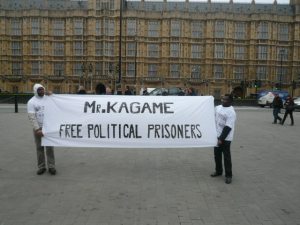
Rwandans ask UK Members of Parliament to follow through British prime minister’s new foreign policy on dictators

On February 25th, 2011, a group of Rwandans living in UK organised a public protest in front of the UK Parliament. They requested from Members of the British Parliament to put pressure on Paul Kagame, president of Rwanda, for the unconditional release of all political prisoners held in Rwandan prisons. Among the detainees are
  • Mrs Victoire Ingabire Umuhoza, Chairperson of FDU-Inkingi in prison since October 14th, 2010
  • Me Bernard Ntaganda, Chairperson of PS-Imberakuri in prison since June 24th, 2010 and sentenced to 4 years in prison
  • Mr Deogratias Mushayidi, President of PDP-Imanzi sentenced to life imprisonment
  • Dr Theoneste Niyitegetse, former presidential candidate of 2003 elections imprisoned since then
  • Charles Ntakirutinka Founder of PDR-Ubuyanja in prison for more than 10 years
  • Journalist Agnes Uwimana Nkusi, sentenced to 17 years in prison
  • Journalist Saidati Mukakibibi, sentenced to 7 years in prison
  • And thousands more detained in inhuman conditions in Rwandan prisons for their political opinions
Participants to the protest also denounce politically motivated sentences of 24 and 20 years in prison made in abstentia by the High Military Court in Kigali against General Kayumba Nyamwasa, Colonel Patrick Karegeya, Dr Théogène Rudasingwa et Dr Gerald Gahima.
David Cameron, the UK Prime Minister publicly admitted recently in Kuwait that Britain and the West made “false choices” to support oppressive regimes that trampled on human rights. ‘As recent events have confirmed, denying people their basic rights does not preserve stability – rather the reverse,” said the Prime Minister. As a logic consequence of that new reality and understanding, protesters would like to see Britain translating such change of foreign policy by stopping immediately their unconditional support to Paul Kagame’s regime. It has abused Rwandans and other populations of the Great Lakes region in the millions. They would also want to see Britain use its leverage position towards the Rwandan government to push for political reforms before it becomes too late for peaceful change.
Asked by BBC World Service how they intended to proceed since in the past Britain has never considered officially Rwanda to be a dictatorship, Ambrose Nzeyimana, who represented the protesters, replied that Rwandans knew too well how oppressive and atrocious Kagame’s regime was. He added that they were planning to work with individual members of parliament to get the issue tabled during question time for ministers at the House of Commons. Such approach has successfully worked in the past. They don’t see why it wouldn’t work this time; particularly when one takes into account social uprisings across the Middle East and North Africa against dictatorial regimes
Enhanced by Zemanta

Monday, February 21, 2011

Rwandan opposition politician jailed for exercising rights


Rwandan opposition politician jailed for exercising rights

Amnesty International has called for the unconditional release of Rwandan opposition leader Bernard Ntaganda jailed today on politically motivated charges.

Bernard Ntaganda, president of the Ideal Social Party (PS-Imberakuri) party, was sentenced to 4 years imprisonment after being found guilty of breaching state security, of "divisionism" for holding public speeches criticizing government policies ahead of last year's elections, and attempting to plan an "unauthorized" demonstration.

Ntaganda had been arrested at dawn on 24 June 2010 - the first day that presidential candidates could register for the elections - and remanded in pre-trial detention.

Restrictions on freedom of association and expression prevented new opposition parties from contesting the August 2010 presidential elections.  

Ntaganda's prosecution for threatening state security and "divisionism" was based solely on his speeches criticizing government policies.

The prosecution had requested a 10 year jail sentence for these two charges and contended that "paint[ing] a negative image of state authority" could cause the population to rebel and create unrest.

"Today's ruling once again criminalizes peaceful dissent", said Amnesty International's Africa Programme Director, Erwin van der Borght.

"The growing trend in Rwanda to convict individuals of threatening national security for criticizing government policies is deeply concerning and in violation of Rwanda's obligations under international human rights law".

Last week, two Rwandan journalists, Agnes Uwimana and Saidati Mukakibibi, were found guilty of threatening state security for opinion pieces critical of government policies published before last year's elections.  They were sentenced to 17 and 7 years respectively.

Vague and sweeping laws on "divisionism" and "genocide ideology" were introduced in Rwanda in the decade after the 1994 genocide.  

Up to 800,000 Rwandans were killed in the genocide, mostly ethnic Tutsi, but also Hutu who opposed the organized killing.

The laws prohibit hate speech, but are broadly drafted so that they criminalize expression that does not amount to hate speech, including legitimate criticism of the government.

The Rwandan government expressed a commitment in April 2010 to review the "genocide ideology" law, but it is unclear whether the "divisionism" law will also be revised.

Alice Muhirwa, Martin Ntavuka and Sylvain Sibomana of the United Democratic Forces-Inkingi (FDU-Inkingi) were found guilty of conspiring to participate in demonstrations on 24 June 2010 without authorization.  They were fined 100,000 Rwandan francs.

The prosecution had requested a two month jail sentence.

Jean Baptiste Icyitonderwa of PS-Imberakuri was acquitted of conspiring to participate in the same demonstration without authorization.

Theobald Mutarambirwa of PS-Imberakuri and Theoneste Sibomana of FDU-Inkingi, also charged with conspiring to participate in demonstrations without authorization, will be tried separately.

The opposition politicians were arrested on 24 June 2010.  

Some of the FDU-Inkingi members were arrested near the Ministry of Justice in the capital, Kigali, where they had gathered to request the registration of their party.

Some of the PS-Imberakuri members were arrested outside the US Embassy, where they had gone to enlist help following Ntaganda's arrest.

Although the opposition members were convicted of conspiracy to participate in demonstrations without authorization, Amnesty International has found no evidence that they either resorted to, or intended to resort to, violence.

The government failed to put forward any legitimate justification for banning the demonstration.

Ntaganda had requested authorization to hold the demonstration.

The prosecution said the authorities had attempted to notify Bernard Ntaganda that the demonstration was banned, the day before it was due to take place.  

But the defence said the demonstrators were unaware of the move.

Those arrested were later released on bail, after spending days in police detention and reportedly being subjected to ill-treatment such as being beaten and handcuffed to each other, even when they went to the toilet.

"Instead of jailing individuals for planning a demonstration, the government should have taken steps to allow for peaceful protest before the elections," said Erwin van der Borght.

Restrictions on freedom of association prevented new opposition parties from contesting the elections, which President Kagame won with 93 per cent of the vote.  

PS-Imberakuri had secured registration, but was subsequently infiltrated by dissident members, who decided not to field a candidate.

Ntaganda was called before the Rwandan Senate in late 2009 to respond to "genocide ideology" accusations.  In April 2010, the Senate's political commission said they felt such accusations were well-founded.
Enhanced by Zemanta

Thursday, February 17, 2011

Uganda's Museveni says he's not sweating 'Egyptian-like revolution'


From Foreign Policy
Uganda is holding elections on Friday and increasingly autocratic President Yoweri Museveni has made it clear he won't tolerate any street protests like those that have swept the Middle East recently: 
Most analysts expect Museveni to win, though his share of the vote dwindled at each of the last three elections. The opposition alleged vote-rigging at each of the polls.
"There can be no Egyptian-like revolution here," Museveni told a final news conference ahead of polling day. "Someone taking power by extra-constitutional means? That one is out of the question. It will not happen."
Besigye, who is facing former ally Museveni for the third time, told Reuters in an interview last month that a popular uprising in Uganda was "even more likely" than in either Egypt or Tunisia after what he says are years of corruption.[...]
Museveni also warned his security forces were ready to deal with violence.
"Very simple, just lock them up," he said when asked how the government would deal with rioters. "In as humane a manner as possible, bundle them into jails. And that will be the end of the story. And to the courts."
Museveni, who first took power in 1986, has now been president almost as long as Hosni Mubarak. Also like Mubarak, he's been a strategically important U.S. ally -- Uganada is the primary contributor to the U.N. peacekeeping mission in Somalia and has carried out a U.S.-backed effort to eradicate the brutal Lord's Resistance Army rebel group -- and a major recipient of U.S. aid. If anti-government demonstrations erupt this weekend, the White House will again be in a tough spot. 
My colleague Elizabeth Dickinson wrote recently on how sub-Saharan Africans are reacting to the news coming out North Africa and the Middle East in recent weeks. Another country to watch, which has been almost entirely ignored by the international media, is Gabon, which is in the midst of a popular uprising against President Ali Bongo Ondimba, son of longtime strongman Omar Bongo, who won a widely-disputed election in 2009. Julie Owono's blogging on Global Voices is a valuable source for following the latest developments.
Enhanced by Zemanta

Wednesday, February 16, 2011

Victoire Ingabire Calls for Reconciliation and Equal Distribution of Wealth for all in Rwanda

February 16, 2010 2:53 pm Written By Newstime Africa 
President Paul Kagame affirmed last week that the “honeymoon” of hard-talking opposition politician Ms. Ingabire Victoire will come to an end at some point with the law taking its course. Just day after the Monday 8th press conference, Ms. Ingabire was summoned by the Criminal Investigations Department (CID), a meeting whose details remain sketchy. The Human Rights Watch slammed the Rwandan government for what it calls harassment of political opposition figures, urging the authorities to “loosen up control of the political space.” But the government stands its ground saying no one will be allowed to break the law and make mince meat of the country’s progress. Since her arrival on January 16th this year, Ms. Igabire has continued to draw sharp criticism from various quarters with regard to her position on the country’s law on genocide as well as being accused of inciting the public with inflammatory remarks. She sat down with Newstime Africa where the presidential hopeful reiterated no amount of intimidation will make her back-track on her ambitions, of one day becoming president of the land of mountain gorillas.
Excerpts of the interview follow.
Igabire Victoire: The first day I came I visited the Gisozi Genocide Memorial (Kigali) where I talked about what happened back in 1994, the Genocide against the Tutsi. Our position as the United Democratic Forces (FDU) is that, we call for everybody who was involved in the genocide one way or another be made to face justice. But on the other hand we know that from 1990 to 1994 there were crimes against humanity committed against both Hutus and Tutsis and today the international justice and even justice here in Rwanda is only concentrated on the genocide crime. We cannot forget crimes against humanity committed in our country. If we want to achieve reconciliation for our country we need to understand and accept the pain of everybody in the country, which is the only way we will achieve total reconciliation.
The big problem we have in Rwanda; and that the difference between us and the regime of general (President) Paul Kagame, we think if we are to really achieve reconciliation of the Rwandese people, we need to fully talk about what happened, why genocide was committed in the country, why the crimes against humanity were committed, whose responsibility was it and what we have to do together as Rwandese people to avoid the same problem in the future.
Talking about it, we trust it is the only way to achieve total reconciliation. I don’t believe forbidding people to talk about what happened is the way to resolve the problem. You know the government denies the existence of ethnicity in Rwanda. We say ethnicity is not the problem here, the problem is the politicians. We have to find out a way to deal with this. We need an institution that provides security for all. We reiterate, there is no shame in saying I am Hutu or am Tutsi, there’s nothing wrong with that. The problem comes in when politicians exploit that difference to stay in power or acquire that power. We need to find a common ground, to work together. It should not be on the basis our ethnicity but on the basis of what we believe in.  Now my talking about a taboo is what has caused all this criticism about me.
People must learn to accept the differences of the other person, if we have different visions or opinions; that doesn’t mean we are enemies; we can go ahead and see what common ground is there to work together. There is nothing wrong with having different ideas!
Newstime Africa: Your comments come out as you wanting to see the Hutus killed in that period also receive justice, elaborate?

Igabire Victoire: I never singled out any particular group as the ones to face justice. I said everybody who was involved in one way or another in the killing of the Rwandese people has to face justice. We don’t need to know which ethnic group he/she belongs to. That’s the only way to have equal justice for all and with it total reconciliation.
I am not a law practitioner, I am a politician and I see what is wrong; the situation that the law needs to deal with. As a politician, I maintain we need equal justice for all.
Newstime Africa: The president last week said you are just campaigning as an individual as the law hasn’t yet allowed you to be called an opposition politician, what is taking so long to register your party, I mean what is their course of action?
Igabire Victoire: I am the leader of the Rwandese opposition, the media calls me so. I am the leader of the United Democratic Forces, and in September last year we decided to come back to the country. I was the chairperson back then and am here now to ask for the registration of my political party that’s first.
Secondly before I left the Netherlands, the party chose me as their flag bearer, now this means if my party is registered I will be their presidential candidate. It is not yet official because we have to first register our political party subsequently, as a presidential candidate. It was decision of the party, to have me represent them at the polls.
It is taking long to register my party because I had to start from scratch; I lived outside the country as a refugee. So when I came back the first thing I needed was an identity card, when I got the ID on the second day as you are aware, I was attacked and they stole my bag which had the ID card. Well now I have it back and today (15th Feb) I will send the letter to ask for authorization to meet the party members so as to collect signatures. With the signatures we can start the process of registration for our party. It takes two months to register a party and if we don’t have any more problems, we hope to make it for the June deadline.
Newstime Africa: Do you think the government is attacking you as a politician?

Igabire Victoire: Yes. What I saw when I came back to the country is that the government is not ready to accept opposition. We insist it is time to have a democratic process in our country. It is time people have freedom to say what they want, to freely organize meetings they need to discuss issues important to them, freedom of expression and freedom of association.
We need political space, which is the only way to hear everyone’s point of view.
Newstime Africa: What is your response to accusations that you are deliberately provoking the government to arrest you and in turn raise your profile?

Igabire Victoire: Nothing could be further from the truth. I wouldn’t like to be arrested because if I am imprisoned I cannot do anything. I am here to be an active politician. Nobody would like to be arrested and that includes me. That is a very wrong opinion they have of me.
Of course the government has an agenda of mudslinging me to the population. What is puzzling me though is why they are afraid, why are they doing this? I cannot understand. I have been away for 16 years, time in which they have ruled the country, now why are they afraid of me? I don’t understand why they take such measures, you see tomorrow (today) I have to go back to the CID office.
Newstime Africa: When you first went to the CID office what did you talk about?

Igabire Victoire: They accused me of genocide ideology, that I am a divisionist and that I work together with the FDLR (Forces démocratiques de libération du Rwanda remnants of the Hutu militia highly blamed for the 1994 Rwanda genocide and still operating in eastern DRC). Of course I asked them what they mean by genocide ideology because it is vague, some word I cannot understand. They said I criticize Gacaca (locally organized courts that try category 2 genocide suspects, relying heavily on eye witness accounts and sentencing is mostly communal service) which amounts to genocide ideology, surely I don’t understand.
Regarding my criticism of Gacaca, as a politician I have to speak out when something is wrong. Now there are some innocent people tried by Gacaca and sentenced and they know of these cases. My criticism stems from the fact that genocide is a huge crime, one you cannot task people who know nothing about law to deal with. We say it is a heavy crime that has to be tried in normal courts not with people who know nothing about law.
On the other hand when something is good I appreciate it first. For example the Gacaca itself, I say it has allowed victims and perpetrators to meet. When someone meets the person who killed his whole family or a loved one, sit together, talk and find forgiveness; that is the reconciliation we need. That people can move on, is one tremendous achievement by the Gacaca courts that I laud and say is great.
Newstime Africa: When you talk to the people what do they tell you? And what is their response to your points of view?
Igabire Victoire: As we have not yet officially began the campaign period, I am limited to what I can say and do. But what I am currently doing, seeing I spent 16 years of my life outside the country, is going to market places and other public arenas to sit with the people and listen to them. Understand their problems, their queries and get to know what they need to see changed. I also need to understand really; what is problem in the country. I saw it fit to do things this way first because you know; when you’ve lived far and for so long, it is best to first listen to them and see things their way.
Now when the campaigns begin, I will talk to them about our party manifesto, our vision for the country as a party, for say education or development.
Newstime Africa: What is your cause exactly? What are you offering the Rwandese people?

Igabire Victoire My number one agenda is reconciliation, if the Rwanda Patriotic Front (RPF) doesn’t want to talk about it, I will. We have to protect future generations. If we want to end the cycle of violence we know in Rwanda we have to achieve of reconciliation. We need to look at what is wrong with the politics of our country and of course how to deal with it. If RPF doesn’t accept it and start to talk about it, in 20 or 30 years we run the risk of future generations having the very same problem.
Secondly, I want development of the whole country. Poverty can be a source of conflict. Only 2% of Rwanda’s population has all the riches. The wealth of this country is with a few. The rest live in extreme poverty and for us this is a problem that needs to be addressed before it escalates into something bigger in the future. There must be an equal distribution of resources. People talk about how Rwanda is developing which to some extent is true, I mean look at the city of Kigali it is beautiful, but we need to do more.
Newstime Africa: As a woman politician in a country that has broken world record in empowering women in all areas, politics, business you name it, do you feel any support from your fellow women, and is this status of affairs making it any easier for you?

Igabire Victoire: To say Rwanda is a champion of women’s rights because we have many women in parliament and government, I don’t think that is the reality. In real sense I don’t think they have power to change anything, because when I see the pain of the Rwandese people and knowing as women we are sensitive beings, we relate easily to the other person’s pain; if really these women had power in government and in parliament, something ought to have changed.
And this is why I maintain if I win this election, something will definitely change, to reduce the pain the misery of our people.
Newstime Africa: Now do you see anything good done by the Kagame regime at all?

Igabire Victoire: Of course, Today Rwanda is a country recognized internationally for many great things. That is something they’ve really worked on. Look at Kigali; it is one beautiful city, the cleanliness. But behind the beauty many people live in extreme poverty.
In education, every child now has a chance to go to school. Due to poverty many parents weren’t able to pay the school fees but now the free nine year basic education is taking care of that.
Newstime Africa: What do you see as the future of Rwanda?

Igabire Victoire: My dream is to see a Rwanda where all differences are put together for the benefit of our nation. To work together despite our diversity, that nobody has to live in fear of being killed for who he is. I sincerely hope no more killings will happen here, I cannot understand why you would kill your neighbor because he is Tutsi or he is Hutu.
I also hope to see a situation where we have dialogue between ourselves, the political actors and the civil society. That we can sit down together and chart our way forward. That is the only heritage we can give the future generation.

When I came back, what was written in the media is that I only talk out is the ethnic problem, of course reconciliation is top on my agenda but we have many other problems to pay attention to, like poverty as I mentioned earlier, making healthcare affordable for all not a commercial sector for a few, agriculture and ensuring food security and what each and every one of us can do for the benefit of our great nation.
Apologies for the wrong spelling of the presidential candidates name. This has been rectified.
© 2010, Newstime Africa. All rights reserved. – Reproduction of Newstime Africa content on any other news medium without the prior consent or approval of the publishers is forbidden, and in direct contravention of International copyright laws. Violators will be pursued and prosecuted
Enhanced by Zemanta