EXPOSED, RWANDAN WAR FINANCIER’S DIRTY BUSINESS DEAL IN NIGERIA
Written by Prince News Jul 3, 2010
EXPOSED!
•Rwandan war financier’s dirty business deal in Nigeria
By EMMANUEL MAYAH
Saturday, July 03, 2010

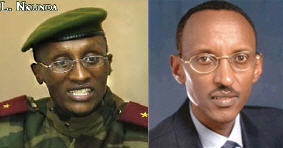
•Nkunda: The butcher of Congo
Like a predator, he is always on the prowl, walking in the shadows – sometimes of the valley of death. His name is Tribert Ayabatwa Rujugiro. In many countries, his reputation precedes him. If there is anything like ‘International Mr. Fix-It,’ that sobriquet would go to this Rwandan, a tobacco tycoon with the mentality of an octopus. Rujugiro is also a suspected war financier. And now, he has opened shop in Nigeria.
At some point in the protracted conflict in Congo, Rujugiro became a pain in the neck for the United Nations, as detailed report directly linked the tycoon with rebel leader, General Laurent Nkunda. However, for the billionaire businessman, whose activities in Nigeria are now the subject of vociferous debates, controversy and wheeling dealing appear to be a way of life.
Until his reign of terror was punctuated, Laurent Nkunda was a dreaded warlord, notorious for turning a sizable part of Congo into killing fields. In the heat of the war in Democratic Republic of Congo, a UN Security Council Panel Report on Sanctions revealed that Rujugiro regularly held meetings with leaders of the rebel group, CNDP, including General Nkunda, at his farm in Kilolirwe. Rujugiro is from North Kivu province. He is known to have been an important backer of the Rwandan Patriotic Front (RPF) during the Rwandan civil war of 1990-1994. Among other things, the panel obtained a paper copy of an e-mail from Rujugiro, dated 28 August 2007, thanking a Dubai-based employee for making the necessary arrangements to pay $120,000 to cover the salaries of the “soldiers” for “our friend Laurent N.”
An electronic copy of another e-mail sent from Rujugiro to Rene Munya, a South African associate, showed the tycoon asked Munya to clarify the identity of some financial transactions sent by a “friend” notorious for using multiple identities. Meanwhile, while he was fuelling the war in DR Congo, Rujugiro quietly was entering a Memorandum of Understanding (MoU) with the Nigerian government.
$7.4 million fraud
Two years ago, Tribert Rujugiro breathed air of freedom, after a one-year house arrest in London. Since November 2006, the Rwandan businessman has been having a running battle with the South African government, which, in June 2008, got the British authorities to arrest him. Rujugiro had become a caged man, after his tobacco firm was shut over fraud charges. Three years ago, officials of South African Revenue Services (SARS) halted all operations at Rujugiro’s Mastermind tobacco company, in Wilsonia following a $7.4 million fraud case. While closing a manufacturing facility was considered unusual in South Africa, the severity of the fraud charges was said to have left the SARS with no choice.
Before the London arrest, South Africa had been building charges against the company’s three Rwandan directors: Tribert Ayabatwa, Patrick Rujugiro, Jean-Paul Nkwaya, and two senior employees – import/export manager Jennifer Putter and financial manager Pascale Wiehahn. Jointly, the five faced 25 counts of fraud relating to non-payment of excise duties, 25 charges of illegally exporting goods from the Customs and Excise warehouse, six charges relating to the non-payment of Value Added Tax, and a charge of irregular dealing in goods. Since the early 1990s, Rujugiro’s company, Mastermind Tobacco SA Ltd, has manufactured cigarette brands such as Yes, Forum and Legends, for both local and international markets.
As detailed in court papers, Rujugiro’s business style saw his company passing off local cigarette sales as exports in order to obtain a zero-rating VAT. Through under-invoicing, cigarettes distributed locally were for years under-declared to revenue officials, all resulting in the revenue service receiving less in excise duties and VAT. When the company was found out, the South Africans did not find it funny. Under the law in the former apartheid colony, products manufactured in South Africa and destined for export attracts a zero VAT. This means that no tax is payable to the South Africa Revenue Service, in respect of sales to foreign customers and the products are also exempt from South Africa excise taxes.
One year after his arrest, Rujugiro, who somehow managed to beat off extradition, wangled his release after his company entered a guilty plea to the charges of fraud and tax evasion. To avoid jail, the Rwandan agreed to a settlement that saw him paying immediately $368,000 to the South African government. Judge David Van Zyl of East London High Court in South Africa on June 5, 2009 ordered Mastermind Tobacco SA Ltd to remit the remaining $7.0 million by June 2010. Under the guilty plea, Rujugiro must pay $3.3 million within seven days of the court’s ruling, and the balance in monthly installments of $307,200, starting on or before July 1, 2009.
Judge Zyl also imposed a fine of 250 million rand ($30.7 million) on the company, but suspended it for five years on the condition that Mastermind pays the balance amount and is not convicted during this period for any contravention of the VAT Act, the Customs and Excise Act or fraud. The judge thereafter ruled that UK immigration officials returned his Rwandan passport. Hours later, a defiant Rujugiro was telling Radio Rwanda in a live interview from his London home that all charges had been dropped because they had been proved baseless.
A piece of cake
But for Rujugiro’s one-year travail in London and the persistence of the South African government to bring him to justice, the activities of the Rwandan in Nigeria might never have come to light. Investigation by Saturday Sun revealed that Rujugiro, reputed for preying on the economy of vulnerable countries, like the conflict-prone Democratic Republic of Congo, has, for some years now, been operating in Nigeria. Indeed, if the UK and South Africa proved not to be unwilling hosts to Rujugiro, Nigeria, as events would show, was, from the very beginning, a piece of cake for the Rwandese.
In 2003, Rujugiro’s company, Leaf Tobacco & Commodities Limited, submitted to the Federal Government of Nigeria a $57 million investment proposal to set up a factory in Nigeria for the manufacture and production of Yes, Supermatch and Forum brand of cigarettes. The factory, which was to be built within three years, was to be jointly owned by Leaf Tobacco & Commodities of British Virgin Island, Bauro Trading BVI and British Virgin Island.
The Federal Government considered and entered a MoU with Leaf Tobacco & Commodities Limited. Among other things, a three-year import concession was granted to the company, effective August 31, 2004. Like most manufacturing concerns, the idea was to attract foreign investment, expand local capacities and content and generate employment. For this, Leaf Tobacco was granted concession, which permitted it to enjoy 60 percent waiver in the importation of Yes cigarette, machinery, vehicles, raw materials and just about every other thing essential for the establishing as well as the running of the manufacturing concern. Basically, the concession to import cigarette for three years was aimed at guaranteeing a ready market for its products by the time local production would have commenced. The MoU equally dwelt on the contribution to community health schemes, satisfactory and regular interface with host communities, provision of such amenities as potable water and generally showing good corporate citizenship.
Investigation revealed that years after the concession was granted to Rujugiro’s company, Leaf Tobacco & Commodities Limited has continued to import Yes cigarette from Dubai without paying any attention to its obligation to the Nigerian government. Obviously picking out only what suits it, the company continued to import tobacco and enjoys waiver. Three years after, no factory is seen standing; no production activity is going on anywhere; no foreign capital had been put into the Nigerian economy; no employment has been generated, and no dialogue has been entered into with rural host communities. Besides activities at its various warehouses, where tobacco imports are stored, works at its factory, along Abuja-Kaduna expressway, were generally handled at snail pace.
Angered by the long and brazen disregard of the MoU, the Federal Government, in the third quarter of 2007, withdrew all trading concessions to Leaf Tobacco & Commodities Limited. Shortly after this period, there came a string of allegations of illicit importations of the Yes product through land borders. There were also allegations of under-invoicing and counterfeiting, all culminating in a raid and seizure, at Ibadan, by the Consumer Protection Council (CPC). Mrs. Ngozika Obidike, CPC’s Head of Investigation & Regulation, told Saturday Sun that cartons of Yes cigarette were confiscated because they were found not to be carrying the Nigerian health warning on their label.
Elsewhere in Rwanda, Rujugiro was not idle. The tycoon, who was one of the closest advisors of President Paul Kagame, was part of a new initiative called Rwandan Investment Group (RIG), a private investment company created by some 43 local investors. Created in September 2006 and possibly modelled after Nigeria’s Transcorp, with enormous government patronage, RIG, headed, of course, by Rujugiro, was investing in extraction of methane gas in Lake Kivu, in the western part of Rwanda, silk and cement production, maintenance of Kigali industrial park and peat extraction. The same company was also targeting a pharmaceutical industry in the southern province shortly after the acquisition of the only state owned cement factory located in the western part of the country. Rujugiro is one of the four investors that control 70 percent of RIG shares, thus throwing only 30 percent to 41 others.
In April 2001, the Panel of Experts on the Illegal Exploitation of Natural Resources and Other Forms of Wealth in the Democratic Republic of Congo, had Rujugiro’s name on their list. The Rwandese owns or has stakes in numerous businesses in Africa and the Middle East, including in the tobacco, construction, real estate and banking sectors.
Middle of nowhere
Back in Nigeria, Leaf Tobacco & Commodities Nig. Ltd was taking steps towards damage control. The Rwandan billionaire got the withdrawal reversed and the concession extended by pledging a new corporate attitude that everyone hoped would fast-track work at the factory and improve the company’s commitment to its obligations. Indeed, the factory, located in Gbakura in Kagarko Local Government Area of Kaduna State, could be said to be in the middle of nowhere. Located in a hamlet on the Suleja-Kaduna road, it commenced production in 2008. It may as well be a step calculated to fulfill all righteousness, given that the factory’s output evidently was not satisfying the company’s market share. So far, importation has not stopped.
Documents obtained by Saturday Sun showed that in the eight months, between October 2008 and June 2009, a total of 55 containers of Yes cigarette were imported into Nigeria using the land borders. Each contained 1, 080 cases of Yes. While 48 containers came in through the Cotonou port, seven were imported using Lome port in Togo. A random sampling showed that on October 1, 2008, three containers, with numbers KNLU 10676-3, MSKU 881021-4 and MSKU 048471-8 and each laden with 1, 080 cases of Yes cigarette destined for Nigeria, were conveyed out of the Cotonou port by three trucks with registration numbers: 8C 5025/3591 RN, 8F 9247/7408 RN and 8B 8704/05 RN.
The same month Yes products were dispatched from the same port again on the October 17. In the following month of November, dates of dispatch were on the 3rd and 16th. while in December, the dates were 5th, 11th and 15th. The last consignment for the year 2008, carried Yes International loaded in container No. MSKU 9724764 and was conveyed by a truck with registration number AF 9781/A5383 RB.
In January 2009, Yes consignments were dispatched from Cotonou on the 5th, 10th, 21st, and 22nd. Then in February, five containers were dispatched on 11th; two, on 20th and one on 21st. On March 1, one container came in through Lome port, in container number MSKU 963488. Through Cotonou, two containers were dispatched on 6th, while four were dispatched on the 14th of the same month. Two containers were dispatched on April 21 from Togo, while four arrived from Cotonou on 22nd. On May 5, another container of Yes arrived from Togo; two more came from Cotonou on 11th, with another arriving on 21st of the same month. By mid June, three containers of Yes cigarette had arrived from Lome, one on the 7th and two on the 15th.
In an effort to track Rujugiro’s activities in Nigeria, this reporter, last year, paid his first visit to Leaf Tobacco & Commodities Nig. Ltd. The first shocking discovery was that after seven years of operation in Nigeria, the company had no visible corporate head office. Though the company’s official address read: Plot 645, Ndola Square, Off Michael Okpara Way, Wuse Zone 5, Abuja, the address was practically non-existent. There was no building in that neighbourhood with such an address as Plot 645. While one could easily see various offices, like the Federal Inland Revenue Service (FIRS), Corporate Affairs Commission (CAC), other corporate entities housed by Shippers Plaza, searching for Leaf Tobacco was like looking for a pin in a haystack. It took another day of long search for the reporter to discover that officials of this tobacco company operated from a residential building close to Ibro Hotel, the opposite side of Michael Okpara Way.
When this reporter visited Leaf Tobacco’s factory along Suleja-Kaduna expressway, more shocks awaited him. Save for a few artisans around, the facility was desolate. There was no work going on in the factory. The production manager, Mr. Dondogori Donatien, who is from Burundi, was not on duty. Another expatriate, Francois Nahayo, had been transferred to another Rujugiro’s factory in South Africa. It was gathered that on account of raw material shortages, production had been halted for two weeks. Some workers had been laid off and those still hanging on were told to take a two-week break without pay. The works of the contractors were also found to be on hold.
The contractors had been engaged to do several things, including laying a new roof. They too had no materials to work with; though they were optimistic the materials would arrive soon. One of the contractor’s men revealed that the factory “is not even half-finished.” None of the workers had any idea what capacity the factory was producing before the machines went silent. For everyone, it was difficult to say where the Yes cigarettes in the market were coming from: the Gbakura factory or far-away Dubai? The same question was being asked in respect of a batch of bad cigarettes withdrawn from the market and dumped at the factory storeroom. Sources within the factory, who could not say whether the bad cigarettes were manufactured in the factory or imported, revealed that the company was waiting for the Customs to see the bad batch before it can be destroyed.
Last month, on a second visit to Leaf Tobacco, this reporter saw that some workers had been called back. However, production was said to be skeletal. Meanwhile, the resumed production is drawing the ire of the host community. A youth leader, Isah Namji, told Saturday Sun: “Whenever the machines are switched on, smoke that is harsh to the eyes drift from the factories into our homes. Some of our brothers employed in the factory have told us that the bad smoke is coming from the tobacco leaves processed inside the factory. Everyone is affected by this smoke; including schoolchildren.”
It was gathered that unlike in the past when processed tobacco leaves were imported, the leaves were now being processed in Nigeria. The youth leader further disclosed that just as there is no single project to be pointed at as Leaf Tobacco’s corporate social responsibility, the company is so insensitive to the extent that when poor villagers go to the factory to fetch water, they are chased away. An angry Isah said: “We don’t have anybody to fight for us. Our Village Head by name Danlami Sheayisimi is not educated; the councilor representing us, Mr. Elisha Baba, has been going there to talk to them but he is not very powerful to handle the matter.”
At the factory gate, the reporter requested to see Mr. Dondogori Donatien. He was directed to the amorphous Abuja office. Weeks later, in a telephone interview with this reporter, the Burundian denied receiving any complaint from the villagers. He said there was no smoke and no environmental pollution. In his words: “How can there be smoke coming from the factory? To show you that it is all lies, we are not producing any tobacco in Nigeria. All our products are imported.”
Pressed to comment on the status of cigarettes allegedly trucked to Cameroun and if what was going on in Nigeria was not a repeat of the South African experience, Mr. Donatien said the reporter was wasting his time.