Africa Great Lakes Democracy Watch


Welcome to
Africa Great Lakes Democracy Watch Blog. Our objective is to promote the institutions of democracy,social justice,Human Rights,Peace, Freedom of Expression, and Respect to humanity in Rwanda,Uganda,DR Congo, Burundi,Sudan, Tanzania, Kenya,Ethiopia, and Somalia. We strongly believe that Africa will develop if only our presidents stop being rulers of men and become leaders of citizens. We support Breaking the Silence Campaign for DR Congo since we believe the democracy in Rwanda means peace in DRC. Follow this link to learn more about the origin of the war in both Rwanda and DR Congo:http://www.rwandadocumentsproject.net/gsdl/cgi-bin/library


Showing posts with label RWANDA-UNITED KINGDOM. Show all posts

Sunday, November 21, 2010

UK aid to benefit Rwanda which is accused of acts of genocide in Democratic Republic of Congo

The Writer:Nzeimana Ambroise
A persistent unanswered question has been on the lips of everyone who has been observing conflicts and politics in different parts of the world. What are the criteria the Department for International Development (DfID) follows to distribute British taxpayers’ money as aid to different countries? Unless you assume there are hidden pointers that ordinary Westerners aren’t allow to know, no one would understand for example how Rwanda led by Paul Kagame could be one of the favourite beneficiaries, knowing that its record of human rights abuse is unprecedented.
Let’s forget the UN/ Gersony report of October 1994 or the Garreton report of 1997 which, though covered up and therefore not followed up, documented killing of thousands of Hutu population the first in Rwanda and the second in Democratic Republic of Congo (DRC). But the UN report published on October 1st, thanks to its leaking by the newspaper Le Monde a month earlier, accuses openly the Rwandan Patriotic Army and its AFDL partner in war of having committed acts of genocide in DRC. Since October 14th, 2010, the President of Rwanda has imprisoned Ms Victoire Ingabire, leader of FDU-Inkingi, an important opposition personality on Rwandan ring-fenced political space, and this occurring without any clear condemnation from the international community.
On the Mo Ibrahim Index Rwanda scores 47.2% and stands at no. 31 out 53 African countries. For a reminder, this index measures annually four parameters across the continent. These are safety and rule of law, participation and human rights, sustainable economic opportunity, human development. Overall the country has moved backwards by 2.2% from previous period of 2007/8. There has as well been a significant decrease in safety and rule of law by 8.4%, while in terms of sustainable economic opportunity, a 2.2% increase had been registered.
In its press freedom index, Reporters without Borders indicates that Rwanda was ranked 157th out of 175 countries in the 2009 listing. The country was featured among the four lowest African scorers of the record. Eritrea, Somalia and Equatorial Guinea were the only countries below Rwanda in the ranking. Transparency International has on the other hand referred to Rwanda as the least corrupt country in East Africa. But it is arguable because, according to the country’s critic, there may not be official corruption following the fact that Rwanda is a police state. As Transparency itself points it out, ‘it was unable to produce a comparison of how Rwanda’s institutions fared because reports of bribery were so low – and no Rwandan organization was included in the regional comparison.’ For example, the South African newspaper Sunday Times uncovered in February 2010 the case of two luxury jets worth around one hundred millions of US $ belonging to the Rwandan president, and this may only be the tip of the iceberg.
At a time of drastic measures that the British government is currently taking to deal with its massive deficit, very few departments have seen their budgets increased. International development is among the handful winners. Apparently the department budget is ring-fenced, but even there fundamental changes may be planned in its spending.  Anne McElvoy, writing in The Evening Standard, seems to be sceptical about supposed changes. ‘Ring-fencing of spending of international development, (which) means that less rigour will be applied there than in other areas – and in a department whose inefficiencies are legendary in Whitehall,’ she argues.
It has been announced that aid budget will mainly focus on ‘fragile states’ such as Afghanistan, Pakistan and Yemen and other countries deemed important for Britain’s national security, with less for prosperous nations such as India and China. The aim is seemingly to tackle underlying problems, such as poor education, governance and healthcare, which are exploited by militants seeking recruits for terrorism acts. However, such prioritisation supposes that hopefully, there won’t be any recruit from Uganda, Rwanda, Burundi or Democratic Republic of Congo who will come to London to blow himself with other members of the public, since some of these countries could be as well called fragile states, when considered the total absence of political space for dissent voices.
Tim Whewell’s film, ‘What is the true price of Rwanda’s recovery’, which was shown on Newsnight in March 2010 on BBC Two, explained that whoever between Labour and Tories British political parties would’ve won the general elections, support to Paul Kagame’s regime would’ve remained. As for Britain’s role in supporting Rwanda, Mr. Cannon, British ambassador in Kigali, says that: ‘Although there are aspects of the country’s human rights that are not perfect – certainly we wouldn’t be here or doing what we’re doing if we didn’t think there was a commitment on the part of the government to the values we share.’ He points in particular to a shared commitment to pro-poor policies – thanks in part to British aid, the proportion of poor Rwandans fell from 70% of the population to 57% between 1994 and 2006. He however forgets to mention that in 1990, before the guerrilla war led by Paul Kagame, that proportion of poor Rwandans was according PNUD only 47%.
The particular treatment of Rwanda responds to a number of specific interests the country represents or defends for Britain in the Great Lakes region. French was replaced by English as national language, without any public consultation, despite the consequences of such decision on thousands of Rwandan public servants who had been educated in French for several generations. The Rwandan president was rewarded admission of his country to the Commonwealth though Rwanda and countries of the ex-British empire didn’t share any common heritage. Such admission maybe could’ve been tolerable at least if Commonwealth Human Rights Initiative and other human rights organisations hadn’t vigorously denounced the level of human rights abuse by the Rwandan president.
But this was without considering current cuts that the coalition government Lib. Dem/ Conservatives would impose to the British nation or the exposure to compelling evidence of Paul Kagame’s crimes to the public which had turned a blind eye on his excesses because of his country’s recent history. Despite an increasing and unprecedented record of abuses of human rights particularly against Rwandan politicians from the opposition, Kigali doesn’t look worried to loose the support of Britain, this even after the publication of the UN report on crimes committed in DRC. The fact of pointing an accusatory finger to Paul Kagame seems to have rather radicalised his attitude towards his opponent politicians: Victoire Ingabire from the FDU-Inkingi and Me Bernard Ntaganda from Socialist Party Imberakuri are paying with tortures and imprisonment for the frustration of the Rwandan president. But this may not apply for Andre Rwisereka, vice-president of the Green Democratic Party of Rwanda who was apparently assassinated by the regime’s handlers in July 2010 for political reasons. On this particular case, Kigali has refused an independent inquiry into the death of this politician, but instead imprisoned probably innocent people to calm pressing calls for justice.
At the Conservative conference held a few months ago, the issue of human rights in Rwanda was apparently raised but couldn’t find any ear ready to listen to the point of concern. Those who tried to highlight the question found it played down because Rwanda is seen as a flagship for Britain in the matters of aid to development. But what the whole picture of support to Paul Kagame doesn’t tell is how that provided financial support enables Rwandan authorities to get a hand on Eastern Congo mineral resources with the complicity of private companies based in Western countries, or to oppress and legally discriminate among its citizens, and spread internationally its propaganda of being a success story in the midst of an African continent marred with conflicts and all sorts of negative clichés. Another hidden reality was uncovered by UN experts on the consequence of aid in the Great Lakes region. They found that, for example in the case of Uganda, ‘(it) gave the Government room to spend more on security matters while other sectors, such as education, health and governance, are being taken care of by the bilateral and multilateral aid,’ asserts the UN report of 2001 on ‘Illegal Exploitation of Natural Resources and Other Forms of Wealth in the Democratic Republic of the Congo.’
In the light of current cuts, would British taxpayers continue to see their money which would have helped them or else to deal with ongoing tough times be spent as aid to development of dictatorial and oppressive governments such Rwanda, without asking pertinent questions to their leaders? I don’t think they would knowingly. As international aid budget is scheduled to increase during the current parliament, British public should be more attuned to asking from their ministers a minimum of criteria of human rights and press freedom, and democratic credentials, beneficiaries of British aid should comply with rigorously.
Enhanced by Zemanta

Sunday, October 17, 2010

Two Sides to Every Story: Congo and the Rwandan Genocide


Two Sides to Every Story: Congo and the Rwandan Genocide
By Katherine Iliopoulos
 SIURCE:Crimes Of War
Narratives on the 1990s in Rwanda focus invariably on the country’s darkest hour: the genocide perpetrated by the Hutu against the Tutsi. It seems to many as if the story began shortly before April, 6, 1994, when the incumbent President’s plane was shot down on approach to Kigali airport, unleashing a wave of mass violence that claimed 800,000 lives.
There are scholars such as Mahmood Mamdani who have sought to go beyond popular understanding, by contextualising the genocide in terms of colonial history and developments in neighbouring countries and moving away from the popular understanding that the genocide was simply the product of ethnic hatred. Without wishing to trivialise the 1994 genocide, argue ”moral equivalence” or promote the so-called ”double genocide theory,” most would agree that it is important to recognise that mass violence was committed by both sides. Furthermore, the 1994 genocide needs to be placed in the context of the Rwandan Civil War that began in 1990.
The question of the Rwandan genocide has never really disappeared from the media and popular discourse, but it has been in the spotlight in recent weeks after a draft UN report on the most serious violations of human rights in the Democratic Republic of Congo over an eleven-year period (1993-2003) was leaked to the French newspaper Le Monde.
The lengthy report states that after the Rwandan Patriotic Front's (RPF) takeover of Rwanda in 1994, it proceeded to carry out “systematic and widespread attacks” against Hutu refugees who had fled Rwanda to neighbouring Zaire (now the Democratic Republic of the Congo) as well as against the Hutu civilian population of Zaire in general.  It concludes that the pattern of these attacks “reveal[s] a number of damning elements that, if they were proven before a competent court, could be classified as crimes of genocide.” Luc Côté, a war crimes prosecutor from Montreal who led the investigation and co-authored the report, told Agence France Presse that the evidence of genocide includes speeches in which Hutus were targeted for elimination, systematic and repetitive killings, the burning of corpses and attempts to bar outsiders from visiting massacre sites.
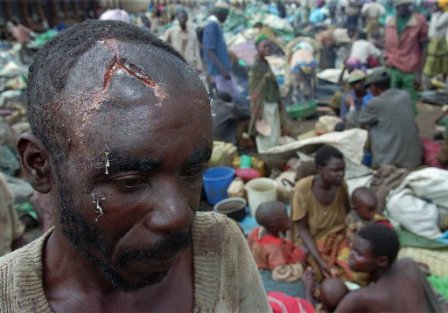
A Hutu refugee with open machete wounds on his head stands amidst a group of hundreds of fellow refugees who were surrounded by the Tutsi Army Thursday April 27, 1995, in the school compound of Kibeho, southern Rwanda. At least 2,000 people were killed by army gunfire or trampled in a stampede the previous week while the Rwandan army was trying to close the camp, which the government considered a center for extremist Hutu militias. (AP Photo/Jean-Marc Bouju)

This is not the first "public" revelation of RPF crimes. In 1994, Robert Gersony, an employee of the U.S. Agency for International Development then attached to the UN High Commissioner for Refugees, had been dispatched to survey the situation inside Rwanda to determine if conditions were right for a return of the Hutu refugees who had fled the RPF.  Instead, he found that the RPF had been committing systematic massacres of the Hutu population in Rwanda starting in April 1994 and continuing through the date of his oral presentation to the UN Commission of Experts on Rwanda on October 11 of that year.
With the RPF sweeping through the country, the Hutu génocidaires - including politicians, priests and militias - fled to neighbouring Zaire where they hid among more than a million genuine Hutu refugees. When they regrouped to continue their resistance, RPF leader Paul Kagame – the current President of Rwanda - ordered an invasion of eastern Zaire in 1996 marking the beginning of the First Congo War. This triggered a conflict that drew in six additional countries (Burundi, Uganda, Angola, Zimbabwe, Namibia and the Central African Republic) and led to the deaths of about 4 million people.
The leaked UN report, based on interviews with 1,280 individuals and review of more than 1,500 documents, raises deep and troubling questions about the use of the word ‘genocide’.
The common understanding of RPF aggression was that it was directed at those responsible for the genocide committed against the Tutsis; however, the UN report states that the majority of the incidents reported indicate that the Hutus were targeted as such, illustrated by the numerous targeted attacks against non-refugee Congolese Hutus. The report identifies the systematic use of barriers by the RPF, particularly in South Kivu, which “enabled them to identify people of Hutu origin by their name or village of origin and thus to eliminate them”.
This tendency to target all Hutus as such is, according to the report, also supported by evidence of declarations made during RPF “awareness-raising speeches” in certain places, “according to which any Hutu still present in Zaire must necessarily be a perpetrator of genocide, since the ‘real’ refugees had already returned to Rwanda.” These speeches were considered to have possibly constituted incitement for the population to look for, kill or help kill Rwandan Hutu refugees, whom they called “pigs”.
According to the definition of the international crime of genocide, certain genocidal acts such as the murder of those belonging to a particular ethnic group need to have been committed with the specific intent to destroy a particular group as such. It is this element that is the most difficult to prove in a court of law.
One of the most important issues in international criminal law is whether a genocidal policy or plan is an element of the crime of genocide. According to the jurisprudence of the ad hoc tribunals, the existence of a genocidal plan is simply one factor from which such intent can be inferred. The draft UN report opens the possibility that a court could deduce the existence of a genocidal plan from “the behaviour of certain elements of the RPF in respect of the Hutu refugees and Hutu populations settled in Zaire at this time,” which seems to equate to “a manifest pattern of similar conduct directed against that group”.
But the UN report also sets out some facts that may cause a court to hesitate in making a finding of genocide against the RPF.
One of the most significant factors that may be at odds with any portrayal of a genocidal RPF is that as of November, 15, 1996, at the beginning of the First Congo War, several tens of thousands of Rwandan Hutu refugees were repatriated to Rwanda with the help of the RPF and that hundreds of thousands of Rwandan Hutu refugees were able to return to Rwanda with the consent of the Rwandan authorities prior to the start of the First Congo War, which ended when Zairean President Mobutu Sese Seko – who was supporting Hutu extremists - was overthrown with the support of Uganda and Rwanda.
Without doubt the report presents a challenge to Rwanda's President, Paul Kagame, who was recently elected to a second seven-year term in office.  Kagame rejected the draft report and threatened to withdraw Rwanda’s peacekeeping forces from the Darfur region of Sudan and other African countries should the United Nations publish the report in its current form. UN Secretary-General Ban Ki-Moon rushed to Kigali shortly afterwards to urge him to reconsider in light of Sudan’s 2011 referendum on succession.
This is not the first time that Rwanda has threatened to withdraw its forces from Darfur. A similar threat was made in 2008 in response to the indictment issued by Spanish Investigative Judge Andreu Merelles against UNAMID (UN Assistance Mission in Darfur) deputy commander Karake Karenzi along with 39 other Rwandan officers for genocide, crimes against humanity, war crimes and terrorism perpetrated over a period of 12 years, from 1990 to 2002, against the civilian population, primarily against members of the Hutu ethnic group.
The Spanish investigation was prompted by complaints from families of nine Spaniards who were killed, harmed or ”disappeared” during the relevant period, but the indictment was subsequently expanded to include crimes committed against Rwandan and Congolese victims, based on the doctrine of universal jurisdiction.
The Spanish proceedings revealed prima facie evidence that from October 1990, a political-military structured group, heavily armed and well organised, engaged in a series of criminal activities which were carried out in Uganda against the territory of Rwanda. The indictment, based on the testimony of 22 witnesses, identified a “large extremist group of Rwandan Tutsis based in Uganda called the Rwandan Patriotic Front (RPF), which was created in order to achieve three purposes: 1) To eliminate the largest number of persons of the Hutu ethnic group, the ethnic group predominant in their country of origin; 2) To seize power by force; and 3) To form a strategic alliance with the Tutsi ethnic group and other Western allies, to terrorise firstly the population of Rwanda and then all the Great Lakes area in order to increase their sphere of power, control and influence and to invade Zaire, taking and using as their own the rich natural resources of the country”.
According to the indictment, on October 1, 1990, the RPF crossed the Ugandan border into Rwanda “with the purpose of invading, killing certain civilians and causing massive internal displacement.” The indictment then describes in detail a series of massacres, attacks and acts of terrorism against the civilian population in Rwanda that took place over the next four years.
In turn, Rwandan President Habyarimana’s party created its own militias, which would come be known as the Interahamwe. They launched numerous attacks against Rwanda’s Tutsi population, and were the ones who would later carry out the 1994 genocide.
The indictment goes on to describe how, in March 1994, “in order to begin the definite assault to power and to create a situation of civil conflict,” several meetings were attended by the leaders of the RPF with the purpose of preparing an attack to assassinate the President. The last of these meetings took place on March 31, 1994, and was attended by General Paul Kagame and other high-ranking officials. Arrangements for the attack were made to determine the place from where the surface-to-air missiles would be launched and the composition of the command that would carry out the attack. On April 6, 1994, the President’s plane was shot down, killing all those on board and sparking the genocide. In the following months, the RPF continued to launch attacks against civilians in Rwanda.
On July 17, 1994, the RPF seized power. Consequently, hundreds of thousands of Hutus headed for camps for internally displaced persons mainly in the western areas of Rwanda, while over a million sought refuge in neighbouring countries, especially Zaire. The indictment then details more RPF massacres and attacks against refugees and civilians in Zaire/DR Congo through to 1997, the end of the First Congo War, as well as from 1998-2002 (the Second Congo War). The draft UN report says that “the entire period [1996-1998] was characterised by the relentless pursuit of Hutu refugees and ex-Interahamwe by [RPF forces] across the entire Congolese territory.” It contains a catalogue of atrocities perpetrated by the RPF, along with forces from Uganda and Burundi, against the civilian population in DR Congo during the Second Congo War, including sexual violence and the use of child soldiers. But it does not make explicit mention of violence committed against Hutus during this period.
The majority of the victims during the wave of terror, according to the Spanish indictment, were Rwandan Hutu refugees or Congolese Hutu civilians. The Spanish judge did not indict Kagame, because as head of state, he has immunity from prosecution, even though many of the incidents clearly imply criminal involvement on his part.
But it was French judge Jean-Louis Bruguière who issued an indictment on November 17, 2006, against Kagame alleging that he was responsible for ordering the downing of Habyarimana’s plane in April 1994. A week later, Kigali severed diplomatic relations with Paris. The incident will be re-investigated by a team of experts later this month, with a view to determining from where the missiles were fired as a possible indicator of who was behind the attack.
The question of genocide aside, the UN findings are expected to lay the foundation for potential prosecutions for war crimes and crimes against humanity against senior Rwandan figures such as Colonel James Kabarebe, who led Rwanda's military operations in DR Congo and now heads the Rwandan forces. Kabarebe is also one of ten Rwandan officials accused by Bruguière of involvement in the assassination of Habyarimana.
The International Criminal Tribunal for Rwanda (ICTR) would have the authority to try these crimes if they were committed in 1994, because its jurisdiction extends beyond the territory of Rwanda to include “Rwandan citizens responsible for such violations committed in the territory of neighbouring States between 1 January 1994 and 31 December 1994.”
It would however be unable to prosecute individuals for crimes committed before or after 1994. Ordinarily, prosecutions for crimes committed outside 1994 would rest with the Congolese judicial system. However, the draft UN report identifies a multitude of shortcomings such as the judiciary’s lack of independence, military interference in judicial affairs and a severe lack of resources.
It is clear that the system lacks the legitimacy needed to make the smallest inroads into ending impunity in DR Congo. Justice sector reform has been recommended as one component – with others including truth and reparation-seeking mechanisms – of a ”transitional justice” solution for the country.
The ICTR has been in possession of evidence that could be used in prosecutions of senior members of the RPF, however, so far it has only prosecuted Hutu defendants.
Former ICTY and ICTR Chief Prosecutor Carla del Ponte writes in her 2009 memoir Madame Prosecutor: Confrontations with Humanity’s Worst Criminals and the Culture of Impunity, that she was eventually removed from her ICTR post after she refused to yield to pressure from the then U.S. ambassador-at-large for war crimes, Pierre Prosper, to sign away investigations of allegations against the RPF.
That was not her first confrontation with blackmail, she writes. Earlier, Kagame’s government was obstructing justice by sabotaging the ICTR trials of Hutu génocidaires by introducing measures to restrict the movement of witnesses travelling to Tanzania to testify.
In a meeting with Kagame on June 28, 2002, Del Ponte requested the military prosecutor’s files relating to the killings of the archbishop and other clergymen by RPF in Kabgayi in June 1994, the only RPF incident that she wished to investigate, at least initially.
President Kagame refused to hand over the files. “You are destroying Rwanda,” he said. “If you investigate, people will believe there were two genocides”.
The President’s desire to prevent any such perception within Rwanda may be said to be one of the reasons behind the country’s ”genocide ideology” laws. Ostensibly, the laws have been created to encourage unity and restrict speech that could promote hatred, given the central role that hate speech played in the 1994 genocide. However, rights groups such as Amnesty International have criticised the legislation saying it violates the freedom of expression and is being misused to criminalise criticism of the government and legitimate dissent, including suppressing calls for the prosecution of RPF war crimes.
The final version of the UN report is due for release on October 1. It remains to be seen whether, after the Rwandan backlash, any reference to “genocide” against the Hutus goes on the record.
At the very least, war crimes and crimes against humanity committed in the DR Congo need to be exposed and addressed. As Carla Del Ponte wrote, “a victim is a victim ... [and] irrespective of the identity or ethnicity or the political ideas of the person who committed it ... a crime is a crime”
Enhanced by Zemanta

Friday, October 15, 2010

Rwanda: Protect Rights and Safety of Opposition Leaders

SOURCE: Human Rights Watch
Victoire Ingabire Re-arrested, Bernard Ntaganda in Serious Condition

2010_Rwanda_VictoireIngabire.jpg
The police should grant Ingabire access to visitors and should respect her rights to due process. If she is to be charged, it should be on the basis of solid evidence, not as a punishment for her criticisms of the government.
Rona Peligal, Africa director at Human Rights Watch
(New York) - The Rwandan government should fully respect the rights of opposition party members and allow them to carry out their legitimate activities without fear for their safety, Human Rights Watch said today. 
Human Rights Watch issued its statement in response to the re-arrest of Victoire Ingabire, president of the opposition party FDU-Inkingi, and the transfer from prison to a hospital of Bernard Ntaganda, president of another opposition party, the PS-Imberakuri, both on October 14, 2010. Both parties have been critical of the Rwandan government and were prevented from participating in the presidential elections in August. 
Ntaganda was arrested on June 24 and has remained in detention awaiting trial. He had been on a hunger strike to protest his treatment in prison. On October 14, he was rushed from Kigali Central Prison to the Centre Hospitalier de Kigali (CHK), Kigali's main hospital.  His relatives and friends reported that he was in intensive care, but were not given specific information on his condition. Some of them were able to see him briefly in hospital and reported that he was very weak. That evening, he was transferred to King Faysal Hospital, also in Kigali.
"We are worried about Bernard Ntaganda's condition," said Rona Peligal, Africa director at Human Rights Watch. "The authorities should ensure he has access to appropriate and prompt medical treatment and that family and friends are allowed to visit him.  They should also ensure that if his condition suggests evidence of abuse, for example that he has been ill-treated or attempts have been made to force feed him or retaliate against him for his hunger strike, this is immediately investigated."
In the days preceding Ntaganda's transfer to the hospital, friends had been refused permission to visit him in prison. On their most recent attempt to visit on October 13, prison officials reportedly told them that they would be able to see him on October 15 - by which time he had been transferred to the hospital.
The authorities should ensure that proper medical information about the condition of his health and the treatment he is receiving is available to his family, Human Rights Watch said.
The arrest of Victoire Ingabire came after police had surrounded her house for several days. Then on October 14, they came to her house and took her to the Criminal Investigations Department (CID), where she was questioned in the presence of her lawyer. She was then transferred to Kicukiro police station, where she remains. Colleagues who brought her food and water on the morning of October 15 were not allowed to see her. 
According to police statements, Ingabire's interrogation relates to testimony from a former commander of the Democratic Forces for the Liberation of Rwanda (Forces démocratiques pour la libération du Rwanda, FDLR). The FDLR is an armed group active in the Democratic Republic of Congo, some of whose members took part in the 1994 genocide in Rwanda. The commander, who was arrested on October 13, allegedly implicated Ingabire in activities to form a new armed group.
"The police should grant Ingabire access to visitors and should respect her rights to due process," Peligal said. "If she is to be charged, it should be on the basis of solid evidence, not as a punishment for her criticisms of the government."
Background
Members of the PS-Imberakuri and the FDU-Inkingi were subjected to persistent harassment and intimidation in the period leading up to presidential elections in August.  Neither party was able to field candidates in the elections, which the incumbent, Paul Kagame, won with 93 per cent of the vote.
On June 24, police arrested Ntaganda, raided his house and the party office, and took away documents and other belongings. Ntaganda was accused of several offenses, including endangering national security, and inciting ethnic divisions (in relation to his public statements criticizing government policies) and organizing demonstrations without official authorization. 
Ingabire was questioned by the police numerous times in the first half of the year. In March, police stopped her at Kigali airport and prevented her from leaving the country.  In April, she was arrested and brought before a court to face accusations of "genocide ideology," "divisionism," and collaboration with the FDLR. She was released on bail, with charges still pending, and is not allowed to travel outside the capital.
Several other members of the PS-Imberakuri and the FDU-Inkingi were arrested in June and July, some when they attempted to hold a demonstration on June 24.  Some were released; others remain in detention. Several were ill-treated by the police.  They were beaten and kicked, and were kept handcuffed to other prisoners, even while eating and going to the toilet.
Members of a third opposition party, the Democratic Green Party of Rwanda, also received threats in the pre-election period. The party's vice-president, André Kagwa Rwisereka, was brutally murdered in July; his mutilated body was found outside the town of Butare. The circumstances of his death remain unclear. Police arrested a suspect but released him a few days later. No further judicial action has been taken.

Enhanced by Zemanta

Thursday, October 14, 2010

Justice Still Remote for Victims of Atrocities in DRC

SOURCE:Potent
London, Oct 13, 2010 (UN Integrated Regional Information Networks/All Africa Global Media via COMTEX) -- The authors of the UN "mapping report" detailing more than 600 "serious violations of human rights and international humanitarian law" committed in the Democratic Republic of Congo (DRC) between March 1993 and June 2003 see the landmark document as an important step in delivering justice to victims of the atrocities.
While the report made no claim to meet the evidentiary standards required in a courtroom, it has prompted widespread discussion about what should happen next regarding the alleged abuses attributed to troops from Rwanda, Burundi, Uganda, Chad, Zimbabwe and Angola.
IRIN evaluates the options.
Congolese judicial system
Under DRC law only military courts can try international crimes, as the civil criminal code has no provisions relating to war crimes, crimes against humanity or genocide. Military judges have handed down some verdicts in war crimes cases, citing the 1998 Rome Statute of the International Criminal Court, but the system functions poorly and judges reportedly often succumb to political interference.
As the UN report points out, the civil system is barely equipped to deliver justice at any level. It lacks adequate funding personnel, transportation, training, professional development, witness protection and judicial independence.
While most countries spend 2-6 percent of their national budget on justice, the DRC spent an average of 0.6 percent a year between 2004 and 2009, according to the UN report.
The International Criminal Court (ICC)
The Hague-based court was established to hear cases of war crimes, crimes against humanity and genocide committed after July 2002. Some crimes committed in Ituri do fall within the ICC's mandate. However, most incidents in the report occurred from July 1996 to January 2000, during the first and second DRC wars, ruling out the ICC as a legal recourse. The court's Trust Fund for Victims, which provides reparations for war crimes' victims even without judicial verdicts, is also unlikely to help for the same reason. "The Trust Fund typically becomes involved once the ICC has substantively become involved in the situation concerned. It would not get involved in other crimes in Congo that pre-date the Rome Statute," said Carla Ferstman, the director of Redress, a human rights group working with victims of war crimes in DRC.
Three cases involving crimes allegedly committed in DRC are currently before the ICC, including that of Callixte Mbarushimana, a leader of a Rwandan rebel group who was arrested in Paris on October 11. He faces five counts of crimes against humanity (murder, torture, rape, inhumane acts and persecution) and six counts of war crimes (attacks against the civilian population, destruction of property, murder, torture, rape and inhuman treatment).
The International Criminal Tribunal for Rwanda (ICTR)
As with the ICC, the ICTR is also limited by its mandate. This includes trying crimes, including genocide committed in Rwanda, or by Rwandans in neighbouring countries, but only in 1994. The tribunal is also due to close next year. "The ICTR is overloaded and trying to close its doors," said Phil Clark, research fellow at the Centre for Socio-Legal Studies at the University of Oxford.
The International Court of Justice, ICJ
The ICJ settles disputes between states. In 2005 in ruled in favour of DRC in a case brought against Uganda over the illegal exploitation of natural resources during the second war. Uganda has yet to pay the billions of dollars of reparations ordered by the court.
Both parties to a dispute must be willing participants in any ICJ case. While all UN member states are party to the Court, not all adhere to the principal of compulsory jurisdiction, i.e. of having to answer to charges brought by another state.
For example, a case the DRC hoped to bring against Rwanda was never heard by the ICJ.
Given Rwanda's blanket dismissal of the UN report, it (and other named states) are unlikely to agree to appear before the ICJ.
The recent rapprochement between Kinshasa and Kigali also reduces the chances of an inter-state court case.
New ad-hoc international tribunal
A request by DRC for the UN to establish an ad-hoc tribunal similar to the ICTR and International Criminal Tribunal for the former Yugoslavia came to nought.
There is a need for a judicial mechanism, but the process has to come from the Congolese people
Generally set up outside the country where the crimes were committed, such courts have been criticized as slow and expensive in relation to the number of trials and too distant from the victims of the crimes being prosecuted.
"These crimes took place in Congo so it wouldn't be good if the whole process of justice took place outside," said Carina Tertsakian, the senior Rwanda researcher at Human Rights Watch (HRW).
Hybrid court
Crimes committed in Sierra Leone, East Timor and Kosovo are, or have been, tried in a family of international judicial entities known as hybrid courts - "hybrid" because they involve staff and apply legislation that is both international and domestic.
Like international tribunals their efficacy is affected by the need for international cooperation and judicial assistance by states and international organizations.
The UN plays a leading role in all existing hybrid courts.
Mixed chamber
HRW, as well as the report's authors, advocate a so-called "mixed chamber" embedded in the DRC justice system with local and international judges and prosecutors working together. Cheaper and quicker to set up than an international tribunal, it would apply Congolese laws and procedures, but would temporarily include non-Congolese staff.
The Bosnian war crimes chamber in Sarajevo could be the model. Tertsakian believes a mixed chamber would give Congolese a sense of "ownership" of the justice process which would also benefit from international involvement.
"We think there needs to be an international component to the process to strengthen and build up the capacity of the Congolese justice system and also provide the process with a degree of additional credibility and to combat political interference," she said.
"Any case that reaches the trial stage will be politically sensitive, and there is likely to be pressure from various quarters, and to guard against that it would be important to have some international personnel working alongside Congolese judges and prosecutors."
A mixed chamber, however, would struggle to arrest non-Congolese suspects. Both Rwanda and Angola forbid extradition of their nationals, meaning serious support from the African Union, regional governments and the international community would be essential to avoid the problems already being experienced by the ICC which is unable to execute the majority of its arrest warrants because of lack of cooperation from member states. (Unlike the tribunals for Rwanda and Yugoslavia, the ICC has no personnel with powers of arrest).
Photo: IRIN
The report focuses on atrocities committed by foreign troops in the DRC (file photo)
Universal jurisdiction
The principle of universal jurisdiction allows suspects of serious international crimes to be prosecuted by third party states.
Belgium, the Netherlands and Spain have in the past prosecuted people from DRC and Rwanda under the principle of universal jurisdiction.
While suspects' governments may be unable to halt such prosecutions, such cases are very likely to create diplomatic rows over purported infringements of sovereignty.
Truth and reconciliation commission
The UN report says more than 30 commissions have already been set up, in particular in Argentina, Chile, South Africa, Peru, Ghana, Morocco, El Salvador, Guatemala, East Timor and Sierra Leone.
However, a previous DRC truth commission with the ambitious mandate of examining all political, economic and social crimes committed between 1960 and 2003 never really got off the ground.
It collected no witness statements nor opened a single enquiry. Commissioners were drawn from the warring groups and some were involved in the crimes they should have been investigating.
The University of Oxford's Phil Clark is sceptical that another would work much better.
"I think there is an argument that there is a need for a truth commission, but it needs to be better organized and structured and it can't involve commissioners from the main protagonists in the conflict. My sense is horse may have bolted on that front," he said.
Nothing happens ever
The crimes outlined in the UN report have been known for many years and well documented by a variety of local and international human rights and civil society organizations. Some say the reasons nothing was done then - the size of the DRC, the sheer number of crimes committed, the countries involved, the devastation of DRC's infrastructure - still exist today and that no substantive action will be taken on the report.
Clark believes the "international community" has Congolese justice fatigue. "Unfortunately I am quite pessimistic on the justice side of things that we are going to see any accountability for the crimes that have been identified by the mapping report," he said.
"There is a sense that so much has been done for this region and the results to date have been fairly patchy so the idea of wading back into the Great Lakes with a new type of institution I think is going to be a fairly unattractive possibility for most global policymakers."
That's a view shared by Mauro De Lorenzo, fellow at the American Enterprise Institute. He doubts the "international community" is willing to put at risk improving relations between DRC and its neighbours.
"It's hard to see people being enthusiastic about putting into jeopardy progress that has been made in the region," he said.
Nothing happens yet
De Lorenzo urges patience. "There's a time and place. We're just now having trials in Cambodia. It's not for us to rush and decide for the Congolese how they should do it," he said.
The International Centre for Transitional Justice's DRC head Sharanjeet Parmar agrees Congolese views are essential in determining the next steps. "There is a need for a judicial mechanism, but the process has to come from the Congolese people," she said.
Parmar, however, says some consensus is needed internationally and that doing nothing is not an option. "These are some of the worst atrocities seen on the continent in recent history, and if the international community can't work out the diplomatic and political intricacies to deliver on justice then that's a poor reflection on these international bodies we've invested decades in building."
Theme(s): Gender Issues, Governance, Human Rights, Conflict,
Countries
Photo
Film & TV
Women sit together and practice their literacy skills at the Heal Africa Transit Center for women victims of sexual violence in DRC
Our Bodies, Their Battleground
MORE REPORTS
AFRICA: Thinking big on climate change modelling
HEALTH: "Encouraging" drop in maternal deaths
DRC: Displacement and discrimination - the lot of the Bambuti Pygmies
DRC: Timeline on Lubanga's ICC trial
DRC: International justice denied?
MORE ON CONFLICT
Analysis: Red Shirt resentment simmers in Thailand
In Brief: IDP resettlement on track, says Sri Lankan government
In Brief: Thousands of DRC, Burundi refugees to return home
In Brief: Somali civilian deaths at "alarming" levels
MDGs: Banging a drum for the MDG summit
MOST READ
SWAZILAND: Changing the focus of food assistance
SRI LANKA: North crying out for more private investment
BANGLADESH: Mixed messages on sex work undermine HIV prevention
ASIA: Cities key to disaster risk reduction
SUDAN: Stigma continues to hold back Darfur's HIV fight
PHILIPPINES: Peace dividends emerge as Mindanao IDPs go home
NIGERIA: Clean up mining to avert further deaths, says UN
CONGO: School for peacekeepers
AID POLICY: Giving livestock LEGS
PAKISTAN: Child-labour risks rise across flood zone
Other OCHA Sites
Donors
Feedback | Terms & Conditions | News Feeds | About IRIN | Jobs | Donors
Copyright IRIN 2010. All rights reserved. This material comes to you via IRIN, the humanitarian news and analysis service of the UN Office for the Coordination of Humanitarian Affairs. The opinions expressed do not necessarily reflect those of the United Nations or its Member States. The boundaries, names and designations used on maps on this site do not imply official endorsement or acceptance by the UN. Republication is subject to terms and conditions as set out in the IRIN copyright page.
[ This report does not necessarily reflect the views of the United Nations ]
(c) 2010 UN Integrated Regional Information Networks. Distributed by AllAfrica Global Media (allAfrica.com).

Copyright © 2010 Acquire Media. All rights reserved.

These news stories are produced by third-parties and are not reviewed or edited by Poten & Partners. They are collected and distributed as a convenience, subject to the Terms and Conditions described on our website, and provided without warranty of any kind. Any opinions expressed in these articles represent the views of third-party authors and should not be construed to reflect the opinions of Poten & Partners.
Enhanced by Zemanta

Monday, October 11, 2010

Why the flare-up? Hutu genocide and RPA war crimes is no Watergate

SOURCE:Newsline
Ever since the UN report detailing horrific war crimes and probable genocide against the Hutu in DRC made international headlines, there has been unprecedented outcry within the international community and the media as if this is a new discovery. But in fact, these crimes have been Kagame’s most poorly kept secrets.
These crimes are no Watergate; many of us knew this, and the international community that is simply exploding now, knew but pretended not to know. Actually, many covered up these crimes; mostly the US.
The only surprise is the timing of the report (when Kagame and his government are all over in the global mainstream news largely for wrong reasons), the comprehensiveness of the report and how it has been received in mainstream western media. Otherwise, the report is just another piece in many other similar reports before it. Beginning with what was called liberation war, dissident former army officers like Major Alphonse Furuma and Lt Abdul Ruzibiza have given
testimonies of how Kagame’s troops systematically massacred defenseless Hutus during the 1990-94 war that brought President Kagame to power. Only two months after Kagame’s forces captured power in Rwanda, in October 1994, Robert Gersony, a U.S. expert hired by the United Nations High Commissioner for Refugees (UNHCR), accused the RPF regime of having killed at
least 30,000 Hutus in Rwanda since coming to power. As soon as the report was released, the regime in Kigali threatened to terminate the operations of the United Nations Assistance Mission in Rwanda (UNAMIR) if the report was validated. The U.N. then succumbed to the combined pressures of Kigali and its international lobbies and demanded that the UNHCR put the Gersony Report under embargo while promising a counter investigation.
Special Representative of the U.N. Secretary General Shaharyar Khan refused thereafter to confirm the existence of the Gersony Report to the UNHCR. The report has simply disappeared from the archives of the United Nations, according to a communication made to defense counsel at the ICTR.
In October 1994, in the wake of the controversy around the Gersony Report, Irishwoman Karen Kenny, whom the United Nations High Commissioner for Human Rights had appointed to head the U.N.’s Human Rights Field Operation in Rwanda, resigned. This should have been an eye opener at the time, but the international media failed to pick up the story.
After the Gersony Report, Amnesty International, a London-based human rights watchdog, released a report exposing human rights violations committed by the Rwandese Patriotic Army in the period of April-August 1994. Amnesty International pointed out that many defenseless people had been killed by the RPA and its supporters. AI said violations included hundreds of
deliberate executions, as well as abductions or ‘disappearances’ of captured combatants and unarmed civilians suspected of supporting the former government. For reasons best known to them, the international community and the mainstream media looked the other way.
On April 22, 1995, under the nose of UNAMIR, the Rwandan Patriotic Army massacred and displaced Hutu people in Kibeho refugee camp. The U.N. did nothing to make sure that the mastermind of these massacres be brought to court and punished. Instead, they simply asked the Rwandan government to follow up on the matter. First hand reports and accounts by the International Committee of Red Cross and Doctors Without Borders put the blame entirely on the RPA. Many international news media buried the story.
In 1997, Roberto Garreton, the Special Rapporteur of the U.N. commission in charge of human rights in the DRC, released a report on crimes committed by the Rwandan Patriotic Army against the Hutu refugees there. The Kigali regime immediately launched an intense effort to suppress the report and block a U.N. mission requested by President Laurent Desire Kabila that was aimed at confirming the results of the U.N.’s Garreton Mission. The Garreton Mission had to give up.
Carla Del Ponte, former ICTR Prosecutor General, emphatically stated, on more than one occasion, that there is evidence pinning the RPA for war crimes, and she made public how she was frustrated in her efforts to prosecute the RPA for those crimes. As was the case with such reports, the UN, the major powers and many international news media had other ‘serious’ issues to look to. 
Summing it all, what has been described as ‘damning revelations’ are just a confirmation of what has been reported over time but remained shelved because Washington and London wanted them to be. The only difference is the internal power play and dynamics in the White House and the Downing Street. What remains to be seen is whether justice will follow; and the world is eagerly waiting.
The author is the Deputy Managing Editor of the Newsline
E-mail: didas@newslineea.comThis e-mail address is being protected from spambots. You need JavaScript enabled to view it
Cell: (+250) 788305549 begin_of_the_skype_highlighting              (+250) 788305549     
Enhanced by Zemanta

Saturday, October 2, 2010

U.N. waters down genocide charges against Rwandan forces in Congo

SOURCE: Foreign Policy
The U.N. High Commissioner for Human Rights on Friday issued a somewhat watered-down report detailing allegations that Rwanda and its allies may have committed genocide against ethnic Hutu refugees in eastern Congo between 1993 and 2003.

The release of the long-awaited 566-page report -- referred to as a mapping exercise -- comes several weeks after a draft version of the damning report leaked to the French newspaper Le Monde, prompting Rwanda to threaten to withdraw thousands of its peacekeepers from Darfur and other U.N. missions in retaliation.

Despite the changes, the final report still constitutes the most comprehensive and damning official account of crimes committed in one of Africa's deadliest conflict zones. And it continues to assert that an alliance of Rwandan, Burundian soldiers and Congolese rebels may have committed genocide during military operations in eastern Congo during the 1990s.

But it has softened its finding with numerous words and phrases -- including "alleged", "suggests" "apparent" and "if proven in a court of law" -- that serve to lessen the force of some of the final conclusions. Instead of stating whether crimes had been committed, the final report leaves it to a court to definitively decide.

The final text also contains a far more detailed and robust set of countervailing legal arguments suggesting that Rwandanan forces, in fact, may not have committed genocide despite possible culpability for large-scale killings of civilians, and that any final decision would have to be made by a court.

The decision to amend the final text came after U.N. Secretary General Ban Ki-moon's top advisors, including his chief of staff, Vijay Nambiar, voiced concern to the High Commissioner, Navi Pillay, about the legal basis for the genocide charge. A top U.N. official, who was involved in the deliberations, insisted that the effort to revise the text was not carried out to assuage the Rwandans.

The violence in eastern Congo stems from the 1994 Rwandan genocide, where ethnic Hutu extremists, backed by the former government, orchestrated the murder of more than 800,000 ethnic Tutsi and moderate Hutu.

Rwanda's current president, Paul Kagame, was the commander of the Uganda-based Tutsi rebel army, the Rwandan Patriotic Army(RPA), that now stands accused of wrongdoing. It was the RPA under Kagame's command that seized power in Kigali and drove the Hutu perpetrators of the Rwandan genocide, together with hundreds of thousands of Hutu civilians, across the border into eastern Congo (then known as eastern Zaire). The report maintains that they conducted massive atrocities along the way.

In 1996, the Rwandan army fashioned an alliance -- known as the The Alliance des Forces Democratiques pour la Liberation du Congo-Zaire (AFLD) -- with Burundian forces, and a Congolese rebel leader, Laurent Desire Kabila. The force initially launched a series of attacks on the Rwandan refugee camps in Congo, which had been used as a staging ground for attacks against the new Rwandan government.

The mapping exercise was set up, in part, to investigate crimes committed by Rwanda and its allies as they continued their military campaign to Kinshasha, where they overthrew the government of Mobutu Sese Seko and installed Kabila as the leader of the newly named Democratic Republic of Congo. But the report also documents crimes by numerous other countries, including Uganda, and various rebel groups who were drawn into Congo's widening war.

The report was tasked with investigating 617 mass killings in eastern Congo between 1993 and 2003. The final version noted that the majority of victims were children, women, the elderly and the sick, and that they were often murdered with the claw edge of a hammer. "The apparent systematic and widespread attacks described in this report reveal a number of inculpatory elements that, if proven before a competent court, could be characterized as crimes of genocide," according to the report.

The report added, however, took pains to say that there are "a number of countervailing factors that could lead a court to find that the requisite intent was lacking, and hence that the crime of genocide was not committed."

"Facts which tend to show that the RPA/AFDL spared the lives, and in fact facilitated the return to Rwanda of very large numbers of Hutu militate against proving a clear intent to destroy the group," the report said.

The report also argues that it is "very difficult to establish" a genocidal intent where an "alternative inference" can be drawn from the conduct of a perpetrator. The report then sets out to propose a series of alternative theories for attacking Hutu refugee camps, including the possibility that Rwanda and its Congolese allies were engaging in "collective retribution" against Hutu civilians suspected of having engaged in the Rwanda genocide -- a horrific crime perhaps, but not genocide.

The reports release comes weeks after Ban Ki-moon, his peacekeeping chief, and his human rights advisors, traveled to Kigali to meet with President Kagame. After the meeting, Kagame backed down from a threat to withdraw his peacekeepers. But he has made it clear that he will carry through with it if the U.N. presses ahead with the prosecution of Rwandan officers implicated in the crimes.

Rwanda's foreign minister Louise Mushikiwabo reacted angrily to the report, saying that "Rwanda categorically states that the document is flawed and dangerous from start to finish." She said that the report's findings constitute "a moral and intellectual failure, as well as an insult to history."

Human rights activists said they were confident that despite amendments that softened the report it still presented an overwhelming body of evidence that will now be hard to ignore. The challenge now, they say, is to press ahead with some mechanism for holding perpetrators accountable. "The real question is, does the political will exist to have a process that identifies individual perpetrators, or those most responsible, and brings them to justice? The report does a good job of fleshing out the facts as they are known."

Here's a sample of the changes the U.N. introduced into the final report:

BEFORE: With the respect to the charge of genocide, the original draft report noted that there were developments -- like Rwanda's repatriation of hundreds of thousands of Hutu refugee -- that would cause jurists to hesitate in reaching a genocide ruling.

AFTER: The final version included a far more detailed account of the challenges in securing a genocide finding:

"In the absence of direct evidence of intent to destroy the group, such intent can only be inferred from circumstantial facts and evidence, that is, from the conduct of the alleged perpetrator, if it is the only reasonable inference possible. Where an alternative inference can be drawn from the conduct of the alleged perpetrator, the clear ‘intent to destroy' required is difficult to establish. A number of alternative explanation or inferences could be drawn from the conduct of the RPA/AFDL in attacking the camps in Zaire in 1996 and 1997. The intent underlying the killings could be deemed as collective retribution against Hutu civilians in Zaire suspected of involvement with the ex-FAR/Interhamwe, reinforced by the RPA/AFDL's conviction that upon destroying the camps, all Hutu remaining in Zaire were in sympathy with the perpetrators of the 1994 genocide in Rwanda."

--

BEFORE: "In conclusion, the vast majority of violent incidents listed in this report are the result of armed conflict and point to the commission of war crimes and serious breaches of international humanitarian law."

AFTER: "In conclusion, the vast majority of violent incidents listed in this report are the result of armed conflict and IF PROVEN IN A JUDICIAL PROCESS, point to the commission of war crimes AS serious breaches of international humanitarian laws."

--

BEFORE: "This report shows that the vast majority of incidents listed fall within the scope of widespread or systematic attacks, depicting multiple acts of large scale violence, carried out in an organized fashion and resulting in numerous victims."

AFTER: "This report shows that the vast majority of incidents listed, IF INVESTIGATED AND PROVEN IN A JUDICIAL PROCESS, fall within the scope of widespread or systematic attacks, depicting multiple acts of large-scale violence, APPARENTLY carried out in an organized fashion and resulting in numerous victims."

--

BEFORE: "It could be noted, however, that certain elements could cause a court to hesitate to decide on the existence of a genocidal plan, such as the fact that as of 15 November, 1996, several tens of thousands of Rwandan Hutu refugees, many of whom had survived previous attacks, were repatriated to Rwanda with the help of the AFDL.APR authorities."

AFTER: "There are however a number of countervailing factors that could lead a court to find that the requisite intend was lacking, and hence that the crime of genocide was not committed...Finally, facts which tend to show that the RPA/AFDL spared the lives, and in fact facilitated the return to Rwanda of very large numbers of Hutu militate against proving a clear intent to destroy the groups."

--

BEFORE: "Whilst in general the killings did not spare women and children, it should be noted that in some places, particularly at the beginning of the first war in 1996, Hutu women and children were in fact separated from the men, and only the men were subsequently killed."

AFTER: "Whilst in general the killings did not spare women and children, it should be noted that in some places, particularly at the beginning of the first war in 1996, Hutu women and children were APPARENTLY separated from the men, and ALLEGEDLY only the men were subsequently killed."

--

BEFORE: "It is therefore possible to assert that, even if only a part of the Hutu population in Zaire was targeted and destroyed, it could nonetheless constitute a crime of genocide if this was the intention of the perpetrators."

AFTER: "ACCORDING TO RELEVANT JURISPRUDENCE, even if only part of the Hutu population in Zaire was targeted and destroyed, it could nonetheless constitute a crime of genocide if this was the intention of the perpetrators."

Follow me on Twitter @columlynch
Enhanced by Zemanta

Friday, October 1, 2010

UN Rights Office Tones Down Congo 'genocide' Report Following Protests By Rwanda, Uganda

SOURCE:(AP)  GENEVA (AP) - The United Nations has toned down a report detailing hundreds of gruesome attacks against civilians in Congo over a 10-year period but left intact the suggestion that Rwanda's army may have committed genocide there in the 1990s.

Rwanda and its northern neighbor Uganda had protested a leaked draft of the report last month, threatening to pull their soldiers from U.N. peacekeeping missions unless changes were made to the published version.

The final report, obtained Thursday by The Associated Press, shows that the U.N. Office of the High Commissioner for Human Rights rewrote sensitive sections of the 545-page document to couch them in less inflammatory language.

For instance, an earlier reference to "damning elements" that could be used by a court to conclude that genocide took place has been changed to "inculpatory elements."

Another section elaborates at length - compared with the earlier draft - on a number of "countervailing factors" that could be used to argue that such a crime didn't take place. A draft section that dismissed mitigating arguments was dropped entirely.

Despite the changes, Rwandan Foreign Affairs Minister Louise Mushikiwabo said Thursday that the document was "flawed and dangerous from start to finish."

Mushikiwabo claimed the report had been manipulated by "organizations and individuals" seeking to rewrite Rwanda's history.

Rwandan President Paul Kagame, a U.S. ally, has long claimed the moral high ground for ending the 1994 genocide in his country, during which more than half a million people, mostly Tutsis but also some moderate Hutus, were killed. But the U.N. report casts doubt on Rwanda's claim that it was only pursuing those responsible for the Rwandan genocide when it sent troops across the border into eastern Congo in 1996.

Mushikiwabo said the $3 million report, which details more than 600 incidents between 1993 and 2003 in which tens of thousands of people - mostly women and children - were killed, ignored the historical situation and relied overly on questionable sources.

Ugandan officials also dismissed the report. A spokesman for Uganda's army, which was involved in several conflicts in the area of eastern Congo in the 1990s, on Thursday called the report "rubbish."

"We have not taken it kindly," said Lt. Col. Felix Kulayigye. "They have not asked us about the allegations. They did not get our side of the story."

Ugandan Foreign Affairs Minister Sam Kutesa warned in a letter to the U.N. human rights office that the report undermined efforts made by countries in the region toward regional peace and security.

"Such sinister tactics undermine Uganda's resolve to continue contributing to, and participating in, various regional and international peacekeeping operations," he said.

If both countries make good on their threat to withdraw troops it could create a headache for the United Nations.

Rwanda, a small country in East Africa, contributes thousands of soldiers to U.N. peacekeeping operations in Chad, Haiti, Liberia and mainly Sudan. Larger Uganda is a significant contributor to the African-led force in Somalia.

A spokesman for the U.N. human rights office declined to comment ahead of the report's official release in Geneva on Friday.

U.N. High Commissioner for Human Rights Navi Pillay had delayed publication for several weeks to give affected governments time to publish their comments alongside the final version.

The report, which includes interviews with over 1,280 witnesses, concludes by suggesting ways in which Congo's government, together with the international community, could prosecute the perpetrators of crimes and assist survivors.

Amnesty International described the report as "a very thorough investigation" and called for pressure by donor countries to make Congo prosecute alleged perpetrators.

"What we want now is for action to be taken," said Veronique Aubert, deputy director of the group's Africa Program. "The cycle of violence in the region will only stop if those responsible for these horrific crimes are held to account."

___

Associated Press reporters Godfrey Olukya in Kampala, Uganda, and Edmund Kagire in Kigali, Rwanda, contributed to this report.

Thursday, September 30, 2010

RWANDA: “GENOCIDE OF TUTSIS”, THE BIGGEST LIE OF THE CENTURY. ANATOMY OF A UNIVERSALIZED LIE.

The lies we’ve been told for a long time. The truth about the Rwandan genocide. What they’ve never said about the real culprits…
A few days before the release of UN report on genocide in Congo, I’m reposting one of my articles on the Rwandan genocide, an article which prompted to severalthreats...

RWANDA: “GENOCIDE OF TUTSIS”, THE BIGGEST LIE OF THE CENTURY. ANATOMY OF A UNIVERSALIZED LIE.

On April 6th, 1994, the plane carrying President Juvenal Habyarimana of Rwanda and Cyprien Ntaryamira of Burundi was shot down at Kigali airport while beginning its landing. Following the terrorist attack, a horrible massacre and humanitarian disaster plunged Rwanda into horror and chaos. In three months, some eight hundred thousand Rwandans will die as well. This is what we call the "Rwandan Genocide", that some "enlightened minds" call "genocide of Tutsis", as if to say that the victims of massacres in Rwanda were only the Tutsis, to whom we associate a small Hutu group called "Hutu moderates."

The story conveyed through the media, some "experts" and "historians" is quite simple: the Hutu extremists in Rwanda fomented genocide of Tutsis for several years, rising to acts between April and July 1994. Paul Kagame, leader of the Rwandan Patriotic Front (RPF) drove extremists from power and ended the genocide. This story of Paul Kagame, a kind of hero who pulled his people from the clutches of a gang of killers, has justified the many Hutu extermination operations remotely controlled by Kagame in Rwanda and Congo since 1994, under the pretext of pursuing the alleged genocidaires. Today, it isthis same excuse that allows Kagame to occupy part of the Democratic Republic of the Congo. The toll is heavy: more than six million Congolese killed by the Rwandan Patriotic Army.
The debate on the Rwandan genocide or genocide of Tutsis, depending on which way you want to put it, has raised passions. But before going further, let us ask the following question: Was there genocide against the Tutsis in Rwanda? If there was genocide, who is (are) responsible (s)?

I will answer this question by basing myself on the work of the International Criminal Tribunal for Rwanda (ICTR).
The main exhibit of "planning the genocide" on which the International Criminal Tribunal for Rwanda (ICTR) is based is an alleged fax sent by General Dallaire to UN headquarters in New York, January 11th, 1994. It appears that the fax contained information provided by an informant known as "Jean-Pierre" on the preparation by Hutu militiamen, of a plan "carefully prepared" to exterminate the Tutsis to 1000 in twenty minutes. This fax "speaks" also of weapons caches that these militias have hidden throughout the city of Kigali, to carry out their "diabolical plan." What is known about this?

First, it is proven that the famous fax has never existed. The only fax found in the archives of the United Nations speaks of weapons caches and an informant (Jean-Pierre). "The extermination of Tutsis" is not mentioned. Secondly, Jean-Pierre, who worked with the Interahamwe was actually a double agent, he worked closely with the Rwandan Patriotic Front (RPF) of Paul Kagame. His testimony was in fact to demonize the Habyarimana government, accusing it of planning genocide against the Tutsis. A former UNAMIR provided me with a document in which it is clearly stated that "Jean-Pierre" whose real name Turatsinze Abubakar was in constant contact with the liaison officer of the RPF Karenzi Karake and later at the ICTR, his wife confirmed that her husband worked for the RPF in Mulindi before being killed by Kagame’s men.
A year later, a fax appears in an office at the United Nations where it talks about a plan of genocide against the Tutsis. The problem is that the fax is a forgery. It was sent from Britain while Dallaire claims to have sent it from Kigali on January 11th, 1994.This document also contains other handwritten notes after they received it that day. In addition, a note from a UN worker said that "This copy has been lodged in the archives November 28, 1995’’. In fact, the goal was probably to insert the pseudo fax in the archives of the United Nations one year after the tragic events of Rwanda in order to validate the thesis of a ''planned genocide''.

And to measure the degree of deception of General Dallaire, who claims to have sent a fax about a "possible plan of genocide of Tutsis", just watch what he said on his return from Rwanda. Indeed, participating in the program Le Point of Radio-Canada September 14, 1994, a week after his return from Rwanda, Romeo Dallaire has answered the question asked by a Rwandan: “Do you think there was genocide in Rwanda, that is to say, the execution of a plan to eliminate Tutsis in Rwanda?”
The general's reply could not have been clearer: "I would say that there has been national genocide, but genocide of political philosophy, not purely ethnic. Many Hutus as many Tutsis were killed ... I think the overflow we saw was beyond what can be designed. But there was a political moderate destruction process, yes. That after there was a chain of hysteria and basic reactions, and also people who have been inflamed by extremist elements, also yes. But never, I think no one could have planned the amount of overflow."

The theory of the fax had not survived very well in the test of facts and truth, the ICTR has engaged in the search for potential "planners of the genocide of Tutsi." The Prime Minister of the Interim Government of Rwanda, Jean Kambanda will be the first Rwandan personality to be a guinea pig at the ICTR. Upon arrest, he was immediately escorted to a vehicle with tinted windows which vanished in a direction opposite to the detention center. For about nine months, from 27 August to 1 May 1998, former prime minister will be held in the utmost secrecy. He is detained in a house in Dodoma, five hundred kilometers south of Arusha. The ICTR does not authorize him to see a lawyer of his choice. This worries the bodies of human rights including Amnesty International, which in its April 1998 report notes: "The risks associated with maintaining an inmate in an unrecognized detention center were compounded in this case for Jean Kambanda who had no lawyer to advise him throughout his interrogation.’’

The case "Jean Kambanda" is emblematic: the ICTR delegates a Canadian officer to psychologically torture him in order to make him confess to having planned the genocide against the Tutsis! They make him understand that his family would be in danger if he did not cooperate with the court! One would have thought a court case to be worthy of a banana republic, but no, the ICTR. Worse still, the officer responsible for administering a "good dose of torture" to Mr. Kambanda: Pierre Duclos is well known in his country, Canada, he was accused of perjury, fabricating evidence and obstructing justice in relation with the aborted trial of the Matticks brothers, a family involved in organized crime. Yes, the ICTR hires individuals with sulphurous past. In fact, the Canadian prosecutor Louise Arbour has hired Pierre Duclos and it is also she who has stifled the investigation implicating Kagame and his movement (RPF) in the assassination of President Juvenal Habyarimana, considered by United Nations as the trigger for the genocide. "Birds of same feathers" a friend of mine likes to say.
On May 22, 1998, Jean Kambanda pleads guilty to all charges in the indictment, including genocide and conspiracy to commit genocide. It's surprise, the media world are flocking to the news. This is the heyday of the ICTR; nobody resists to have a share of the success. The guilty plea is evidence that genocide was indeed planned by the Hutu government against the Tutsi. Any time after the sentence of life imprisonment of Kambanda, the few members of the prosecutor's office who worked directly on this issue easily confide their unease about how he was treated. From these conversations emerged under the coat a mixture of embarrassment, shame, anger and sarcasm. Not only because he was tortured by the "terrorist cell" of the ICTR, but so many other questions arise as to his participation in the planning of the genocide. Many of these "experts" and "historians" have argued that genocide was planned by the Habyarimana government. So how is it that Kambanda who never worked with this government be accused of having planned the genocide when we know that he took power at the time that genocide was committed already? Was the genocide planned before or after? Those are questions that perplex the ICTR.

The case Kambanda also having shown its limitations, the ICTR does not despair, it is yet to prove that there indeed was a planned genocide against the Tutsis. The court has two big fish: Colonel Bagosora presented as the "mastermind of the genocide" and Zigiranyirazo or "Mr. Z", brother-in-law of President Habyarimana, presented as the godfather of "Akazu", a sort of secret cell of the Hutu government which was used to assassinate opponents and coordinate the genocide of Tutsis in 1994.
After a river paced trial by 409 days of hearings, the statements of 242 witnesses for the prosecution and defense filling 30,000 pages of transcripts, exhibits by 1600, with 4500 pages of findings and 300 written decisions (in the case of Bagosora), the court declared December 18, 2008, Colonel Bagosora not guilty of "conspiracy to commit genocide." It is a blow to the prosecutor, Kigali and friends who see the official account of the Rwandan genocide or "Tutsi" as is, shattered. The evidences presented by the prosecutor to try to prove the planning of the genocide were dismissed by judges as inconclusive. In the case of "Mr. Z", the Appeals Chamber of the ICTR, dated November 16, 2009, dismissed all charges against him calling for his immediate release. The conspiracy theory was therefore rejected, another setback for the theorists of planning the genocide of Tutsis.

Before continuing, I’d like to remind that there has indeed been a massacre of people in Rwanda. My approach is not to deny these facts. If the ICTR has so far not been able to prove that there was a "planned genocide" against Tutsis, this does not prevent the fact that acts of genocide have been well and truly committed against them, but we cannot speak of genocide itself, since it requires careful planning, what the ICTR could not prove. Hutus were also exterminated in the same way as Tutsis. Thus, the reason I prefer to speak of a "Rwandan genocide."

A key question however remains: Who is responsible for the Rwandan genocide?
I will address this issue by attempting to answer two sub-questions that seem important: Who is responsible for the attack against President Habyarimana's plane regarded as the trigger for the genocide? And what is the identity of the killers, those who engaged in the killing of people (hence the "genocidaires")?

The author of the attack

The resolution of the enigma of the attack can change the historical understanding of the sequence that leads to genocide and, where appropriate, the establishment of new political responsibilities in the context of extreme violence and extreme tension in Rwanda in early 1994; the author of the attack could not ignore that thousands of Rwandan Tutsis will pay for their lives. Whoever the author, his cynicism is proven criminal. Although the actions of the RPF had reinforced an anti-Tutsi sentiment in Rwanda before the fateful date of April 6, 1994, it is not at all certain that the forces of extermination could have been released without the death of Habyarimana, thus the importance of this attack in understanding the tragic events that unfolded in Rwanda. All the tragic history of Rwanda is therefore based on this event.

To date, the author (or authors) of the attack is (are) not "officially" known. March1, 2000, the Canadian newspaper the National Post revealed the existence in the boxes of the United Nations, of a confidential investigation report involving the current president of Rwanda in the attack against the Falcon 50 of President Juvenal Habyarimana on April 6, 1994. The same year, a former intelligence officer in the Office of the G2 Rwandan Patriotic Army, Jean-Pierre Mugabe confirmed the responsibility of Paul Kagame in the attack. Later, the French judge Jean-Louis Bruguiere questioned the role played by the current Rwandan president in what constitutes the trigger for the genocide in Rwanda in April 1994.

In 2002, investigative journalist from Cameroon Charles Onana said in his book (Les secrets du genocide rwandais: Enquête sur le mystère d’un président, Paris, Duboiris 2002) that the current Rwandan president was responsible for the attack against President Habyarimana's Falcon 50. The Rwandan government and its president had filed a complaint for defamation against Onana with the Court of First Instance of Paris. After having read the evidence filed by the lawyers of Cameroonian journalist, the Rwandan government withdrew. For Cynthia McKinney, former U.S. Senator from Georgia, Bill Clinton's special envoy to Central Africa, this reversal of the Rwandan authorities was nothing but a guilty plea: "In 2001, I organized as a member of the International Relations Committee U.S. Senate, a panel discussion on the attack. I invited CIA analysts, investigators of the ICTR, a former collaborator of Paul Kagame and several international experts on terrorism. It became clear during this meeting that Paul Kagame and members of his army, the Rwandan Patriotic Army (RPA), were involved in the attack. When Paul Kagame has waived the trial that he had filed against Charles Onana, I interpreted this as an admission of guilt. “There is therefore a shadow of a doubt that the sponsor of this despicable and evil act is Paul Kagame.”

The killers or “genocidaires”

The attack against President Habyarimana's plane was the kickoff of the bloodshed that would unfold in the months following throughout Rwanda. Nobody is spared. Men, women, elderly, infants and babies succumb to death with machetes, clubs and hoes.
Who are these killers? In international public opinion, these criminals have a name: the Interahamwe. But who are they?
Originally, "Interahamwe" which means "those who are put together," was a group of youths standing by policymakers of the MRND, the ruling Hutu party. This kind of groups, each political party in Rwanda had one. The socio-political explosive created by the RPF before the assassination of Habyarimana would radicalize the Interahamwe. At the announcement of the assassination of their leader (Habyarimana) is the explosion of hatred, young (Interahamwe) will engage in unprecedented massacres against the Tutsi and Hutu supporters. What international opinion fails to see in all these massacres committed by the Interahamwe, is the hidden hand of the RPF!
Yes! Indeed, few people know that the RPF had infiltrated the Hutu militias, particularly the Interahamwe in order to launch provocations to exacerbate tensions and lead to the radicalization of the Hutu. The former RPA officer, Abdul Ruzibiza explains how the RPA "has consisted of small groups of highly trained squadrons infiltration, most of whom had their faces misleading because they resembled the ethnic Hutu [...]. Among the demonstrators, there were soldiers of the RPF infiltrators as Lieutenant Kiyago, Lieutenant Jean-Pierre Gatashya, Captain Hubert Kamugisha, Sergeant Mugisha, aka Interahamwe, and others. The goal was to heat the head, sow chaos and destruction throughout the country. "
More importantly, the Interahamwe militia was founded by Anastase Gasana, a Tutsi. Member of the MRND, he joined the MDR and then became advisor to the Prime Minister Nsengiyaremye before being appointed foreign minister of the government Uwilingiyimana. Then he joined the RPF and became a minister in the first government formed in July 1994 after the military victory of General Kagame. Thus, the founder of the claimed Interahamwe, the "killers of Tutsi", made a brilliant ministerial career under the victorious Tutsi regime. Several other leaders of the militia were Tutsi; it is the first and second vice-president and treasurer. It is unusual, to say the least, to see that Tutsis were able to have such important roles in the creation, organization and operation of a militia prepared and presented as having committed the genocide of Tutsis.

A former Interahamwe Tutsi who requested anonymity told me that most Hutus that have evolved within the Interahamwe had been recruited by the former president of the RPF, Alexis Kanyarengwe (Hutu from Ruhengeri), they were trained in camps in Uganda before being injected into the "Interahamwe". What makes the former Rwandan Prime Minister Jean Kambanda say: “When they saw the Interahamwe committing these massacres, they said:" These are Hutus. "However, among those Hutus, there were those who actually belonged to MRND, and much of which belonged to the RPF.”

One thing that strikes in the course of the massacres during the genocide: The Interahamwe, supposed "enemies" of the RPF, exterminated Rwandans(mostly Tutsis) near areas controlled by Kagame's men! At this point Luc Marshal who commanded the Belgian military mission of the United Nations in Rwanda (UNAMIR) states that "Not once the RPF had tried, despite the numbers they had in place, to secure areas for Tutsis to allow them to find refuge."Ruzibiza then wonders: "why is it that the small bridge near the station Nyabugogo, Gatsyata was barricaded by the Interahamwe who had decimated the people despite the installation of the battalion Bravo by Kagame on Mount Jari? How to understand that people who were killed in Gisozi, Kagugu and Kinyinya were within two kilometers of Inkotanyi (Tutsi fighters)? What distance is there between the CND (Rwandan parliament where were the fighters of the RPF) and Kacyiru, Cymicanga and even between the CND and the Church of the Holy Family so that people perish without anything being done for help? "

Are we facing a case of failure to assist persons in danger? NO. The extermination of the Tutsis was part of the strategy of the RPF in its quest to seize power in Rwanda. Ruzibiza gives many other details which throw an entirely new history of the Rwandan genocide: "On the side of RPF reprisals against Tutsis served its cause well. This was the price to pay. Several examples are there to show how the RPF attacks multiplied in order to encourage the population to attack Tutsis. It could well alert international opinion, which saw in general, only the abuses by those in power. "But the young Tutsi officer does not stop there, he even said that "Kagame has prevented us from saving our families while we had the means and the will."

We therefore have among the Interahamwe, a group of individuals who massacred the Tutsis on behalf of the Hutu regime without realizing they were being manipulated without their knowledge by Kagame, who took great advantage of this situation, and secondly another group of individuals who massacred the Tutsis and Hutus on behalf of the RPF. In both cases, Kagame is the winner. After explaining all this, we come to the conclusion that the Rwandan genocide is the responsibility of Paul Kagame and members of his politico-military movement RPA / RPF. These Tutsi extremists are unquestionably at the heart of the tragedy in Rwanda and the Democratic Republic of the Congo and cannot, simply because they are Tutsis, pretend to play the victim or become their spokesman.
This article is an excerpt from my upcoming book on the destabilization of the Great Lakes.

By Patrick Mbeko (enfantsducongo@gmail.com)

Translated from French by Fifi Manesa
Enhanced by Zemanta