Africa Great Lakes Democracy Watch


Welcome to
Africa Great Lakes Democracy Watch Blog. Our objective is to promote the institutions of democracy,social justice,Human Rights,Peace, Freedom of Expression, and Respect to humanity in Rwanda,Uganda,DR Congo, Burundi,Sudan, Tanzania, Kenya,Ethiopia, and Somalia. We strongly believe that Africa will develop if only our presidents stop being rulers of men and become leaders of citizens. We support Breaking the Silence Campaign for DR Congo since we believe the democracy in Rwanda means peace in DRC. Follow this link to learn more about the origin of the war in both Rwanda and DR Congo:http://www.rwandadocumentsproject.net/gsdl/cgi-bin/library


Showing posts with label BILL CLINTON KAGAME. Show all posts

Friday, September 16, 2011

RWANDA:Rwandan President Paul Kagame’s visit and relations with Carnegie Mellon University


September 15, 2011

To:       President Jared L. Cohon
           President - Carnegie Mellon University
           5000 Forbes Avenue, Pittsburgh, PA 15213
From:   The African Great Lakes Coalition
C/O Friends of the Congo
1629 K Street, NW Suite 300
Washington, DC 20006
RE:       Rwandan President Paul Kagame’s visit and relations with Carnegie Mellon University


Dear President Jared L. Cohon,

As a Coalition of Africa-focused human rights and peace organizations representing a broad range of individuals, including Rwandans, Ugandans, and Congolese people, we write to express our dismay at your university’s decision to welcome and inaugurate a partnership with Rwandan President Paul Kagame at Carnegie Mellon University (CMU) on September 16th, 2011.

CMU’s announcements about President Kagame’s visit represent his story as one of triumph.  The institution credits Kagame heavily for the country’s recovery and growth: “[u]nder President Kagame’s leadership, Rwanda has become one of the world’s most compelling stories of economic development.”[1]  He is lauded as a man receiving “recognition for his leadership in peace building and reconciliation, development, good governance, promotion of human rights and women's empowerment, and advancement of education and ICT.”[2]  Given this perspective, it is clear why you would be excited to deliver “an important announcement regarding the collaborative role that Carnegie Mellon will play in helping Rwanda to realize its vision.”[3]

We regret to inform you that your characterization is dangerously skewed, and that, in its haste to collaborate with President Kagame, your institution may become a collaborator in the pejorative sense by supporting an unjust, oppressive regime, and an official version of Rwandan history that silences opposition and gives power to a leader who abuses it.  In 2010 a Human Rights Watch article insisted that, if "leaders continue to ignore the darker side of Kagame's story, they will only compound the problem.  Burying the truth about horrific crimes is a very effective way to sow the seeds for future grievances and more violence.”[4]  If CMU wishes to act as an agent of progress for Rwanda, it must take this darker side of Kagame’s story into account.

Consider these recent charges and reports on Kagame’s militarily aggressive activities in Congo and politically oppressive activities within Rwanda:

  • In 2008, The Spanish National Court, The Audiencia National (charged disgraced Chilean dictator Augusto Pinochet), indicted forty Rwandan military officers for terrorism, mass killings, and several counts of genocide against Rwandans, Congolese, and Spanish citizens, following the 1994 genocide.[5] Spanish Judge Fernando Andreu has said he has evidence implicating Rwanda's current President Paul Kagame, who has immunity from prosecution as a head of State.

  • Following the August 2010 election where Paul Kagame won with 93% of the votes, many observers have called it fraudulent and noted that it was marred with political violence, incarceration, and intimidation and repression of press freedom. The White House issued a statement raising concerns that “[n]o one should underestimate the enormous challenges born of the genocide in 1994.  Rwanda’s progress in the face of these challenges has been remarkable, and is a testament to the people of Rwanda.  Rwanda’s stability and growing prosperity, however, will be difficult to sustain in the absence of broad political debate and open political participation.”[6]

  • On October 1, 2010, the U.N. Office of the High Commissioner for Human Rights (UNOHCHR) published The United Nations Mapping Exercise Report, which documents crimes committed in the Congo from 1993 to 2003. It singled out the crimes committed by the Rwanda army by noting that “the apparent systematic and widespread attacks described in this report reveal a number of inculpatory elements that, if proven before a competent court, could be characterized as crimes of genocide.”[7]

  • In May 2011, British news sources reported of attempted assassinations carried out by Rwandan government personnel against Rwandan refugees and exiles. [8]

  • The June 3, 2011 report from Amnesty International condemns Kagame’s government, saying “The Rwandan Patriotic Front (RPF), in power since the 1994 genocide, tightly controls political space, civil society and the media, contending that this is necessary to prevent renewed violence. Human rights defenders, journalists and political opponents cannot openly and publicly criticize the authorities. People who do speak out risk prosecution and imprisonment.”[9]

Many are beginning to exercise greater caution in cultivating relations with Kagame.  Locally, the Pittsburgh City Council adopted proclamation 1011-1897 on July 12, 2011, identifying the Rwandan government as a major destabilizing force in Congo and scolding the federal government for continuing to fund the Rwandan government in the face of its many human rights abuses.  Giving resources and power to Kagame means underwriting what he does with them.  As a prestigious university you will extend many resources to President Kagame, making CMU an underwriter for his vision of development and the manner in which achieves it.

If CMU is genuinely invested in sustainable peace and development in Rwanda, and if it is determined to cultivate a relationship with Kagame, we are insisting on greater caution and responsibility.  We urge you to make your partnership with Kagame conditional on improvements in his human rights record and extension of political freedoms.  Without these measures, you will open your university to a great deal of warranted criticism, negative media attention, and an almost certain historical stain as one of the institutions that supported the despotic rule of another African strongman. We invite you to partner with our organizations to work towards prioritizing economic progress as well as human rights in the East African community in general, and Rwanda in particular.


Sincerely,


The African Great Lakes Coalition (AGLC)

Monday, June 27, 2011

Three Rwandan complaints against a planned documentary on France 2

Three Rwandan complaints against a planned documentary on France 2 click here for original article in French
Paris, June 18, 2011 (FH) - Three Rwandans have filed a complaint referred to the Court of Paris against the documentary "Genocide in Rwanda: the killers among us," whose distribution is scheduled for Tuesday, June 28 by the public television France 2.
The widow of President Habyarimana, Agathe Kanziga, filed the first complaint against the company France Televisions and the production company Tony Committee. She was joined by two other Rwandans interviewed by the director of Manolo Arthuis, as part of a television documentary produced for the show The Great Hunt.
"Our goal is not to condemn or to prevent the spread of this documentary, provides counsel for Agathe Habyarimana, Philippe Meilhac. All that we ask today is to watch it, in order to see whether or not a violation of the presumption of innocence. Despite several requests, we refused it. "
"It took us six months of investigation to make this documentary and film, of course with their consent, three genocide suspects living on French soil," said Manolo for Arthuys.
Agathe Habyarimana was shot "in the presence of his lawyer and two members of his family," while the doctor was Twagira Charles' home and without a lawyer, "and the former Rwandan army officer Marcel Bivugabagabo" in a rectory and without a lawyer, "says the director.
"I received from Mr. Arthuys almost a year ago, I allowed him to see my client continues Me Meilhac. What worries me deeply is that we are on a serious subject, that in terms of process it is at the very beginning, and I am a little surprised at how they present the show. It seems that it is totally dependent. "
A press of France Televisions, cited by the plaintiffs, announced in effect: "Sixteen years after the fact, the Rwandan justice and international justice are tried and sentenced many officials. But how many are still at large? While some are hiding in Africa, others live with impunity in Europe, particularly in France where Manolo for Arthuys found them. "
Another release presents the show The Great Hunt, made a documentary and a discussion moderated by journalist Nicolas Poincaré, as "a collection of five investigative documentaries devoted to men who are or have been, the most sought after in the world. "
On the set of the show's June 28, four guests are scheduled to date for the debate: James Kabale, Ambassador of Rwanda, Alain Gauthier, president of the Collective of plaintiffs for Rwanda (CPCR), Filip Reyntjens, Professor of Law at the University of Antwerp and a journalist, Maria Malagardis.
In their chambers, each of the three complainants argue that none of them is under an indictment before the French courts or prosecution before the International Criminal Tribunal for Rwanda. Only preliminary proceedings are initiated.
The most famous of them, Agathe Habyarimana, is within the scope of an extradition request issued by Rwanda, which will be heard June 29 in Paris. It is also the subject of a judicial investigation opened in March 2008, following a complaint of the SCRC, in which it is heard as a witness simple.
The former Lieutenant-Colonel Marcel Bivugabagabo has also been a Rwandan extradition request rejected by the court of Toulouse in 2008. The same year, the SCRC has filed a complaint against the former officer. This indicates, in its application for interim relief, since he had "never been heard by an investigator."
The Hirondelle News Agency has learned, however, in January 2010 that Marcel Bivugabagabo was the subject of a "preliminary investigation" during a visit to Rwanda two French investigating judges, and Brigitte Jolivet Nicolas Aubertin.
Charles Twagira for his part in 2007 obtained the status of political refugee in France. He is also the subject of a complaint of the SCRC, filed in the court of Rouen in early 2010 and sent to the court to Paris, where a judicial inquiry was opened. He works as a doctor.
Initially scheduled May 31, the distribution of this document has been extended to June 28, May 26 arrest of former military leader of Bosnian Serbs, Ratko Mladic, then having been a special issue of The Great Hunt.
The three complaints filed with the interim High Court of Paris will be heard as a group, Monday, June 20
Eighteen court records concerning the Rwandan genocide suspects residing on French soil are being educated to the high court of Paris.
PF / GF

Friday, June 24, 2011

MINUTE OF SILENCE OBSERVED IN FRONT OF KIGALI MAXIMUM PRISON IN MEMORY OF VICTIMS OF DEMOCRACY AND FREEDOM OF EXPRESSION IN RWANDA.

Press Release


Today at 10:00, the Rwandan opposition has observed a minute of silence in front of the maximum prison today, in memory of Rwandans who lost their lives struggling for democracy; in memory of those who were assaulted, tortured and arrested a year ago; in memory of all political prisoners; in memory of all Rwandans inside and outside Rwanda sentenced on politically trumped up charges. This solemn moment was interrupted by Nyarugenge LPD, Mutezintare, who yelled that the presence of opposition members is an unacceptable threat to peace and security.  Like a year ago, members of the police threatened democracy activists. Until the afternoon security guards were still nervous as one of them pushed harder the back of Ms. Alice Muhirwa, FDU-Inkingi Treasurer who was bringing food to Ms. Victoire Ingabire.
 
Today, 40 members of the opposition queued at the kigali maximum prison gate for a chance to visit democracy prisoner Madame Victoire Ingabire, FDU-Inkingi Chair,  but were refused again. It's the 13th week of isolation.  The political prisoner Bernard Ntaganda has completed his first year in prison; Charles Ntakirutinka, leader of PDR Ubuyanja, is held since April 2002; The presidential candidate Doctor Theoneste Niyitegeka was arrested in September 2005 and is serving a 15 year sentence since; Deo Mushayidi, leader of PDP Imanzi was arrested in March 2010. Ms. Victoire Ingabire is spending her 253 day in captivity today.
 
 
On 24th June 2010, opposition leaders and members peacefully demonstrating in front of the Rwandan Ministry of Justice in Kigali were assaulted, arrested, tortured and held incommunicado for several days. The very day, an independent journalist Jean-Leonard Rugambage was gunned down.   3 Weeks later on 14 July 2010 was discovered the beheaded body of the late André Kagwa Rwisereka, Vice President of the Democratic Green Party of Rwanda.
The year 2010 has been a turning point, an eye opener on the real political stability of Rwanda. Similar signs and symptoms of looming turmoil were observed in the country in the late 50s just before the 1959 social revolution and the independence; in 1973 just before the military putsch that removed the first Hutu leaders; in 1990 before the war and 1n 1993, just before the Rwandan genocide. The then leaders and the international community ignored those bedlam  warnings until implosion and chaos. There is no exception today. The independent media is stifled, the opposition thwarted, the opposition leaders are in prison and others in exile, the ruling class is monopolising the wealth, the economy, the power; the judicial is politicised and in the hands of the rulers; there is increasing fear in the country;  huge expenses for propaganda and cults of personality; the regime uses the state police to buttress it's reign;  international human rights voices are criticising the state of terror in the country.
We call upon the government to open up the political space, to release all political prisoners, journalists, human rights activists and to stop the harassment of Rwandans inside and outside the country.
FDU-INKINGI
Interim Vice President
Boniface Twagirimana

Telephone leak of the murder List in Rwanda

This post is also available in: Kinyarwanda by UMUVUGIZI

Gen Nziza: The brain behind the continued murders!!
With the continued search for truth and justice, Umuvugizi newspaper has once again managed to unearth evidence of how the regime in Kigali continues to shade blood of the unsuspecting victims notably those who fall out with the powers that be.
This time the newspaper brings out the telephone conversation of the head of military spy network Col. Dan Munyuza with those who were supposed to assassinate Gen. Kayumba Nyamwasa mid 2010 in South Africa. According to the conversation, though the attempt failed, plans to have him killed continue, this time in a more sophisticated manner; a slow death that no medics will get to its bottom.
In the conversation, Col Munyuza informed those supposed to carry out the bloody mission that the list of those to be killed had over ten people whose death should not raise any suspicions like the attempted assassination on Kayumba did.
The colonel says that since killing with guns is more dangerous and failing them. The machinery have introduced the use of a liquid poison to be put in food or drink. According to the conversation, the poison has been tested beyond doubt that even medics cannot find the cause of death when they carryout post-mortems on its victim.
Those on the urgent death list include Gen. Kayumba Nyamwasa, col. Patrick Karegeya, the tycoon Tilbert Rujugiro who fell out with the regime and the former Principle Private Secretary to the president Dr David Himbara. Attempts to have Himbara hijacked off Nairobi airport in 2010 failed after they found that he possessed a Canadian passport. The list also has some Rwandans in the USA and Europe.
According to the leaked telephone conversation, Gen Jack Nziza and company carry out the bloody mission with Kagame full knowledge and support. This is evidenced in the way they bargain on how much the killing will cost and how Kagame will get to their throats if they failed him.
In the coded telephone conversation, they refer to Karegeya as Umuzungu (Whiteman)
This article comes as a warning to all those Rwandans who ran away from Kagame’s blood-thirsty regime not to eat or drink from any places for their security just as Col Dan Munyuza explains in the attached telephone conversation.
Johnson, Europe

Rwanda butcher Kagame invades France

From the AFRICA DICTATOR by Herman
A Kagame killing cell has been discovered in France. French security officials say that two former RPA soldiers, former Sgt. Jean Bosco Sasita and Second Lt. John Bosco Murenzi have been hunting opponents to tyrant Kagame.
Four major French towns –  Orleans, Lille, Rouen and Toulouse, are a target and Rwandan  living there have been warned.
Sgt Jean Bosco Sasita was an RPA, soldier and eventually worked as an accountant for the G3 department.
He arrives in France in 2006, as a refugee of convenience, with the support of the Kagame intelligence which was using hm to spy on the RPF dissidents based in Uganda and mostly members of the RPR -Inkeragutabara opposition party.
Second Lt John Bosco Murenzi, is a former bodyguard seconded to president Pasteur Bizimungu. He worked for Directorate of Military Intelligence (DMI) services, under the authority of General Jack Nziza,the butcher of Kabgayi, who was personally involved in the killing of at least 3 bishops of the Rwandan catholic church during the 1994 genocide.
While working as a military intelligence operative, Lt Jan Bosco Murenzi also  attended Kigali Institute of Science and Technology (KIST). He is now on an impossible mission in France to assassinate, terrorise, or poison Kagame’s opponents.
Observers say that Paris would retaliate to any attack from the “evil of the Great Lakes.” All Eu security services are on a maximum alert, to thwart Kagame’s plans.
Rwandans stand up! Stop this evil of the Great Lakes before he destroys our beloved mother land

Thursday, June 16, 2011

Rwanda: Why sterilize the poor?

Rwanda’s economy is said to be doing well, so how does population size become a problem that requires dire, questionable voluntary vasectomies of the poor?

by Charles Kambanda, PhD


Poor Rwandans are targeted by the government’s call for voluntary vasectomies of 700,000 men who can’t support their children.
In controversy is the minister of health’s announcement of what the government of Rwanda calls voluntary vasectomies (sterilizing) of 700,000 males between 2011 and 2013. The target group is men who cannot pay bills for their children’s upkeep. The poor who make over 75 percent of Rwanda’s population are only uncertain of when their males will be sterilized. At issue is not whether the country needs sound family planning policy. Whether the political elite will stick to voluntary vasectomies is the main concern. Conceptualizing “voluntary” vasectomies in Rwanda’s contemporary public policy, history gloss and politics is utterly crucial.
The timing of sterilizing 700,000 males raises red flags. In Rwanda’s socio-political environment that swivels on passivity, apathy, suspicion and docile citizenry with militarized “civil society,” securing free will of the men to be sterilized borders on insanity.

Who are the poor?

The deprived are the Twa, a secluded ethnic group. The needy are the Hutu peasants who survived the Congo refugee camps’ massacres. The hard-up in Rwandan society are those few Tutsi survivors of genocide who have not benefited from the genocide survivors’ fund. The underprivileged are the Hutu populace that was uprooted from their land, without compensation, under the habitant and land reform government policy.
The poor are those Tutsi returnees who have no close relations in the Tutsi dominated government. The bitter fact is that poverty in Rwanda runs along the country’s ethnic divides. The poor are mostly victims of the country’s unresolved ethnic and power sharing crisis.
History is seldom a bad teacher. However, people are hardly good students of history. Rwanda’s post-independence history, not different from the country’s pre-independence era, insinuates a constant fight between the Hutu, the majority ethnic group making up about 86 percent of the population, and the Tutsi, the minority ethnic group making up about 14 percent. The Twa hardly make up 1 percent.
Growing or dropping in numbers of either ethnic group is an issue for each ethnic group’s political and physical survival. The Hutu-Tutsi co-existence failed on a win-win modus operandi. The victor seeks to depopulate the loser, or at least to delay the other ethnic group’s violent return to power.
War crimes, crimes against humanity and genocide have long been a “social engineering” and depopulation strategy geared at incapacitating the loser in the country’s power grabbing paradigm. In 1959 it was some Hutu’s turn to “depopulate” the Tutsi.
In the 1980s a Hutu-led government flocked the Tutsi to cannibals and crocodiles in the country’s national park, Akagera. Although scholars disagree on whether the 1994 genocide was committed by only the Hutu against the Tutsi, the scholars appear to concur that genocide was a strategy to “tame” the enemy’s unmanageable and unwanted population.
The brutal massacres of the Hutu refugees in Congo, which the United Nations’ Mapping Report accuses the Tutsi-dominated Rwandan troops of, could also be viewed from this perspective. With growing international enforcement of laws on war crimes, crimes against humanity and genocide, Rwandan society appears vulnerable to apparent legal methods of birth control like “voluntary” vasectomies to achieve the traditional ethnic depopulation conspiracy.
Sociologists, philosophers and psychologists have long discussed whether a poor person can make choices. Do the poor have free will? The Rwandan government does not appear uptight about this paradox. The poor, who cannot nourish their children, are said to be going for “voluntary” vasectomies. This is the proverbial hiding of the head in the sand.

If poverty is a criterion for vasectomies, free will cannot exist


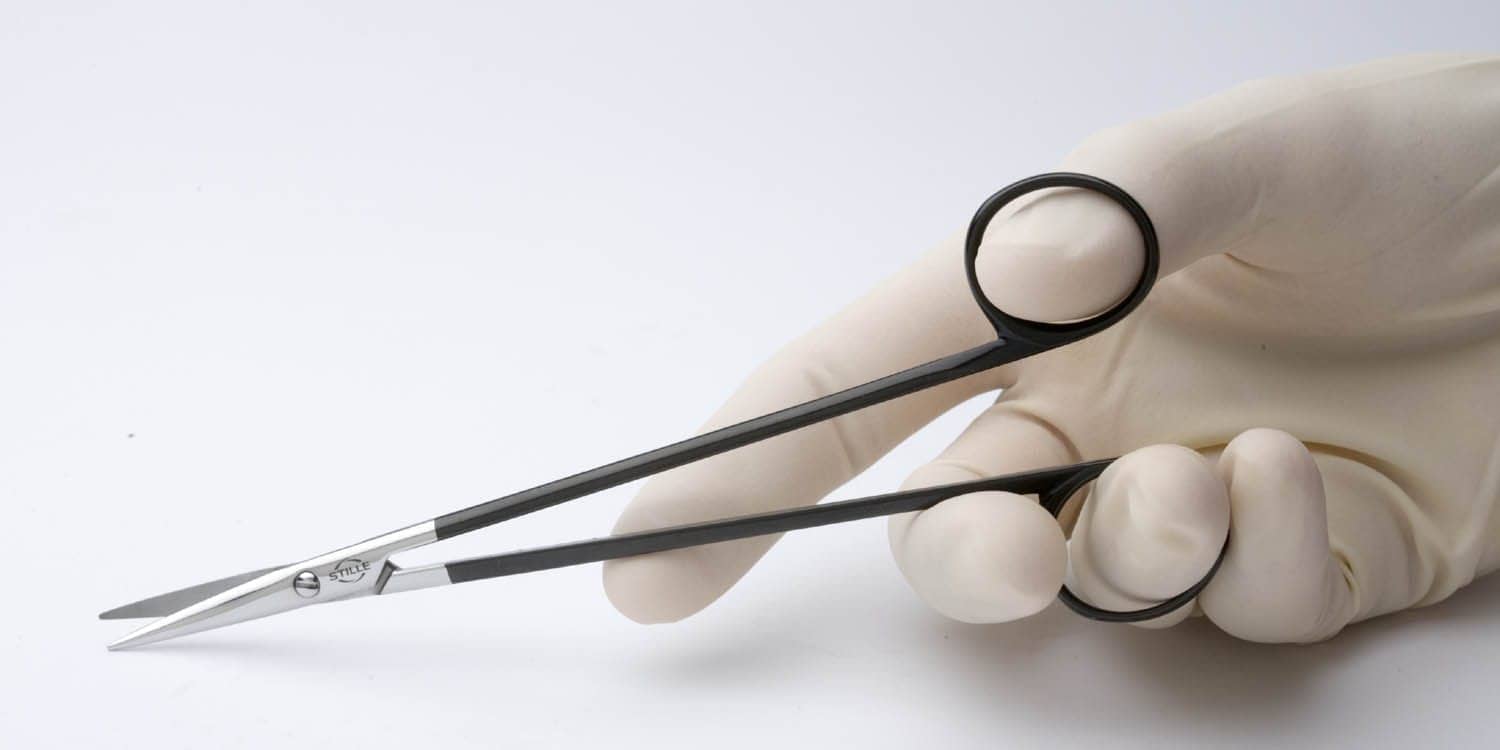
This new policy forcefully encourages human beings to dispel with their primary animal instinct: reproduction. Image sourced at http://www.yorkmedicaltechnologies.co.uk
If the policy be voluntary, the 700,000-man target contradicts what the government of Rwanda calls voluntary vasectomies. Last year, 2010, the vice president of Rwanda’s parliament marketed, in vain, a policy proposal for compulsory sterilization of the “socially retarded” Rwandans. It took excessive efforts by international human rights organizations to thwart the policy proposal. The 2011 “voluntary” vasectomies policy may be a continuum of the 2010 policy proposal. Public policy analysts consent that current latent public policy ideas and motives of any country must be read in light of the similar previous policy. First, the government of Rwanda implemented the habitant and land reform policy. People were supposed to abandon their traditional homestead and go to live in settlement centers – imidugudu. The previous homesteads were meant to be for farming. Initially the government called it a voluntary policy.
Implementation of this policy turned out to be forceful and inhumane. Some government officials snatched victory from the jaws of defeat; they grabbed the land people had abandoned for settlement centers. Second, the government’s policy of what was called voluntary sharing of land between the Hutu owners and the Tutsi returnees ended in the forceful grabbing of land from the Hutu in many regions of the country. Will vasectomies of the unprivileged males be voluntary as the government suggests?
Self-propagation is a basic need and right. However, producing excessive children, as many Rwandans do, is a symptom of insecurity and poverty. There is a general demographic pattern for the well-off to produce between one to three children. The deprived generally produce more than six children. It is no surprise that in a country like Rwanda, where about 75 percent of the population survives on less that $1 a day, the population is increasing by 3 percent per annum. If quantity of the population be the problem, vasectomies are not a durable solution.

The first beneficiary of development is the human person

The quality of a country’s human resources and not the quantity is what matters. Investing in human development is the only sustainable solution. The Rwandan government has sustained one of the most expensive wars in Africa. It is well documented that Rwanda has one of the biggest and most heavily armed militaries in the Great Lakes region of Africa. Rwanda runs the most expensive presidential personal security unit in Africa.
Rwanda’s economy is said to be doing well. Ironically, money is available. How does quantity of the population become a problem that requires dire, questionable voluntary vasectomies?
Human history demonstrates habitual failure by some leaders to reconcile the existence of the poor in an environment that the political leadership project as prosperous. Adolf Hitler exterminated the gypsies alongside the Jews because the gypsies – the poor – would negate the economic prosperity of Germany. This is how seriously the world takes protection of the poor.

Crime against humanity

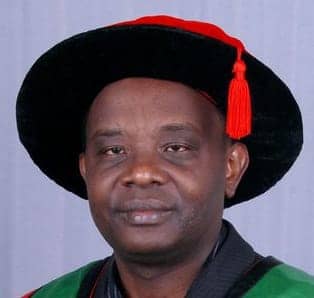
Rwandan American Law Professor Dr. Charles Kambanda


Denying people the right to self-propagation on the basis of their failure to meet costs for their children ought to be an issue of utmost concern for the international community. Targeting the poor with vasectomies is presumed forceful because the poor always lack free will. Vasectomy in this unique Rwandan context might amount to a crime against humanity. The essence and function of government is redistributing resources and power among the citizens. Vasectomy in a Rwandan context manifests government failure to perform its core functions and responsibilities. The policy mirrors incivility, lack of public conscience and negates the basic ethical tenets.
Dr. Charles Kambanda, Dip.Phil., BA, LLB, MA ETPM, MBA, MA HRTs, LLM, PhD, teaches at St. John’s University Law School, LLM Center, New York, and previously lectured at the National University of Rwanda, where, according to the Rwanda News Service, he was known for his “outspoken nature.” This story first appeared on The Proxy Lake: Views and News on the African Great Lakes Region.
Enhanced by Zemanta

When President Kagame went to Chicago

From Ellyakanga blog
“This is what has become the hallmark of the so-called dissidents – ill-mannered, have no programme except insults, out of touch with events in their own country. If they have any programme it is to destroy their country,” wrote Joseph Rwagatare in The New Times.
Do not ask me who the feisty gentleman is. The last time I checked, he was the headteacher of one if not the leading girls school in Rwanda – FAWE Girls School. That was before he switched trades. He is gradually and progressively assuming the position of Rwanda’s critic in chief specializing mainly in criticizing Rwanda’s critics. A cool way to earn a living.
I love reading from Joe. He is smart, knowledgeable albeit selectively, articulate and writes with too much passion. He typifies someone who knows what his readers want and is willing to give them exactly that, nothing more unless it is like I said, selectively less.
Anyway, Joe was referring to the events during President Kagame’s recent visit to Chicago for the much talked about Rwanda Day. Unlike Joe, I did not attend. In hindsight, I wish I had. I am a poor lad you see. Crossing the Atlantic is far from catching a train to say Brighton. It needs bucks. Had I been “the good guy” (from the with us camp) I probably would have benefited from the generous envelopes that were being handed to selected members of the Rwandan diaspora for travel and accommodation expenses to and from Chicago. Unfortunately, whoever was in charge of giving out the said envelopes appears to believe that my opinions over the years have put me on the other side (the against us camp). Thus if I had to attend, and assuming of course that I could guarantee my security, all expenses had to be on me.
But why travel so far, spend so much money, to see someone you have seen before and listen to them speak when whatever is to happen will after all, be delivered right to your desktop by great writers like Joe or members of the mainstream media?
Enough of that. Turns out that while Kagame had a good time in Chicago and was received by so many including leading businessmen and potential investors, something rather ugly was happening just outside the venue where this event was happening – a protest against Kagame.
We know from Joe’s report that this was a small group of nobodies who besides failing to raise a respectable quorum were also afraid to show their faces. Wrote Joe, “Outside, in the deserted streets, a handful of fugitives, not more than a dozen, and hired protesters made a lot of discordant noises…Even their organizers did not seem to believe in what they were doing. Theogene Rudasingwa who had promised to disrupt the North American diaspora meeting (aptly dubbed Rwanda Day) with the President of Rwanda even refused to talk to the media he had invited”.
“He and many others did not want to show their faces – perhaps out of shame and guilt (although those are not qualities you would associate with Rudasingwa). They certainly lacked conviction”.
He continued, “It was clear that the dozen noisemakers and their crest-fallen organizers were only performing a task they had to do because they had been either hired or needed to justify to their funders so that money could keep flowing”.
I am trying to figure this out. A dozen rag tag noisemakers are on Chicago’s deserted streets justifying their funding  for protesting the visit of a visiting ” kick ass” head of state and a former headteacher cum presidential advisor finds this worthy worrying about? Well, I ain’t a big time gambler but if I was to put anything on this, I wouldn’t mind a tenner on the rag tag noisemakers having had such profound effect.
Experience has taught me that when it comes to protests, quite often, it is not the numbers that count but the message. The Rudasingwas may have hidden themselves away from the camera but the very fact that we are talking about this protest now or even writing opinions about it could be to them the gain they aimed to achieve. Which brings me to the question: who really benefited from Chicagogate? Was it Paul Kagame and his entourage, potential investors who got to meet Rwandan officials and speak to the man who matters, or the dozen noise makers who despite their failure to show their faces have managed to have us all, including by the way mainstream media, talking about their small act of resistance to what they say is Kagame’s oppression on Rwandans – the same people who this day was meant to benefit?
It is easy for a spin doctor or a writer for that matter to sit down at home and write a critical commentary on an event he or she considers anti-his/her belief. While getting carried away is normal, I guess we must never forget to desist falling into the trap of risking absurdity and the possibility of being accused of double standards.
I would, as someone who missed out the big day in Chicago preferred to hear and read from good writers like Joe a rendition of what exactly happened inside Hyatt Hotel. A more detailed account of the conversations that Rwandans inside the hotel discussed with Rwandan officials leave alone President Kagame, the mood inside and whether anything tangible in terms of investment had been promised or harnessed from the so called investors or members of the business community. Yes. Investment because at least, I would know that somehow, our president went to Chicago, spent a fortune on transporting himself and a few colleagues there – on board an expensive private jet - but in a few months or years to come, some qualified Rwandan who has been looking for a job for the last 2 years will finally get employed because the president went to Chicago and secured a multi-million dollar investment.
But what did we get instead? Well, Joe accusing Paul Rusesabagina of “wanting Rwandan history to revolve around his fictitious image”. And yes you hear that right. Wanting Rwandan to revolve around his fictitious image? Is this not the man who has been internationally honored for saving 1,268 refugees during the Rwandan genocide? Joe, unless you are making a claim that you feel Rusesabagina should start peddling, when was it that he ever said that Rwandan history revolved around him? As a a former headteacher, I am sure you are aware that if anything, someone else with the same first name but different surname has effectively assumed a cult hero figure status as Rwanda’s saviour and if claiming the whole country’s history is problematic, you are better off channeling your well deserved advice somewhere nearer to you than to a man you and your ilk have essentially made a monster when history has it that he was and will remain a hero to some if not many.
There is more to criticism than blatant bashing.
Over to you my little monsters…
Enhanced by Zemanta

RWANDA: The Chatteau, the lives of Rwandan prisoners in Rwanda

Le Château: the lives of prisoners in Rwanda tells the story of life in Rwanda’s prisons in the ten years which followed the 1994 genocide.  In 2004, around 85,500 people were detained in Rwanda.  Most are accused of participation in the genocide, which claimed more than 500,000 lives.  Many have spent more than ten years in prison without being tried.
In Rwanda, every aspect of prison life is defined by overcrowding.  The standard width of a prisoner’s living space is 40 centimetres.  The prisoners call this their “château”, their castle.  Many prisoners sleep outside, exposed to the sun and the rain.  Family visits last just three minutes.
Yet prisoners have succeeded in imposing order on chaos.  The prisons are effectively run by the prisoners themselves, through a highly efficient hierarchical system which mirrors the society outside.
This book presents a vivid portrait of humanity pushed to the extreme:  an intense and disturbing picture of suffering, ruthlessness, creativity, humour and resilience.  It confronts the reader with a morally complex world, full of contradictions, where the absence of justice makes it almost impossible to differentiate between the guilty and the innocent

“In turn captivating, horrifying, thought-provoking and deeply moving, this account of life inside Rwandan prisons shows how human beings can and do survive in the most extreme conditions.  Listen to the prisoners speak and you will hear tales that transcend the limits of time and place.”

Alison Des Forges, historian and writer on Rwanda


Scope of this book
Why Rwanda’s prisons are unique
Recent events in Rwanda


PREFACE

Chapter I
Forty centimetres:  space
“Hell on earth”: the early years (1994-1999)
Improvements in prison conditions since 1999
The state of prisons in 2004
Health care
Food
Trading space
A life of luxury
Fashion
Chapter Ii
The prisoners’ government:  organisation
The structure
The capita général
Elections
Getting rich inside
The prison administration
Searches
Chapter Iii
Tomatoes, blackboards and guitars:  work and leisure
Work
Education
Entertainment
Chapter Iv
God
Chapter v
“Living as sisters – a survival strategy”:  women in prison
Conditions and organisation of the women’s blocks
Relations between the women
Babies in prison
Relations between women and men
Chapter vI
Real minors and false minors:  children in prison
Absolute minors
Genocide minors
Minors’ living conditions
Activities for minors
Sexual abuse
Chapter viI
Families in prison
Chapter viiI
Waiting to die:  the elderly in prison


 Lists and more lists
Ill-treatment in detention
The survival of the elderly in the central prisons
Activities for the elderly
The vulnerable among the vulnerable
The memory of the family
The response of the government
Enhanced by Zemanta

Crouch End dad Jimi Mistry sees poverty firsthand in Rwanda


HOLLYWOOD actor and devoted dad Jimi Mistry has visited Rwanda to highlight child poverty in the run up to Father’s Day.

The star of The Guru and East Is East, who lives in Crouch End, made the journey with ActionAid to meet children growing up without parents.
He has sponsored a child through the charity for many years and shared the experience with 10-year-old daughter Elin.
Jimi said: “As a dad, I want the best for my daughter, Elin. I kept telling her how excited I was about the visit, but I had no idea what to expect.
“I was amazed. Rwanda is a beautiful country with warm, humble and dignified people and given the genocide in 1994 what I saw is even more remarkable.”
Jimi visited Mpanga Primary School, which has moved from the top to the bottom of a mountain thanks to ActionAid’s child sponsorship scheme.
The children had been left exhausted and teachers were hard to find because the five kilometre hike up the mountainside was so perilous.
The actor spoke to 13-year-old schoolgirl Martina, who had faced wild hunting dogs on one journey to school, and made the trek himself.
He also overcame a personal fear and milked a cow at the primary school - which has helped the children recover from malnutrition.
“Often the basics, like milk are taken for granted,” said Jimi. “It was an unforgettable moment watching a little girl called Rachel, who is just a little younger than my daughter, being given a regular drink of milk and therefore the chance of a brighter future.”
ActionAid is asking people to support its Unforgettable Moments campaign by donating 50p a day - the cost of a pint of milk.
To sponsor a child visit www.actionaid.org.uk/moments
Enhanced by Zemanta

Friday, June 10, 2011

Religious leaders who don’t speak out for their followers are accomplices of bad governance

This is true about all spiritual leaders. Despite the fact that I am not a religious person, neither a pagan, but only a believer, I highly consider and am strongly aware of the significant importance that religious leaders play in billions of people’s lives.
Many of us are guided and behave in our daily life according to the way we were brought up spiritually. Consequently, spiritual teachers as other social leaders including politicians, influence our lives in ways we are not always conscious about. In case of one of these life shapers of billions of us on the planet doesn’t behave in an appropriate manner that appears to harm our well being, they should be reminded of the wrong they may be doing by anyone with some public cloud.
This week, the Archbishop of Canterbury, Dr Rowan Williams, the highest authority of the Church of England after the Queen, expressed publicly his concerns about the British coalition government which, according to him, was putting people in a situation where “We are being committed to radical, long-term policies for which no one voted.” As expected, David Cameron, the prime minister, replied publicly stating his disagreement with the religious leader, particularly on issues like debt and welfare and education.
As we all know it is not only in UK where radical policies are decided and implemented by governments, some not even elected, or without proper consultations with their constituencies. The only difference between UK and other similar said democracies compared to unrepresentative governments is that any public personality who expresses a differing opinion on the government policies is not persecuted for their views in the former countries.
Under undemocratic regimes there are evidently risks of speaking out against governments in place. But also not pointing out to them what they may not be doing right is failing the test of trust that their constituencies or followers have put in them. At a wider extent, by shying away from political intervention on issues affecting their followers, religious leaders become accomplices of the tyrants.
As leaders, between representing their followers on issues that impact on their well being and becoming accomplices of dictators, they have to choose. Unfortunately, we know that corrupt regimes infiltrate the religious order and place in such institutions their people who cannot speak against the system.
Imagine how the social landscape would be like in place like Ethiopia, Rwanda, Uganda, Democratic Republic of Congo, Zimbabwe, Burkina Faso, and many others, if religious leaders like the Archbishop of Canterbury could talk openly without fear of persecution, and criticise publicly some governments’ policies. To religious leaders and their followers, particularly under dictatorial regimes, the guess is yours.
Enhanced by Zemanta

Wednesday, June 8, 2011

Paul Kagame: 17 years of flawed policy of reconciliation between Hutus and Tutsis

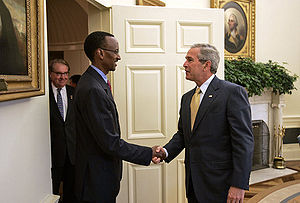
President George W. Bush welcomes President Pa...Kagame and Bush
By the Rising Continent Blog
Since 1994, the Rwandan government has requested and received billions of dollars to rebuild the country. Because of what had happened then, there was little left to bring back some sort of togetherness between Hutus and Tutsis. Paul Kagame, Rwandan president, playing on the guilt of the international community, has used the funds he got to pursue his own agendas. But officially he and his representatives go out explaining to the world that the money was being used effectively to develop the country and particularly reconcile the Rwandan communities. The famous Gacaca courts, Ingando programs, ongoing Intore initiatives and Rwandan Diaspora communities, have been all claimed to have been developed and funded in that official policy of reconciliation.
However, recent events related to Rwandan government terrorist activities in UK against Kagame’s opponents have demonstrated that almost all the funding has contributed and continues to reinforce an apartheid sort of regime in Rwanda where Tutsis are the White South Africans of the past, and Hutus, even less considered than the Black South Africans of the segregation era.  On May 26th, 2011, Ruhumuza Mbonyumutwa wrote in Jambonews online news site an article which highlights to the point how Paul Kagame has so far been lying to everyone about the Rwandan reconciliation. The majority of Rwandan was already aware of such lies. But the international community were not as spot on as it appears today about these monstrous lies. I have translated from French and reproduced the mentioned article below, as nothing can be as explanatory as its author narrates the facts and related story.
London: meeting with a controversial Rwandan woman

For almost a month, the news in the Rwandan Diaspora is dominated by reports from London saying that the Rwanda government is harassing several Rwandan-British living there and has even planned to eliminate some of them.
But who are these individuals disturbing Kigali, what is their background, why do they bring concern, what do they want?
Young Hutu refugees who fled RPF atrocities, Tutsi woman survivor of the genocide of 1994, men and women who fought in the ranks of the RPF, their profiles are diverse but what they share in common is the fact that they regularly participate together to activities organized by an association called ‘PAX,’ of which the latest was a commemoration held on April 19th, 2011 and has particularly disturbed the regime in Rwanda.
To better understand this association, Jambonews met Prudentienne Seward, president and co-founder, and whose story symbolizes the complexity of the Rwandan tragedy and has inspired the creation of the organisation.
Prudentienne was born in Rwanda in the early 60′s from a Tutsi father and a mother half Hutu, half Tutsi, which in the Rwandan tradition makes her considered entirely as Tutsi since children belong culturally to the ethnic group of their father.
With a nostalgic smile she tells us how people lived in harmony. She even gives us an example of the annual tradition of ‘Ubudehe’ held in each September and which aimed at bringing together the entire neighborhood to come and help harvesting ‘amasaka’ [sorghum].
For those with large farms, as was the case for her family, they invited all the neighbors to come and help cultivate a field, and then shared together ‘Ikigage’ [sorghum beer] offered by the farm owner to thank everyone for participating. Hutu or Tutsi, it did not matter. The whole neighborhood contributed together joyfully.
When the RPF launched its war on October 1st, 1990, inter-communities’ relations within the population didn’t change much except the fact that on the streets, ‘I was more often asked to produce my ID document.’
On April 6, 1994 when President Habyarimana’s plane was shot down, Prudentienne was in Butare [Southern Rwanda] and that same evening there was panic, ‘everyone had to stay home.’

From April 6th to 21st, 1994, she tells us that in Butare, roadblocks were put up and managed together by both Hutu and Tutsi [this was almost the picture everywhere including in Kigali, the Rwandan capital], who feared that members of the CDR [extremist Hutus] would come to kill Hutu from the South and members of the PSD party.
She tells us that it was on April 21st that systematic massacres targeting Tutsis began, this following a speech [on radio] by the Acting Rwandan President Theodore Sindikubwabo. She says that in retrospect, she questioned the existence of a planning of the killing, because as she explains ‘people were likely encouraged at the last minute, from 21st April onwards.’
Since then on, she felt threatened and feared that at any time, Interahamwe militiamen could come and kill her. It was the mayor of her local authority Nyaruhengeri, Kabeza Charles who saved her life. She adds that her savior was later on killed by RPF soldiers in DRCongo, some years after.
On June 24th, 1994, through Oxfam, at the association ‘Terre Des Hommes’ and especially Chris, her husband, a British citizen, she was able to be evacuated to] Burundi [neighboring country] with a group of foreigners. While in Burundi, she learns that her whole family on the side of her father and her nieces were massacred by Interahamwe.
In August 1994, after RPF seized power, Prudentienne decides to return to Rwanda to find out about her mother and sister. Believing that peace had returned, she encountered instead delusion. ‘when I thought I would find restored peace, I saw horrible things: RPF was busy putting people in camps; everywhere I went, you could come across strong smell of dead bodies and on our way, men were being systematically slaughtered. ‘
She manages to get back to her hometown expecting to find her relatives. She only finds ruins and desolation. ‘Interahamwe had destroyed our house,’ she explains.
It is when she is seeking to find where her mother could be that a local man tells her that her mother, sister and aunt had been killed by RPF a few days before.’ As soon as that man had just explained me what had happened to my family, an RPF soldier who overheard us came and shouted to the man.‘ He told the man, ‘We came to save you now you are saying you were being killed!‘ The soldier shot dead the man before Prudentienne’s eyes straightaway.
Chris, my husband, who was present at the scene then said angrily, ‘you’re supposed to be the saviors of the people and you are about to massacre them?’ Then the RPF soldier explained immediately why her family was killed.  ‘Your mother was killed because she was an Interahamwe, we don’t kill normal people (abantu bazima).
Having heard her husband speak French, the soldiers became restless, screaming, ‘He is French’ and in a panic, they [Prudentienne and her husband] urgently got in their car and drove away speedily. ‘We were pursued by a jeep with soldiers shutting on us. Luckily we managed to escape them,’ she explains.
They fled Rwanda and went to live in Angola, where her husband had been appointed deputy representative of Oxfam. In 1995, Prudentienne decided to return to Rwanda in order to bury with dignity her loved ones. Just starting from the airport, she began to be worried. Officials asked her all sorts of questions, such as, ‘how did you survive?’’Is your family still alive?’One official highlighting the fact that she had a passport which was issued in June 1994, exclaimed, ‘if you survived it’s because you’re Interahamwe.’
At the end of negotiating with the officials, she manages to enter the country without much more trouble. As soon she had buried her mother, she left immediately Rwanda.
On April 3rd, 1996 while in Angola, her husband is killed, ‘caught in an ambush that targeted UN soldiers with whom he was.’

It’s on April 6th, 1996, that she arrived in England where she now lives with her husband’s family which hosted her.
Just after her arrival in England, she was approached by a group of Rwandans who had heard her story and asked her to be part of an association of Tutsi survivors to testify about her traumatic experience.
‘They wanted me to give testimonies regularly, and I agreed but I told them that my mother had been killed by the RPF, aspect of my story they told me that I was not allowed to speak about, [according to RPF] it was an accident, which had been caused by young RPF soldiers who had come back in the country and found their families slaughtered by Interahamwe.’ She then told them that in that case she couldn’t continue testifying, ‘no one can stop me from talking about all the loved ones I have lost.’
There she realized the seriousness of the problem of memory in the Rwandan tragedy, ‘I didn’t want to see the genocide be used to divide further Rwandans, I didn’t want my story to serve as a means to oppress other victims of our common tragedy.’
It was after that, in 1998, she made contact with Rene Claudel Mugenzi [living then in London] and together with other Rwandans, they founded PAX, an initiative which aims to promote peace, justice, forgiveness and reconciliation between peoples of the Great Lakes. About Rwanda particularly, she found that many associations were often mono-ethnic and PAX wanted from the beginning to be wholly inclusive, bringing together all ethnic groups. PAX regularly organizes conferences on reconciliation, and commemoration of all the victims of Rwandan tragedies.
She believes that the biggest problem in Rwanda is the lack of justice. ‘There are a lot of talks on The Mapping Report while nothing is bringing enough attention to the killings that RPF committed inside Rwanda.’
What is most revolting for her is that, ‘there is a significant part of the victims who are silenced, have no rights at all to remember or refer to their dead and this has to stop, because with the current situation there cannot be any effective and genuine reconciliation.’
Since she began running PAX, the Rwandan High Commission in London has tried every trick to recruit her. ‘At first it was seduction. They would explain me how it would be a good option to work with them, but when I persistently refused, they became more threatening.’
The commemoration held on April 19th seems to have particularly offended the regime. It aimed at remembering and honoring ‘all the victims of the genocide in Rwanda and all other atrocities that have affected Rwanda since 1959.’
What particularly upset many pro-Rwandan regime’s who called her [referring to the event] was one sentence in the invitation that said ‘the survivors (Hutu and Tutsi), will give testimonies and share their different experiences so that everyone could understand other people’s pain and therefore they could all move towards forgiveness and reconciliation.’
Since sending out the invitation which equally went to the Rwandan High Commission, many Rwandans sided with the regime in Kigali called her to say that ‘it was really incorrect and inappropriate to talk of Hutu survivors.’

The event took place peacefully without any incident and was reported by BBC Gahuza Miryango. Hutu and Tutsi listened alternatively to each other experiences and personal stories.
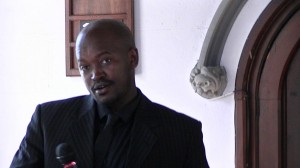
After the testimony of Prudentienne, a former RPF soldier, Noble Marara, who was a bodyguard of Paul Kagame, spoke and apologized ‘for having been part of a group that brought you so much suffering,’ before he hug her under the cheers of all other participants emotionally touched.
Hutu, Tutsi and former RPF soldiers had each individually the opportunity to testify, to tell their story with the aim of enabling everyone to better understand the other.
Since that event, threats intensified. She received multiple telephone calls treating her as Interahamwe and saying that whatever the means to be used, RPF was going to use them to stop her project.
Within three weeks from the event she heard that Rene Claudel’s life was also in danger, ‘I was angry, I wondered how they could get to such madness’ and when we asked her if she was afraid of dying, her response was as immediate as spontaneous, ‘Ntawatinya gupfa, urupfu yararurenze’ [You can not be afraid of dying when you have passed the stage of death]
Prudentienne is the kind of woman whose story gives every excuse to fall into hatred, and yet day after day advocates for peace and forgiveness.
In its virulent response that the Rwandan government has so far provided to deny the threats of harassment [which have been published in most of mainstream media], one persistent argument emerges: why does it attack now Rwandan citizens ‘not so well known’?
RPF government is an ethnocentric and racist regime which has been responsible for the death of hundreds of thousands of Hutu but also an unknown number of Tutsi. The movement draws its legitimacy from the international recognition of the genocide that was perpetrated in 1994 against the Tutsi minority. Once an international partner evokes the slightest criticism about violations of human rights or crimes committed by RPF, the answer is straightforward as noted Theogene Rudasingwa, former chief of staff of Paul Kagame, ‘Where were you during the genocide against Tutsi?’ Intimidated and unanswered, international partners get silent immediately and move to other topics on the agenda.
From a standpoint of Rwandan society, the regime in Rwanda attacks with greater virulence anyone who dares to refer to his victims. ‘Genocidaires, Interahamwe, Negationists, supporters of the genocide, Useless people,’ this is the list of names [insults] given daily to any Rwandan citizen or foreigner, whatever their background, who dares to mention crimes that RPF committed.
The most cynical attacks are those directed at Tutsi survivors, such as Prudentienne who is called ‘Interahamwe’ or Déo Mushayidi [imprisoned Tutsi and leader of a non registered opposition party] who lost almost his entire family in the genocide of 1994 and for whom the Rwandan prosecutor requested a conviction for ‘negationism.’
Projects bringing together Hutu and Tutsi which aim at a genuine reconciliation represent for the Rwandan regime a serious menace, considered the narrative of the country’s recent history that it has imposed and which constitutes its raison d’être.
It’s only by dividing the Rwandan society into two camps and by stigmatizing its opponents but also more generally calling the entire Hutu community genocidaires that the regime can maintain this version of history.
Any lasting peace in Rwanda, in order to be free from any foreseeable bloody conflict, demands however a genuine reconciliation between Rwandans. It requires the recognition of all victims, justice for all, but also and perhaps above all truth about the causes of the tragedy that befelt the entire Rwandan population. Yet so far the regime refuses to take this path for fear that senior RPF executives could become accountable  for their crimes.
It is for these reasons, more than the various groups in the political arena of opposition parties with their ongoing and futile bickering, that associations such as PAX are considered by the Rwandan government as a threat that must be annihilated at any price, because they endanger seriously the very foundations of the regime.
What the story tells about Rwanda since October 1st, 1990, RPF’s ideology and Paul Kagame’s regime
Since the RPF’s attack of Rwanda in October 1990, rightly considered to be led by ex-Tutsi refugees, and because of a plural political party system which had started but unfortunately developed in the middle of a context of civil war, certain animosities had flourished among different sections of the Rwandan community.
From the early days of the RPF guerrilla war in January 1991, the presence of the French on the side of Hutus was a persistent obstacle because they were in the way of Kagame’s evil plans for Hutus until they left after the ‘Turquoise Operation’ in September 1994.
Prudentienne’s mother was half Hutu, consequently, according to RPF ideology that the soldier who confronted her interlocutor applied, she was Interahamwe and not a normal person. Therefore she could be killed and she was. At some extent, normal people would appear here to be only Tutsis. Hutus are all interahamwe, and if they cannot be killed all at once, they cannot be treated by the Rwandan government as normal people. And that’s what has been happening all these last seventeen years of Paul Kagame’s leadership in the country.
Because RPF political ideology is so extremist towards Hutus, it cannot be sold to the international public as it is. Otherwise it would be openly decried, as was the South African apartheid. The regime uses then appealing terminologies such as reconciliation, community work, etc for its discriminative policies.
If you are Hutu, you are not allowed to talk officially i.e. publically of the loved ones you lost during the genocide or any other time or anywhere because of RPF. This happened to Prudentienne. It happened to Rwandans through Umubano community group who in 2006 were remembering during a public event in London what had happened to their compatriots in Tingi-Tingi [ex-Zaire]. Four of their colleagues were imprisoned four months later because Kigali had accused them officially as genocidaires and requested from the UK their extradition. It also happened to Victoire Ingabire Umuhoza, leader of FDU-Inkingi, because she publicly questioned the reason Hutus who died during the genocide had nowhere to be remembered. She is in prison in Kigali since October 14th, 2010. The rest of the Hutu population has to shut their conscience about their dead in order to survive under Kagame’s regime. Unfortunately, it is not only about their dead, but all fundamental human rights.
Enhanced by Zemanta