Africa Great Lakes Democracy Watch


Welcome to
Africa Great Lakes Democracy Watch Blog. Our objective is to promote the institutions of democracy,social justice,Human Rights,Peace, Freedom of Expression, and Respect to humanity in Rwanda,Uganda,DR Congo, Burundi,Sudan, Tanzania, Kenya,Ethiopia, and Somalia. We strongly believe that Africa will develop if only our presidents stop being rulers of men and become leaders of citizens. We support Breaking the Silence Campaign for DR Congo since we believe the democracy in Rwanda means peace in DRC. Follow this link to learn more about the origin of the war in both Rwanda and DR Congo:http://www.rwandadocumentsproject.net/gsdl/cgi-bin/library


Tuesday, August 3, 2010

Does this picture make you think of Rwanda?Rwanda in PR Makeover

by Robert Booth from The Guardian
Positive pictures of Rwanda, such as the country’s famous gorilla trails for tourists, are used to change its image. Photograph: Getty Images
Gorillas in RwandaWhen Louise Mushikiwabo, Rwanda's foreign minister, was due to speak at her country's high commission in London reporters from the world's media waited inside a fake Rwandan village hut and leafed through glossy brochures promoting the country's famous gorilla trails.
Smart-suited young British PR executives poured Rwandan coffee and burbled about presenting "a different image" and focusing on "mountains, gorillas, crops" – all part of the country's increasing efforts to reinvent itself 16 years after it was torn apart by genocide. Alluring offers were held out of trips to the nature reserves for journalists willing to write up such topics, and when Mushikiwabo arrived she wanted to share "the good news that has been taking place in Rwanda". There are more women in parliament than any other country and it has been admitted to the Commonwealth. "We are at a time in our post-genocide history where we have to move on," she said.
As Rwanda prepares to go to the polls on Monday to elect a president for only the second time since 1994, this public relations drive, masterminded by the incumbent president, Paul Kagame, this week faces its sternest test. The government is facing accusations, which it denies, of state murder and corrupting the democratic process. Will the international community accept that Rwanda has indeed, moved on?
Tasked with persuading the world is London PR firm Racepoint, hired by Kagame. "You used to Google Rwanda and the first thing you would see would be about genocide," said Cathy Pittman, Racepoint's managing director. "Now we are feeding content and stories to journalists about the economy and culture. A lot of it is about images."
It sometimes works. A writer from Foreign Direct Investment magazine was taken on a trip to Rwanda by Racepoint and wrote a piece in February which stated Rwanda "prides itself on having zero corruption" and that "Rwanda is poised to become Africa's newest success story".
The Commonwealth Human Rights Initiative, in a report last year, found that Rwanda has "excellent public relations machinery" which has succeeded in "persuading the key members of the international community that it has an exemplary constitution emphasising democracy, power-sharing, and human rights which it fully respects". It concluded: "The truth is, however, the opposite."
Rwanda's constitution, the report said, was "a facade which hides the exclusionary and repressive nature of the regime", "basic human rights are in an unsatisfactory state", "censorship is prevalent" and there are "serious concerns about the level of political freedom".
On 24 June Jean Leonard Rugambage, a dissident journalist, was approached at the gate of his home in Kigali by two gunmen and shot twice in the neck. The killing sparked accusations and denials that his murder was commissioned by the government, which had already withdrawn his newspaper's licence to print.
Hutu opposition politician Victoire Ingabire has failed to secure registration to stand in the election, leading to claims Kagame's regime is blocking her candidacy. At Racepoint's suggestion, James Musoni, Rwanda's local government minister, wrote an opinion piece for British newspapers, which was pitched to the Guardian, among others, to try to deal with these issues.
It concluded somewhat ambiguously: "The government is determined to ensure these elections go ahead peacefully and fairly – without interference from those inside and outside the country who stand to gain from stirring up instability."
Racepoint also arranged for a Guardian journalist to interview Kagame in Kigali. The resulting story was published on 28 May and focused on the allegations.
Earlier this month, opposition politician Andre Kagawa Rwisereka was found dead, reportedly nearly decapitated, sparking concern that the killing was politically motivated.
Rwanda is not alone among regimes with controversial human rights records to turn to London's PR firms for help. Others have hired leading outfits such as Bell Pottinger, led by Lord Bell, a former adviser to Margaret Thatcher; Portland PR, which counts Michael Portillo among its advisers; and Hill and Knowlton, better known for representing Adidas, Castrol and Nissan. Leading consultants have fanned out from London to win contracts as far afield as China, Kazakhstan, Saudi Arabia, Russia and Zambia.
A recent report into the phenomenon in Brussels by Corporate Europe Observatory, a campaign group which researches the power of corporate lobbying, said: "Secrecy among both embassies and consultancies keeps much of this phenomenon out of public sight … some of the consultancies are lobbying on behalf of governments which are directly or indirectly responsible for serious human rights violations."
London's growing status for reputation management is partly down to the time zone, language, and the important role for their clients of British publications with large international readerships including the Economist and the Financial Times, PR executives said.
"If you are managing a client's reputation, whether individual, company or country, it is the Anglo-Saxon media that matters and particularly the London-based media," said Ivo Gabara, who advises the Kazakhstan foreign ministry on press relations in London. "Coverage in the US is important but what is said out of London will determine your global reputation."
An Amnesty report on Kazakhstan earlier this year stated that "torture or other ill-treatment of individuals deprived of their liberty, whether formally detained or in de facto unacknowledged detention, continue to be routinely used".
"I take on business I am comfortable to identify myself with," said Gabara. "In Kazakhstan I see a country making progress on every front including its human rights record, media legislation and political freedom."
The doyen of this business is Lord Bell, the chairman of Chime Group, which runs Bell Pottinger. His firm's political contracts include Sri Lanka, where the government was recently accused of war crimes and Madagascar, where he acts for the former president, Marc Ravalomanana, who was forced out following violent clashes and was sentenced in absentia to four years in jail for abuse of office in buying a presidential jet. Bell's position on the ethics of which contracts to take is simple.
"I wouldn't do anything I would do a bad job on," he said. "It is about the direction of travel. I don't choose to sit in judgment on whether they are going fast enough. If the direction of travel is right then I am perfectly happy to help them."
Another big UK firm, Hill and Knowlton, has contracts with the Malaysian government's cyber security agency; the Singapore prime minister; city governments in Beijing, Shanghai and Chonqing; and Saudi Arabia's investment authority. Portland PR works for the Kremlin while Africa Practice, whose director, Marcus Courage, helped run Mwai Kibaki's presidential campaign in Kenya which was followed by a wave of violence, is working for the government in Gabon.
A PR executive who has worked for governments in eastern Europe and Africa said working for foreign governments was sometimes an exercise in "spinning them into legitimacy".
"You are often paid a lot to do something that you know from the outset you will not be able to achieve," he said on condition of anonymity. "It is almost like a con. You can't spray perfume on a turd. It will smell nice for a while, but eventually it will smell like what it is."
He said he was once offered, but turned down, a £2m two-year contract by the Sudanese government to produce PR about Darfur. With such fees on offer competition is growing.
"Firms distinguish on whether they are being asked to do anything unethical rather than whether their client is acting in that way, rather as a lawyer would take on the case of a criminal," said a senior partner in a leading firm which contested the recent Kazakhstan contract. "We are paid to put the best case on behalf of the client."
Another PR firm with an office in London, Marston Nicholson, produces the Kazakhstan Live website, which has featured items on folk music and apple harvests.
Morris International Associates, a London firm, manages UK media relations for the Saudi Arabian government, including arranging briefings with the London ambassador, Prince Mohammed bin Nawaf al-Saud, and press trips to the kingdom. In 2009 Saudi authorities executed, mainly by beheading, 102 men and women for offences ranging from drug possession and blasphemy to rape and murder, according to Amnesty International. In its latest annual report on the kingdom, the human rights organisation said: "Torture and other ill-treatment continued to be widespread and committed with impunity. Commonly cited methods include severe beatings with sticks, electric shocks, suspension from the ceiling, punching, sleep deprivation and insults."
Ann Morris, a director of the company, acknowledged the country had a mixed reputation and "terrible things happen everywhere", but she insisted the Saudi government "deserves to have the many, many positive things emphasised and pushed forward". She said: "Our aim is very much to develop a better understanding," she said. It is quite often lop-sided. It is quite difficult for some countries to swim above that and show the good things they are doing. Nobody is suggesting any country is perfect but we are trying to get a balance."
Her firm has arranged meetings with Saudi officials for the Guardian and other newspapers.
PR consultants who profess to maintaining high ethical standards said they would not take contracts if they believed their clients' values would reflect badly on them.
"You need to see the whites of their eyes and if you think they want you to spin and promote a picture of their regime which is untrue, it is an unacceptable contract," said Simon Cohen, managing director of Global Tolerance, an agency which has worked for the Dalai Lama, the Wallace & Gromit's Children's Foundation and the Green Party. "PR and communication agencies have to ask if the people they are working with are aligned with their values."
Beneath the PR façade
Rwanda
The PR says: "The Rwandan government has gained significant international support in the past few years precisely because of the stability and reconciliation it has brought to the country." - An article written by James Musoni, minister of local government in conjunction with Racepoint, a London public relations firm, June 2010
A human rights NGO says: "It uses the constitution opportunistically as a façade, which hides the exclusionary and repressive nature of the regime; relies on power structures that sometimes run parallel to, and sometimes cross-cuts, the formal government; and in which the army plays a central role." - Commonwealth Human Rights Initiative report August 2009.
Sri Lanka
The PR says: "We are ready to engage positively with anyone and everyone around the world who wishes to help us achieve our dream of a united and prosperous land and enable Sri Lanka to take its rightful place in the world as an island of unsurpassed beauty, enterprise and now peace." - Sri Lankan president Rajapaksa in an article pitched to the Guardian by Bell Pottinger, a PR group, in December 2009.
Amnesty says: "At the end of the war, atrocities against civilians and enemy combatants appeared to be fuelled by a sense that there would be no real international consequences for violating the law." - Madhu Malhotra, Amnesty International's deputy director for the Asia-Pacific region in March 2010
Kazakhstan
The PR says
"Political stability, religious tolerance and a unique location at the crossroads of China, Russia and Europe gives Kazakhstan a stabilising role for the whole region – as well as making it the perfect host for the Congress of World Religions." Kazakhstan Live – website created for the Kazakhstan foreign ministry by Marston-Nicholson.
The UN says
"I conclude that the use of torture and ill-treatment certainly goes beyond isolated instances. I have received many credible allegations of beatings with hands and fists, plastic bottles filled with sand, police truncheons; of kicking, asphyxiation through plastic bags and gas masks used to obtain confessions from suspects." Manfred Nowak, the Special Rapporteur of the UN Human Rights Council on torture and other forms of cruel, inhuman, degrading treatment or punishment following a visit to Kazakhstan in May 2009
Enhanced by Zemanta

Kagame Said he is ready for another war

Secretary of Defense William Perry and Rwandan...Image via Wikipedia

Kagame warns: “We will fight whoever starts a war against us”

E-mail Print
Bugesera: From telling western critics they can hang, incumbent President Kagame now says for those planning war, they had better take a second chance to think over their plans. This is after an exiled ex-spy chief said President Kagame like other ‘dictators’ don’t step down, they are ‘brought down’.
"We will fight whoever starts a war against us,” said Kagame in Bugesera district on the latest leg of his campaigns. “Rwandan must be allowed to make their choice…whoever is not happy can die of envy.”

Without singling out any specific individuals or groups, the RPF candidate said nobody will scare Rwandans with threats of war.

Ex-spy chief Col Patrick Karegeya, who is in South Africa with wounded Lt. Gen. Kayumba Nyamwasa, said in an interview with a Ugandan tri-weekly The Observer that only armed rebellion would remove President Kagame.

“A dictator can never step down, they are brought down. It’s only Rwandans who can stand up now and fight for their freedom. Kagame will have his breaking point and I think it will be very soon,” Karegeya said.

In a firry speech – a tactic he has employed since Friday last week, President Kagame told Bugesera that critics are wrong to suggest that since everybody supports RPF, then there is no democracy in Rwanda. 

"Some falsely claim that Rwanda has no democracy because everybody supports RPF," said Kagame.

"Who told them this is not democracy. If they want the truth then let them inquire from Rwandans, and residents of Bugesera in particular."

He added: "Democracy and development are twins not enemies. Each requires the other."

The President started DAY FIFTEEN of the campaign trail with a large rally at Nyabugogo here in Kigali for the morning, before he moved to Bugesera around mid-day. By press time, the RPF candidate was in Kicukiro district – also here in Kigali.
Enhanced by Zemanta

Conference for Peace in the Great Lakes took place in Washngton

Today people from different professional fields and friends of Rwanda gathered at the National Press Club in Washington to listen to various lectures prepared by various experts on Rwanda. The meetings was organized by the people who understand the political climate in Rwanda to the run up to the presidential elections on August 9,2010. Among the speakers were Professor Peter Erlinder who is a lawa professor at Mitchell College, Mr. Kalinganire Pascal who is the dorector and founder of Organization for p Peace,Justice, and Development (OPJDR), and Mr Gatebuke who is the African Peace Activist. He has recently been arreasted by the Kigali government when he had gone to represent  his client Ms.Ingabire Victoire who is the leader of main political opposition party FDU-Inkingi. Today Prof. Elrinder presented on the political atmosphere in Rwanda and the repressive stituation that most of the opposition members find themselves in. Among other people who presented on the political situation in Rwanda is Mr. Kalinganire Pascal who is the director and founder of Organization for Peace, Justice and Development in Rwanda a nonpolitical organization based in the United States.

From one speaker to another they all emphasized on the reason why the US government and the International Community should  intervene to establish  democratic institutions in Rwanda by not recoognizing the August presidential elections. This would bring strong institutions in Rwanda and ensure that all Rwandans are free from dictatorship and autocratic rule of Mr Kagame.

All the people in presence had opportunities to ask the panelists different questions regarding their presentations. All the panelists proved beyond any doubt that the upcoming Rwanda elections are not going to be free and fair and Mr.Kagame is ready to impose himselelf again to thew Rwandan people ans the international communities and the US government who is the major supporter of the Kigali regime still watching without saying any thing.

One of the Sspeakers quoted the Kagame's speech of Sunday when he was campaining in in Nyarugurru where Mr.Kagame said that those foreigners journalists who are reporting that there is no democracy because so many people are attending Kagame's rallies they should hung themselves or go to hell.

After the speakers have talked the Rwandan Ambassador to the United States Mr Kimonyo asked to be given opportunity to clarify on some issues that the previous speakers had talked about. the moderator  accepted his request but what the ambassador said was outrageous and unprofessional in any given political and academic domain. He demonstrated that Rwanda is a country of one man show and nothing as democracy that the RPF rule is going to bring to the people of Rwanda.Everyone who has attended can agree with me that  Mr.Kimonyo did not deliver to the expectations of the people and audience in attendance hoping that next time when he comes to do his work in such kind of gathering he should know that people know hahve full information about what is happening in Rwanda and understand what is the responsibility of Kagame's government in the human atrocities  being  committed in DRC.

Enhanced by Zemanta

Rwanda: President lashes out at media


  1. RWANDA - Opposition leader arrested
    AfricaNews political desk
    President Paul Kagame of Rwanda has lashed out at the Western media for criticizing his style of government. He defended the country's political system despite growing concern over the rule of law and human rights.
    “When people choose what they want, that is democracy. When they reject negative forces and divisionism, that is democracy. When they choose the leadership they want that is democracy,” Kagame said according to a Bloomberg Businessweek report. “Whoever does not like the Rwanda way of democracy should go and hang.”

    Kagame, who has ruled for the past 10 years, also accused opposition leaders including Victoire Ingabire of promoting division among voters ahead of elections on Aug. 9. He spoke at a gathering in Gichumba, northern Rwanda, attended by 150,000 people, according to Ignatius Kabagambe, a director in the Information Ministry.

    Kagame led the rebel forces that in 1994 ended the genocide of 800,000 ethnic Tutsis and moderate Hutus. He came to power in 2000 after President Pasteur Bizimungu was deposed, and then won a seven-year term in September 2003 after Rwanda’s first democratically contested multiparty elections.

    In the run-up to next week’s vote, at least two prominent opponents of Kagame have been killed. A third survived a shooting in South Africa in June. The Rwandan government denies any involvement in the incidents.

    Ingabire, leader of the opposition United Democratic Forces, says she has been unable to register as a candidate for the elections because she has been under house arrest. She has called for the election to be postponed.

    Kagame praised the attendance at the rally as a sign of support for the ruling Rwandan Patriotic Front’s policies.

    He said: “I am so happy you came in large numbers, which means you love your country and its prospects for democracy. Foreigners who write that there is no democracy in Rwanda should come and see.”

    Kagame has overseen a period of economic growth, with the World Bank’s Doing Business 2010 report ranking Rwanda as the world’s top “business reformer.” The coffee-based economy is projected to grow 5.4 percent this year, the International Monetary Fund said on July 9.


Reactions

Enhanced by Zemanta

Rwanda 'openly flouting the rules of democracy'

Children on a farm near Volcanoes National ParkImage via Wikipedia
Rwanda's regulatory body has suspended about 30 media organisations, France-based Reporters sans Frontières (RSF) reported on Tuesday, accusing Kigali of "flouting democracy" ahead of elections.

"With just a week to go to a presidential election on August 9, the Rwandan authorities are openly flouting the rules of the democratic game", the organisation said in a statement.

"Press freedom violations, including the jailing of journalists, the closure of news media and the murder of a newspaper editor a month ago, have intensified in the run-up to the election," it added.

RSF said that Rwanda's Media High Council had published last week a list of 19 radio stations and 22 newspapers deemed to comply with its rules.

Permits
Those not on the list, including some radios and newspapers with a wide following, have been asked to apply for permits and are de facto banned until a fresh request is approved, the watchdog said.

"The Media High Council’s measures, coming just a few days before the election, are highly suspect," RSF said.

"The aim is to clamp down on the press and prevent journalists from doing their job as independent and impartial observers of the election process."

A journalist who claimed to have uncovered evidence linking the government to the attempted assassination of a Rwandan general exiled in South Africa was found dead last month, almost decapitated.

The regime denied any involvement.

Enhanced by Zemanta

Human rights fears over 'undemocratic' Rwandan poll

By Channel 4 News

As Rwandans prepare to vote in only the second post-genocide presidential elections, Human Rights Watch tells Channel 4 News laws intended to prevent another slaughter have instead been used to suppress free speech.
Paul Kagame is likely to be re-elected for his third and, according to the country's constitution, final term in Monday's presidential poll. But the run up to the vote has been peppered with accusations that the government is behind several moves to effectively muzzle free speech.
Carina Tertsakian from Human Rights Watch (HRW), who was forced to leave the east African country in April after her visa was revoked, told Channel 4 News "There is no democratic space in Rwanda."
Paul Kagame campaigns in the Rwandan elections (Credit: Reuters)She said although Mr Kagame has a lot of support in the country, "People are afraid if they express themselves freely they may be accused of the offence of promoting genocide ideology which could mean a prison sentence of up to 25 years. They're scared."
The crime of promoting genocide ideology was created in Rwanda in 2008 in order to prevent the re-emergence of the so-called hate speech which was instrumental in driving the 1994 massacres.
However the law itself is surprisingly vague. HRW says it is being used to frighten those who wish to stand against the government, including opposition candidate Victoire Ingabire.

Who is the RPF?
In Greek mythology Saturn ate his newborn children to stop them overthrowing him; the Rwandese Patriotic Front (RPF), which came to power after the genocide in 1994, seems to be following the same pattern writes Channel 4 News' International Editor Lindsey Hilsum. General Paul Kagame, who is standing for re-election as president next week, fears the political opposition far less than some of his former comrades at arms.

Back in 1994, the RPF were heroes. They refused to accept international demands to compromise with mass murderers, and deposed the government which had organised the genocide. They did quite a lot of killing themselves, both in Rwanda and next door in the Democratic Republic of Congo, but also managed to rebuild the country. Maybe they had to be ruthless to transform Rwanda into one of Africa's more prosperous and well governed states.

And yet, and yet. Back in 1996, Seth Sendashonga, the interior minister in the first post-genocide government, was shot dead in the Kenyan capital, Nairobi. Sendashonga was one of the few Hutus who had joined the RPF, but he fell out with some of the senior Tutsis in the movement. According to Africa Confidential, Kenyan police said he was shot with a pistol belonging to a Rwandan diplomat.

And this year, it has all been coming apart. In February, Kagame accused two former members of his inner circle of masterminding a series of grenade attacks in Kigali. Deo Mushayidi, a former RPF ambassdor, was arrested. General Faustin Kayumba, Kagame's former chief of staff, fled to South Africa. On 19 June, an assassination attempt in Pretoria left him with bullet wounds in the stomach. The Rwandan government says it had nothing to do with it – but Kayumba's wife, Rosette, thinks otherwise.

In April, two senior generals – Karake Karenzi and Charles Muhire – were arrested. Others, such as Patrick Karegeya, have also fled into exile.

They are all people those of us who covered the genocide knew back in the mid 90s. Ambitious men, but also intelligent and with a determination to heal their wounded country.

President Kagame says Rwanda is now a democracy, because it is holding elections. It looks more like the classic revolution that ends up eating its own children.

Ms Ingabire has faced repeated arrest since her return to Rwanda after a 16 year absence and in March this year was stopped from travelling outside the country. Her movements have been further circumscribed and she is currently not allowed to leave the Rwandan capital Kigali.
The Rwandan government says Ms Ingabire and her party, FDU-Inkingi, have been collaborating with the opposition militia, the Democratic Forces for the Liberation of Rwanda (FDLR), composed in part of members who carried out the 1994 genocide.
She also stands accused of making public statements criticising the government which has led to accusations of inciting divisions.
Ms Ingabire failed to become a presidential candidate because her she and her followers were unable to register as an official political party. Local authorities had reportedly hampered attempts by FDU-Inkingi to satisfy registration requirements.
Civil society has also been targeted with the Rwandan media having faced censure. Two independent newspapers, Umuseso and Umuvugizi, were suspended by the authorities.
Umuseso had published articles reportedly exposing government corruption. The two papers' editors subsequently fled the country after receiving death threats.
Mr Kagame's supporters say he has done much to improve the conditions of ordinary Rwandese, improving access to healthcare and introducing free schooling. Mr Kagame, who led the Tutsi-dominated Rwandese Patriotic Front (RPF) during the genocide, has ambitions to make Rwanda a regional techonological hub.
But as cracks start appearing in the fabric of the RPF and Mr Kagame faces a final presidential term, it remains to be seen if dissent in Rwanda will continue to be as effectively contained as it has been for the past 16 years.
Enhanced by Zemanta

Rwandan Election: Doubts About the Poster Boy Kagame

by Mike Pflanz.
Paul Kagame: poster boy for the west's aid policies.Paul Kagame: poster boy for the west’s aid policies
Rwanda’s president Paul Kagame, long the darling of western donors, is widely expected to win August’s presidential polls, the second since the 1994 genocide. But is his success down to pure popularity, or because of an apparent crackdown on voices of dissent?
“On the surface, Kagame is a poster boy for the west’s aid policies, an African leader who stamps on corruption, who uses international help to educate children, treat the sick, repair roads and boost business.”
Mike Pflanz.
…
“‘It is strange. Why, if he has all this support, will he not allow opposition and then trounce them at the polls,’ asked a Kigali-based European diplomat. ‘Clearly all this other stuff is not the kind of press we were expecting out of Rwanda in the run-up to the elections.’”
…
“.‘The political environment ahead of the election has been riddled by a series of worrying actions taken by the Government of Rwanda, which appear to be attempts to restrict the freedom of expression’.”
Assistant Secretary of State Johnnie Carson.
Paul Kagame stands at a podium in an open-air stadium in Rwanda’s capital, Kigali, where terrified thousands sought refuge from the men with the machetes as the killing started exactly sixteen years earlier.
It is Genocide Memorial Day, April 7, 2010, and the president is talking about turning grief to strength and determination. So far he has spoken mostly in Kinyarwanda, his nation’s language, but without warning he switches to English.
What he says next is clearly directed at the suited dignitaries representing the world’s diplomatic missions, the donors who together pump roughly $700million into his country annually, or a little less than half its budget.
‘Political space, freedom of expression, press freedom, who are these giving anyone here lessons, honestly?‘ Kagame asks, softly, seemingly genuinely puzzled, as applause breaks out behind him. ‘These Rwandans…are as free, as happy, as proud of themselves like they have never been.‘
On the surface, Kagame is a poster boy for the west’s aid policies, an African leader who stamps on corruption, who uses international help to educate children, treat the sick, repair roads and boost business.
Former United States President Bill Clinton last year recognised his ‘public service’ with a Clinton Global Citizen Award. Former British Prime Minister Tony Blair is an unpaid and enthusiastic advisor to his government. Blair’s successor, David Cameron and senior members of the British Conservative party have for the last four years spent part of their summer recess building schools across Rwanda, and cosying up to its President.
So, why, at an event charged with the memories of sixteen years ago, is Kagame appearing to bite the hands that help feed his people? The reason is another date, August 9, when Rwandans vote in only their second democratic presidential election since the genocide.

UGLY EVENTS

In the lead-up to polling, a series of ugly events has focused the international spotlight on Kagame in a way that has never happened before. He suspended two popular independent newspapers, Umuseso and Umuvugizi, described by the New York-based Committee to Protect Journalists as ‘the only critical media voices left in the country’.
A week later, Victoire Ingabire, head of the opposition Unified Democratic Forces returned from exile in Holland, was promptly arrested and charged with denying the genocide, among other indictments. She has been bailed, but is under house arrest. Her American lawyer, Peter Erlinder, was arrested too, also accused of genocide denial, and only released on medical grounds after three weeks.
A second presidential hopeful, Bernard Ntaganda, is in prison awaiting trial on four charges, including terrorism. A Human Rights Watch researcher was expelled from the country over alleged visa irregularities.
Only three opposition parties have been allowed to nominate presidential candidates. They are accused of at best being strategically soft on Kagame’s ruling Rwandan Patriotic Front, at worst, being its proxies. ‘There is nothing we can do, we have supporters, we are ready to contest the election, but we cannot because we cannot register,’ said Frank Habineza, leader of the Democratic Green Party of Rwanda.
Most seriously, a reporter from one of the banned newspapers, Jean Leonard Rugambage, was shot dead outside his house on the evening of June 24.
Earlier in the day, a story he had written appeared online, alleging Rwandan security force involvement in the apparent assassination attempt of a disaffected army general – and former ally of Kagame’s – in South Africa. General Kayumba Nyamwasa, who reportedly fled Rwanda earlier this year afraid for his life, is expected to survive his injuries.
Two other army generals have been arrested in Rwanda, one for corruption, another for immoral conduct. Both were accused of links to a series of mysterious grenade attacks which killed one person and risk frightening-off tourists, who supply the largest share of the country’s foreign exchange earnings.
The vice-president of the opposition Democratic Green Party of Rwanda was found beheaded near his abandoned car on July 15, in what authorities said was a robbery. But his Green party colleagues immediately voiced suspicions that this too was a political killing. Kagame’s government has angrily denied any involvement in the deaths or shootings.

WESTERN WORRIES

‘It is strange. Why, if he has all this support, will he not allow opposition and then trounce them at the polls,‘ asked a Kigali-based European diplomat. ‘Clearly all this other stuff is not the kind of press we were expecting out of Rwanda in the run-up to the elections.’
Certainly not, agreed US President Barack Obama’s point-man for Africa, Assistant Secretary of State Johnnie Carson. In testimony to the US House Foreign Affairs subcommittee on Africa, he said: ‘The political environment ahead of the election has been riddled by a series of worrying actions taken by the Government of Rwanda, which appear to be attempts to restrict the freedom of expression.‘
Carson’s comments came as something of a pleasant surprise to those frustrated at a lack of international pressure on a leader who, they felt, was being allowed to run his nation like a dictatorship.
‘Carson’s statement was significant, and encouraging,’ said Carina Tertsakian, the Human Rights Watch staffer whose Rwanda visa was cancelled. ‘Sadly so far we have seen very little will on the part of western donors to deal with this issue, we’ve seen nothing like that coming out of the UK, for example, which is by far the biggest European donor and main supporter of the Rwandan government. We hope for more [international pressure], but we’re not seeing it yet.’
But this is exactly the kind of attention that irritates Kagame that prompted his puzzled statements on Genocide Memorial Day. Much of the concern, from human rights organisations and media freedom advocates, centres on the accusation that the government uses the charge of denying the genocide as a political tool to silence critics.
Britain’s new coalition government has said it is watching the run-up to Rwanda’s election closely. Speaking to The World Today during a visit to Nairobi, Andrew Mitchell, the International Development Secretary, said Britain was Rwanda’s ‘good, but candid, friend’ and that he had raised concerns publicly and privately with the government in Kigali.
‘There are real issues about ethnicity in a country which saw over eight hundred thousand people murdered principally by machete and single shot in ninety days,’ he said.
‘You have an incredible legacy to balance between the desire of the survivors for revenge and the rights of the Hutu people to live in peace. I think we in the west should be respectful of that very difficult situation in arriving at conclusions about how the Rwandans handle it.
‘I’m not saying that the restriction on political space should go unchallenged, far from it. But I think that they are entitled to be cut quite a lot of slack in addressing ethnic issues which have the power to be deeply destabilising in a country with Rwanda’s history.’
From holding an iron grip on a generally supportive military, the same army which he led from exile into Rwanda to stop the genocide sixteen years ago, Kagame is now facing dissent among some senior officers.
There are accusations that political patronage is spread too thin. Or that control of privatised state assets is being passed to too small an inner circle.
But critics claim, discuss this and the strong arm of the state will find you. Further, they question the long term sustainability of what is, in essence, the world’s first real experiment in post-genocide state reconstruction.
Kagame’s unspoken theory is that if people are richer, they are less likely to fight because they will have far more to lose.
But that is not proven, and what if another seven years of firmly keeping the lid on dissent means that, come the next election, the pot is boiling and ready to explode?
‘It shouldn’t be us raising these issues, but as a Rwandan, what can you do’, asks Tertsakian. ‘As soon as you say anything, you are arrested and accused of genocide ideology, or threatened with it, or forced into exile.’
That is to entirely miss the point, counter Kagame’s supporters. ‘For Rwandans, guarding against genocide ideology is a matter of core national security,’ said Andrew Wallis, an advisor to Kagame’s government and author of Silent Accomplice: The Untold Story of France’s Role in the Rwandan Genocide.
‘Kagame feels that if you have a western-type full freedom of expression, that will allow revisionism, genocide denial, and that can lead to genocide itself. It’s still too soon since 1994. The feeling is, give the guy a break.’

BEST FOR BUSINESS

And Kagame’s record – human rights concerns aside – is impressive. A country utterly on its knees sixteen years ago, where neighbours had turned on neighbours, teachers on pupils, churchmen on congregations, is now among Africa’smost successful.
Since Kagame was first democratically elected – privately saying his models for how to run his country were South Korea and Singapore -economic growth has averaged above eight percent, and this year the World Bank named it as the world’s best business reformer.
Kigali aims to become a regional hub for conferencing and the service industry. Broadband internet cables are snaking up and down the hills.
Primary schooling is now free, extra teachers are being hired, new universities planned. Subsistence farmers – still eighty percent of the eleven million population – are advised on modern techniques and organic fertilisers.
Rwanda became only the second non-Anglophone country – after Mozambique – to join the Commonwealth last year, and Kagame has come to something of a rapprochement with the French, whom he long accused of favouring the Hutu genocidaires before and during 1994’s horrors.
Both moves are aimed at broadening Rwanda’s business partnerships. Beijing is being courted, but is unlikely to be as big a player as elsewhere in Africa because Rwanda has few minerals.
So, it is clear that Kagame will win re-election this year. For many Rwanda-watchers, the more fascinating contest will be the next presidential polls, in 2017. The president is unlikely to stand again, but as yet there is no clue as to his successor.
‘The question is whether Rwanda is ready for a Western-style democracy, and the answer at this point probably is no,’ said Wallis. ‘He has been called many things, but one is for sure: Kagame is a man of immense vision, and that vision is being impressively implemented. Why must outsiders keep pushing their theories of how to run a country onto Rwanda?’
‘Give him another seven years to bequeath a country where everyone’s too busy making money to risk anything like 1994, and then, perhaps, that will be time for true multipartyism. It’s far from sure, though.’
Mike Pflanz, Correspondent, East, West and Central Africa, Daily Telergaph, in Nairobi.
Enhanced by Zemanta

Critics intensify campaign against Rwanda rigged elections

Paul Kagame.
paul-kagame-tough
Kigali – Hours after President Kagame firing at his fierce foreign critics telling them to “go hung” (see Defiant Kagame tells critics: You “can go hung”), they are countering with a drive to put Rwanda in the spotlight – less than seven days to the presidential poll on Monday next week.
In Washington, several campaign groups, individuals and American politicians have organised a conference on Tuesday to protest against the August 09 election they say is a foregone conclusion.
The American attorney Prof. Peter Erlinder jailed for three weeks here on charges of Genocide denial will be also be there at the Washington event. Erlinder said he would have never come to Rwanda if he had known what the political climate was like.
“I thought with the election coming up and with the many nice things that the United States government has said about the Rwandan government recently and the progress that it has made … Unfortunately what is happening now raises serious questions about whether that progress was real or whether we really do have a military dictatorship that is being supported by our government. It raises a lot of very difficult questions,” Erlinder said.
Fear, nervousness… no freedoms

Following the arrest of Erlinder, US Secretary of State Hillary Clinton said at the time she understood the anxiety of Rwanda’s leadership over what they view as genocide denial, but she urged Rwanda not to undermine its remarkable progress by beginning to move away from positive actions.
Analyst Steve McDonald, with the Washington-based Woodrow Wilson International Center for Scholars, recently returned from Rwanda and was also said disturbed by what he experienced.
“The fear is palpable, the nervousness, the feeling that there is no freedom of speech and association and gathering in the society and I think this could be disastrous,” he said.
He says he believes President Kagame is refusing post-genocide reconciliation as a means to exert his authority. But McDonald is not surprised he has received praise and many awards in the United States, including the Clinton Global Citizen Award last year, from former President Bill Clinton.
“Kagame is an extremely energetic, extremely intelligent man who has fully taken advantage of many of the hot buttons that he knows the West cares about, that is economic progress, that is environmental concern, that is furthering information technology,” McDonald said.
“He is taking the lead on the international stage that originally put him among these new African leaders during the Clinton administration, including Meles Zenawi in Ethiopia, and [Yoweri] Museveni in Uganda.”
“Just election hype”
McDonald says since then he believes these leaders have failed their countries in terms of democracy and human rights.
President Kagame himself has denied his government has been behind any of the killings, and has accused the western critics of making up a crisis in his country which does not exist.
“Why would government be that stupid? I never knew I would be in a government that would be seen as that stupid, that would kill journalists, opposition leaders, one after another, you kill and you kill, as if there is anything to gain from it,” Kagame said at a press conference July 20, just hours before he launched his campaign drive.
In a policy statement to a US Congress committee of lawmakers in May, top U.S. diplomat for Africa, Johnnie Carson, said the political environment in Rwanda was in his words “riddled by a series of worrying actions.”
In response, Foreign Affairs Minister Louise Mushikiwabo shot back in an email message to RNA saying that was “an out-of-Rwanda reading of the situation in Rwanda, with added election hype.”
Election will be “free and fair”
Africa advocacy groups holding a protest conference Tuesday in Washington say foreign election observers in Rwanda will be a waste of money.
The International Crisis Group (ICG) says in a new crisis assessment that Rwanda there is increasing “political violence and a shrinking of the democratic space” ahead of the polls.
“Although the government denies any involvement, this month’s events should be seen as part of an alarming trend towards repression and intimidation, which could have serious security implications come next month’s elections,” said ICG in the assessment released August 01.
The donor community meanwhile seems to have given a clean-bill to the elections, indicating that the polls will be “free and fair”.
The European Union said last week that the introduction of a revised electoral code should ensure a peaceful and technically sound ballot, following the European Union’s recommendations after the 2008 legislative elections where they found procedural irregularities in over half the polling stations.
Frans Makken, Dutch ambassador and co-chair of the EU fund for the NEC, said results will be published outside polling stations and ballot boxes numbered to aid transparency.
“The electoral law has been adjusted for the better, thousands of volunteers have received training, instructions have been adjusted in line with EU observations. We trust that the conduct of the elections will be free and fair,” Makken told Reuters Friday.
With additional reporting from VOA and agencies
Enhanced by Zemanta

Defiant Kagame tells critics: You “can go hung"

Kagame in campaign – Gicumbi – Aug 2010
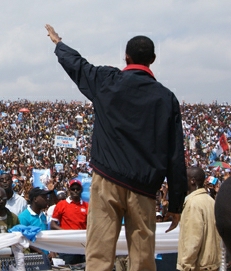
kame-in-campaign-gicumbi-smKigali – President Kagame stood Monday before tens of thousands in Gicumbi with just one simple message: that if his critics do not see the support he has, they can find another place to live.
“Give RPF another chance to develop the nation,” he said amidst wild cheering, on the latest leg of his campaign in Gicumbi, northern Rwanda.
“This is a struggle for democracy,” Kagame said, and put to question the authority of his fierce critics in the west who have recent raised concerns over Rwanda’s democratic credentials.
“Democracy is when people gathered in such a place to decide on their own what they want.
This is the time for Rwandans to make their choice and whoever is not interested may go and hang,” he fired as the crowd erupted in repeated chanting, dancing and drumming.
“When people choose what they want, that is democracy. When they reject negative forces and divisionism, that is democracy. When they choose the leadership they want that is democracy,” Kagame said. “Whoever does not like the Rwanda way of democracy should go and hang.”
President Kagame praised the attendance at today’s rally as a sign of support for the ruling Rwandan Patriotic Front’s policies.
“I am so happy you came in large numbers, which means you love your country and its prospects for democracy,” Kagame said. “Foreigners who write that there is no democracy in Rwanda should come and see.”
Enhanced by Zemanta