Africa Great Lakes Democracy Watch


Welcome to
Africa Great Lakes Democracy Watch Blog. Our objective is to promote the institutions of democracy,social justice,Human Rights,Peace, Freedom of Expression, and Respect to humanity in Rwanda,Uganda,DR Congo, Burundi,Sudan, Tanzania, Kenya,Ethiopia, and Somalia. We strongly believe that Africa will develop if only our presidents stop being rulers of men and become leaders of citizens. We support Breaking the Silence Campaign for DR Congo since we believe the democracy in Rwanda means peace in DRC. Follow this link to learn more about the origin of the war in both Rwanda and DR Congo:http://www.rwandadocumentsproject.net/gsdl/cgi-bin/library


Sunday, February 6, 2011

RPF REGIME IN A MASS VASECTOMY BID TARGETING THE POOR


Since yesterday, Rwanda is engaged in a countrywide local election process that is parading only the ruling party's followers as the opposition leaders are in maximum security prison for politically motivated charges. But many Rwandans plunged in chock and awe when the information about the governmental mass vasectomy bid targeting 700,000 people unfolded.

Millions of lives perished during the Tutsi genocide, war crimes and crimes against humanity committed in Rwanda and in the Congolese bushes; in the country more than 500,000 people are enslaved in Community services known as “TIG” far away from their families; over 100,000 Rwandans are detained in notorious overcrowded prisons; thousands of victims yield to death from Aids related deficiency and Malaria;

And Hon. Richard Sezibera, Health Minister revealed to the Senate (31.01) that his department expected 700,000 men to undergo vasectomy in a bid to curb the rapid growth of the population.

This is a shame indeed. About 50% of married men will “voluntarily” enrol for this non reversal process. This mass emasculation policy should stop with no further debates. The idea that those who can't afford to pay for their family needs must enrol in a draconian birth control system is nothing but pure discrimination against the poor. Birth control is an individual decision. In many countries economic development plays a major function in population reduction. We first need competitive economic policies and sound resource-management practices instead of mass vasectomy. Rwanda is now part of a wider economic market. In order to shift paradigms, we have to think wider enough.

FDU-INKINGI condemns this arrogant campaign of the ruling RPF. We call upon Rwandans, Human rights groups, non governmental organisations and the free civil society to stand up and say NO to this discrimination against the poor segments of the population.

Sylvain Sibomana
FDU-INKINGI
Interim Secretary General
Enhanced by Zemanta

Saturday, February 5, 2011

Philip Gourevitch, an Accessory to Mass Murder and Genocide in Central Africa?

Philip Gourevitch, award winning writer on Rwanda is on the defensive, peddling, spinning, attempting to find his way out of a web he’s woven around himself. One can’t tell right off the bat how he’s trapped himself or why he should feel the need to untangle himself.  But peddle he does, and spin he does as he defends himself against Tristan McConnell’s damning portrayal of his 15 year spin, excusing, justifying, and rationalizing crimes against humanity, oppressive dictatorship, and various other human rights violations committed by Kagame and the RPF/A.
It seems that Gourevitch found it inconvenient to acknowledge the acts of terrorism committed by Kagame and RPF/A, nor did he find it necessary to hold Kagame and the RPF/A responsible for it, as journalists so often do. And now he’s claiming, he’s not in Kagame’s pockets, peddling Kagame’s propaganda. Has he read his own work?
He did not find it convenient to inform the world, that Kagame and the RPF/A took up arms and killed and displaced Rwandan families for four years before the genocide or in what barbaric and heartless manner their deaths were carried out. Acknowledging that, and informing the world of such blasphemy would have thwarted his efforts of stigmatizing an entire group of people victimized by the same people he lauds, and would have meant that he would have had to report on the subsequent possible genocide that happened in the Congo. It was Philip Gourevitch who stigmatized aid organizations that provided aid to refugees in the Congo including food and water, after they survived Kagame’s terrorist organization’s (RPF) slaughter in Rwanda. Had Gourevitch had his way, the survivors of Kagame’s RPF’s slaughter, needed to have starved to death. How dare they retain life! And I’m not talking about the ostensible genocidaires (some of whom currently work for Kagame it turns out – Guest post coming soon!! ).
I suppose it is why Gourevitch found it satisfying that Kagame’s RPF followed them into the Congo, and slaughtered them. Why else would he have rationalized it, rather than calling international attention to it to be stopped? For Kagame to be deposed? But reporting on that, would have conflicted with the type of falsified image he was constructing, the one that elevated a terrorist organization to hero status, solidifying Kagame’s hold on the area, and on which Gourevitch has since benefited immensely both personally and professionally. And let me remind readers once again, that the slaughtered in the Congo, constituted majority women, children, and the elderly, according to the U.N.
In his response to Tristan, Gourevitch asserts that he reported on Kagame’s crimes. But rather, he defended Kagame with each key stroke, rationalized Kagame’s massive crimes against humanity, and defended Kagame’s rights to massively kill Rwandans and Congolese (reported by U.N. majority of whom were women, elderly, and childern), in the Congo. Even in his response to Tristan McConnell, Gourevitch attempts to minimize Kagame’s crimes, despite the overwhelming testimony and evidence, that Kagame has wrecked havoc in the Congo. Missing among the evidence and testimony, were Philip Gourevitch’s personal testimony of what he experienced on the ground, as he watched Kageme’s terrorist organization slaughter Rwandan refugees, and Congolese nationals while he dissuaded aid organizations from feeding them, exacerbating their demise. What he instead reported, was Kagame’s terrorist organization, exercise its justified right (according to Gourevitch and Kagame) to attack another country, and fight Kagame’s battles inside another country’s territory, and he was all too happy to report it, defend it, and inform the world about their organized and systemic killings, with a positive spin.
Can Philip Gourevitch effectively be considered an accessory to mass murder and genocide in Central Africa? How much damage has his award winning work done to the people of Central Africa? Is Philip Gourevitch truly interested in the people of Central Africa or his own prestige? If he is interested in the people, why does he continue to spin for Kagame, and to minimize Kagame’s crimes rather than facing them head on, and calling a spade a spade? Why does he resort to personal attacks of his critics, rather than their work? Why does he continue to undermine Kagame’s opposition and anyone who poses a real threat to not only Kagame’s falsified image (thanks Gourevitch!) but to Kagame’s power hold and an end to Kagame’s mass murder and impunity (thanks again Gourevitch!!)? And when will he finally, FINALLY, do the right thing, and put Kagame’s image, of which he is mostly responsible, in its proper context?
I wonder what Gourevitch was doing  between 1990 and 1994. Did he see Kagame’s RPF attack of a peaceful country as just another African tragic war that he did not need to get involved? Or did he not see a financial profitability opportunity? How would Gourevitch rationalize Kagame’s invasion of the Congo to the Congelese women and children? Would he convince them that they are genocidaires? Has Gourevitch come face to face with Kagame’s victims? Does he consider their stories to be unimportant enough to be told? Does he not wish to inform the world that their blight is important? That they matter? That Kagame should be brought to justice? What does Gourevitch say about the 6 million dead?
How much more will his upcoming book glorify Kagame at the expense of Central African people’s lives?
Enhanced by Zemanta

Friday, February 4, 2011

UN hires fugitive Karegeya to train Somali mercenaries


Karegeya is allegedly working with Gen Salim Saleh (right), the brother of Uganda President Yoweri Museveni
Kigali: RNA..The UN has given exiled ex-spy chief Patrick Karegeya a US$4million contract to train “mercenaries� for the embattled Somalian government – and Rwanda is furious, according to the latest revelations.
Karegeya is among the four former officers convicted by a military court last month for trying to destabilize Rwanda and ethnic divisionism. He is exiled in South Africa with ex-army chief Gen Kayumba Nyamwasa.

Now, details emerging suggest that Karegeya and Gen. Salim Saleh - the brother of Ugandan President Yoweri Museveni, have been granted a multi-million dollar contract to train a force in Somalia for the government.

The story goes that because the Somali Transitional Federal Government (TFG) cannot even protect itself from the many militant groups, it is – with help from the UN, seeking to have a private force to boost its military. Uganda has peacekeepers in Somalia helping the government – which only controls small parts of the capital Mogadishu.

The Independent, a Ugandan magazine, reports that Karegyeya’s proposal to the TFG and the UN is for a six months contract worth US$ 4 million. Karegyeya confirmed to the magazine that he indeed had been hired as a “consultant� but refuted the branding of the force as “mercenaries�.

“This was supposed to be a contract with private security firms that are working legally and above board, not a mercenary force,� he said. However, a mercenary force is defined as an army for hire. Therefore, any private security firm that provides soldiers on contract to a sovereign state is supplying mercenaries.

Karegyeya said The Independent has only ten percent truth. “These people gave me a contract to do consultancy for them for six months,� he said, “I told them that they need to train their own people by hiring private security firms. I then pulled out of the contract around the time Kayumba was shot because the government of Rwanda objected to my involvement. I even have a contract I signed with the ambassador in Nairobi and it does not provide for me supplying mercenaries.�

In Rwanda, government is said to be furious that the UN can indeed hire a person who is openly hostile to its government. Sources confirmed that the UN official based in Nairobi at the centre of this controversy is one Bruno Mpondo-Epo.

The Ministry of Foreign Affairs reportedly told Mpondo-Epo that they strongly objected to the UN paying for a mercenary army organised by a former security chief now turned dissident who is openly hostile to the government. They also expressed concerns that such an arrangement gives Karegyeya opportunity to train an army to destabilize Rwanda.

Rwandan ministry of Foreign Affairs officials were therefore shocked when the UN was willing to go ahead and grant Karegyeya the lucrative contract in the face of their objections, said The Independent.

Rwanda is said to be nervous that Karegeya could use the money from the contract to form a possible rebels group to fight Kigali. The revelations also come at a time when Rwanda, Burundi and DR Congo army chiefs said Karegeya and Kayumba had a new 200-strong rebel force in eastern Congo.

They have denied any such force exists.

Back to the alleged Somali mercenary force, the contract for Karegeya is renewable. The Independent says it has evidence of bank transfers by the TFG from the Commercial Bank of Africa in Nairobi to Karegyeya’s personal account in First National Bank, Sandton. The money was paid by the embassy of Somali Republic in Nairobi.

Karegyeya agreed to mobilise two companies in South Africa with “the required competences, skills and experience� and which had the willingness to undertake the task. He held meetings with them in Johannesburg and Pretoria. Later, a meeting was held in Centurion in Pretoria between representatives of the TFG and the UN which endorsed the proposal.
Enhanced by Zemanta

Thursday, February 3, 2011

Rwanda: Paul Kagame is a visionary leader who has ushered in development in Rwanda and should not be given allowance for genocide


In a press release dated 31/1/11 John Karuranga and the RPP-IMVURA political party make a moving and direct statement to Tony Blair for his December 2010 response to President Paul Kagames leadership of Rwanda and Blair’s assessment of the lives of African people.  In the 15 page document Mr. Karuranga states:
 “As a party, we do not have any confidence in Mr. Blair’s judgment and his AIG is bound to fail soon. His analysis of what HAS GONE WRONG in Africa is flawed. Africa, just like Iraq, which never had Weapons of Mass Destruction, does not have Weapons of Mass Incompetence. It is the tyrannical regimes like those of Mr. Kagame that have blighted Africa’s progress and the real culprits in our view are the foreign think tanks that are now prescribing medicines for African renaissance that will further impoverish Africa and put even more money into the pockets of their so-called service providers and even more into the coffers of corrupt African dictators. Mr. Blair’s agenda is furthering chaining the Rwandan people to a tyranny and making it impossible for Rwanda to recover as a nation and people and is unacceptable.”
He further states that he wishes to engage Mr. Blair in direct communications about the realities the world is not seeing about Rwanda:
“We also want to comment on Mr. Blair’s AIG. Much as we welcome his initiative, we think it is   too late because Mr. Blair had ten years in power in the UK and he could have used his influence and authority to encourage   good governance in Africa including Rwanda. But he did nothing and instead supported Mr. Kagame even when he was rigging elections and declaring a one party state. Secondarily, the AIG program doesn’t meet Rwanda’s specifications because of Rwanda’s social and economic situation. We believe that the AIG project should be reviewed to serve interests of the local people rather than serving the interests of the service providers.
The RPP-IMVURA describes what is needed to overcome the violent history and present state the Rwandan people are living in and how desperately change is needed.  In light of the situations of Tunisia and Egypt the people wanting change in Rwanda are fearful that the same fate is coming to Rwanda. Tony Blair and President Obama have the ability to effect change in this region but they first must accept the realities of those who live there. The dire conditions can no longer be ignored.
To read the full document, please click on the following link to the RPP-IMVURA website:
http://pdf.rwandapeopleparty.org/rppimvura_press_statement.pdf
By: Jennifer Fierberg, MSW
Enhanced by Zemanta

DRC: Mapping human rights violations 1993-2003

DRC: Mapping human rights violations 1993-2003

DRC: Mapping human rights violations 1993-2003In the wake of the discovery of three mass graves in the eastern part of the Democratic Republic of the Congo (DRC) in late 2005, the United Nations first announced its intention to send a human rights team to conduct a mapping exercise in DRC in a June 2006 report to the Security Council.

In May 2007, the UN Secretary-General approved the terms of reference of the mapping exercise following a series of consultations among relevant UN agencies and partners and with the Congolese government
The mapping exercise, led by the Office of the UN High Commissioner for Human Rights (OHCHR) had three objectives:
  • Conduct a mapping exercise of the most serious violations of human rights and international humanitarian law committed within the territory of the DRC between March 1993 and June 2003.
  • Assess the existing capacities within the national justice system to deal appropriately with such human rights violations that may be uncovered.
  • Formulate a series of options aimed at assisting the Government of the DRC in identifying appropriate transitional justice mechanisms to deal with the legacy of these violations, in terms of truth, justice, reparation and reform, taking into account ongoing efforts by the DRC authorities, as well as the support of the international community.
The mapping exercise began in July 2008. Between October 2008 and May 2009, a total of 33 staff worked on the project in the DRC (including Congolese and international human rights experts). Of these, some 20 human rights officers were deployed across the country, operating out of five field offices, to gather documents and information from witnesses to meet the three objectives defined in the terms of reference. The report was submitted to the High Commissioner for Human Rights in June 2009 for review, comments and finalisation.
The mapping team's 550-page report contains descriptions of 617 alleged violent incidents occurring in the DRC between March 1993 and June 2003. Each of these incidents points to the possible commission of gross violations of human rights and/or international humanitarian law. Each of the incidents listed is backed up by at least two independent sources identified in the report. As serious as they may be, uncorroborated incidents claimed by one single source are not included. Over 1,500 documents relating to human rights violations committed during this period were gathered and analysed with a view to establishing an initial chronology by region of the main violent incidents reported. Only incidents meeting a 'gravity threshold' set out in the methodology were considered. Field mapping teams met with over 1,280 witnesses to corroborate or invalidate the violations listed in the chronology. Information was also collected on previously undocumented crimes


.
Enhanced by Zemanta

Wednesday, February 2, 2011

Arrêt du jugement de l' Abbé Emile Nsengiyumva.

717 Arrêt du jugement de l' Abbé Emile Nsengiyumva

Arrêt du jugement de l' Abbé Emile Nsengiyumva.
La dictature Rwandaise détient le prêtre Emile Nsengiyumva sur seul crime d'avoir dénoncé la destruction des huttes des pauvres. Lisez l'arrêt d'une justice sous ordre.

ORDONNANCE NO 003/11/TB/NZG
0880451/S1/11/MS/GE

ORDONNANCE NO 003/11/TB/NZG DU 07/01/2011

EN CAUSE

DEMANDEUR
Ministère Public au niveau du Tribunal de Base de Nzige, représenté par les Officiers du Ministère Public MUKESHIMANA Ellen et GATERA Elie.

DEFENDEUR
Abbé NSENGIYUMVA Emile, fils de BAZAHICA Etienne et MUKANSHUTI Philomène, né le 15/08/1966, dans le secteur Kimisagara, District de Nyarugenge, Ville de Kigali, résident dans la zone de Feri, cellule Nyabubare, secteur Karenge, District Rwamagana, Province de l’Est, Rwandais, célibataire, prêtre.

PREVENTION 
Avoir, en dates des 19/12/2010 et 25/12/2010, en l’Eglise des secteurs Karenge et Nyakariro, District Rwamagana, Province de l’Est, en République du Rwanda, porté atteinte à la sûreté de l’Etat, infraction prévue et punie par l’article 166 du décret- loi no 21/77 du 18/08/1977 instituant le code pénal.

I.LES FAITS DE LA CAUSE
[1]L’officier du Ministère Public demande la détention provisoire de l’Abbé NSENGIYUMVA Emile poursuivi pour atteinte à la sûreté intérieure de l’Etat, infraction prévue et punie par l’article 166 du décret- loi no 21/77 du 18/08/1977 instituant le code pénal.

Des faits ont été commis les 19/12/2010 et le 25/12/2010 dans les secteurs Karenge et Nyakariro, lorsque l’Abbé NSENGIYUMVA Emile représentant la paroisse Karenge, a prononcé, au cours des différentes messes réunissant les chrétiens, les paroles exhortant les chrétiens à ne pas mettre en application le programme de l’Etat de limiter les naissances et celui de lutte pour l’éradication des maisons couvertes de paille, dit «Nyakatsi », et que ce qui détruisent ces maison sont des «ibigarasha» (des bons à rien).

[ 2]Parmi les indices sérieux de culpabilité sur lesquels se base le Ministère Public, il y a le fait que l’Abbé NSENGIYUMVA Emile reconnaît comme siennes les paroles prononcées au cours des différentes messes, confirmées par les différents témoins. Le tribunal va examiner si les indices soutenus par le Ministère Public sont sérieux et suffisants pour justifier la détention provisoire.

II. ANALYSE DES FAITS DE LA CAUSE
a)    Question de savoir si les propos tenus et avoués par l’Abbé NSENGIYUMVA Emile constituent des indices sérieux.

[3] Le Ministère Public a soutenu, à la page 20, que l’Abbé NSENGIYUMVA Emile a avoué avoir dit aux chrétiens venus à la messe de Noël qu’il désapprouve le comportement des chrétiens qui ont détruit les maisonnettes de leurs voisins, car ils ne sont pas des « Intore  »(Braves), mais plutôt des lâches;

[4] Au cours de l’audience publique, l’Abbé NSENGIYUMVA Emile n’a pas nié ces propos, au contraire il a affirmé qu’il appelle « ibigarasha »
( des bons à rien), les chrétiens qui ont osé détruire les maisons d’autrui. Il voulait simplement leur faire comprendre qu’ils doivent suivre la loi de l’amour [ du prochain ] et éviter d’être chrétiens seulement de nom.
[ 5 ] Le Ministère Public a dit que l’Abbé NSENGIYUMVA Emile a interdit aux chrétiens qui ont détruit les huttes de communier à la messe de Noël avant de se confesser (côte 21) ; pour l’accusation,  il voulait décourager le peuple et le rendre insoumis  au pouvoir.

[ 6 ] Pendant l’audience, l’Abbé NSENGIYUMVA Emile a dit qu’ il n’a fait que rappeler que, en tant que chrétiens, toute personne qui avait agi ainsi, ne pouvait pas aller à la communion sans d’abord se confesser ;

[ 7 ] Le Ministère Public a ajouté que l’Abbé NSENGIYUMVA Emile a appelé certains chrétiens dont les huttes ont été détruites pour qu’ils se mettent devant l’assemblée afin de raconter comment leurs huttes ont été détruites, et le Ministère Public considère qu’il s’agit là d’une manière de soulever la population contre les projets de l’Etat.

[ 8 ] Ici, l’Abbé NSENGIYUMVA Emile,  quant à lui, il a dit que quand il a demandé à ceux dont les biens ont été endommagés de se lever,  ne se sont justement présentés que les vieilles avec leurs enfants ; et que lui en tant que pasteur il parle pour eux, et il a ajouté qu’une coutume qui ne protège pas les personnes âgées et les enfants tombe en désuétude.
[ 9] Le Ministère Public a ajouté – voir côte 28- que l’Abbé NSENGIYUMVA Emile a avoué avoir critiqué, à l’Eglise, publiquement, les projets de l’Etat, ce qui signifie qu’il n’est pas d’accord avec la stratégie adoptée pour lutter  contre les maisons couvertes de paille. Il aurait dû approcher les autorités civiles et les consulter, en tant que citoyen qui aime sa patrie au lieu de blâmer les chrétiens qui ont mis à exécution ce projet.

[ 10 ] Ici, l’Abbé NSENGIYUMVA Emile a dit qu’il ne trouve pas de raison de d’abord consulter l’autorité  avant de s’adresser à ses ouailles.   
Toutefois, il a affirmé s’être adressé à certains responsables de cellule et de quartiers.

[ 11] Le Ministère Public a poursuivi en démontrant que – voir côte 18 et 19 – l’Abbé NSENGIYUMVA Emile a avoué avoir dit publiquement aux chrétiens que la limitation des naissances a de mauvaises conséquences sur leur vie propre, oubliant que la non limitation a des conséquences plus graves pour la famille et pour le pays.

[ 12 ] Ici, l’Abbé NSENGIYUMVA Emile s’est défendu en disant qu’ il fustige l’usage des médicaments pour réguler les naissances, car ces médicaments ont des conséquences néfastes surtout pour les femmes. Et d’ajouter que l’Eglise prône la méthode naturelle. Raison de plus,  il est membre du forum du secteur Karenge, un forum de sensibilisation pour la régulation des naissances, il ne peut donc pas être contre le programme de régulation des naissances.

[ 13 ] Le tribunal constate que l’Abbé NSENGIYUMVA Emile avoue judiciairement et publiquement qu’il a critiqué la manière de mise  à exécution du programme de lutte contre les maisons couvertes de paille. Il dit  que les chrétiens qui l’ont fait sont des déchets, et  avoue qu’il leur a interdit de communier dans cette messe de Noël.  Il  a demandé à ceux dont les maisons ont été détruites d’aller devant les autres et expliquer comment leurs maisons ont été détruites. Il a avoué avoir dit aux chrétiens que la prise des médicaments pour limiter les naissances a de mauvaises conséquences sur la vie des femmes. Tout ceci a été dit dans les messes des 18/12/2010 et 25/12/2010 en oubliant que la parole est prise pour la vérité et qu’il l’avait préparée comme l’affirme son Conseiller, Monsieur Karambizi Canisius. Tout ceci peut soulever la population et l’inciter à la désobéissance jusqu’au soulèvement pouvant compromettre la sécurité du pays.
Le tribunal trouve qu’il s’agit là d’indices sérieux de culpabilité contre l’Abbé NSENGIYUMVA Emile ; qu’il a commis l’infraction pour laquelle il est poursuivi sur base de l’article 95 de la loi no 12/2004 du 17/05/2004 portant code de procédure pénale telle que modifiée et complétée à ce jour.

[14] Sur le point de savoir si les témoignages de NZAGIRAMUNGU Célestin, UHORANINGOGA Fidèle, TWIZEYUMUKIZA Jean Bosco, KAMANZI Védaste et TWIZEYEMUNGU Donat doivent être considérés comme des indices sérieux.

[15] Parmi les indices sérieux avancés par le Ministère Public, on trouve ce témoignage de TWAGIRAMUNGU Célestin aux côtes 6 et 7 où il a expliqué que l’Abbé NSENGIYUMVA Emile a commencé en critiquant le fonctionnement des juridictions Gacaca et la mise en application du programme de lutte contre des maisons couvertes de paille, en ajoutant que les auteurs se sont entraînés dans Itorero (braves). Le témoin UHORANINGOGA Fidèle, côte 9 – explique que l’Abbé NSENGIYUMVA Emile a mis en avant les vieilles et a dit que le programme de lutte contre les maisons couvertes de paille n’est en rien différent de ce qui s’est passé en 1994 en voulant démontrer que rien n’a changé.  Le  témoin TWIZEYUMUKIZA Jean Bosco- côte 11 et 12 – a expliqué que l’Abbé NSENGIYUMVA Emile a dit qu’on ne peut pas défendre l’enfant et le vieillard qui ne respectent pas les droits de l’homme. Le témoignage de KAMANZI Védaste se trouve à la côte 13 ; il est Secrétaire Exécutif de la cellule  Nyamatete, et affirme que l’Abbé NSENGIYUMVA Emile a dit qu’on ne peut détruire la maison de Jésus à la campagne et revenir à l’Autel, que cette façon de dire les choses lie les autorités devant exécuter le programme de l’Etat. Le témoin TWIZEYIMANA Donat – côte 13 – affirme que l’Abbé NSENGIYUMVA Emile a dit : « D’où venons-nous ? Où allons –nous ? » ; Que s’il en était ainsi le peuple souhaiterait avoir une autre direction ayant une autre vision.
[16] Au cours de l’audience publique, l’Abbé NSENGIYUMVA Emile n’a pas nié les différents témoignages. Il s’est expliqué en disant que la coutume qui ne veille pas sur les intérêts des jeunes et des vieux n’a pas d’avenir ; il a demandé à ceux dont les maisons ont été détruites de se présenter, il a constaté que seuls les vieilles avec leurs enfants se sont présentés alors que ce sont ces mêmes personnes qu’il entend défende. Quant à la comparaison avec ce qui a été fait pendant le génocide et la lutte contre les maisons couvertes de paille et le mauvais fonctionnement des juridictions Gacaca, il a dit qu’il n’a fait que donner des exemples, entre autre exemple « détruis - toi même ta maison, et si tu ne veux pas, nous le faisons à ta place et tu payes le travail ainsi fait » ; il a dit que dans les juridictions Gacaca , on a constaté qu’il y a eu des gens poursuivis pour destruction  des biens, faire partie des assaillants et d’autres qui disaient qu’ils étaient mandatés par leurs compagnons pour aller tuer leurs voisins. Il a continué en expliquant que la mesure prise à l’encontre des chrétiens qui se sont livrés aux destructions des maisons couvertes de paille était une façon de leur rappeler en leur qualité  de chrétiens que celui qui se sent coupable ne peut pas communier ; qu’il a dit aux chrétiens que ceux qui ont commis pareils actes ne peuvent pas communier  avant de se confesser et que cela ne doit pas être considéré comme une punition faute de liste des auteurs.

[ 17 ] Le tribunal trouve que toutes ces paroles prononcées par l’Abbé NSENGIYUMVA Emile au cours de la messe de Noël du 25/12/2010 à l’Eglise de Nyakariro tel qu’expliqué par les témoins aux côtes 6, 7, 9, 11, 12, 13, 14 constituent les indices sérieux de culpabilité, surtout en ce qui concerne les témoignages concordants et les aveux comme expliqués ci- haut. Ainsi, avoir tenu pareils propos critiquant la mise en œuvre du programme de l’Etat de lutter contre les maisons couvertes de pailles,
en disant que ceux qui l’ont fait sont des déchets, en donnant des exemples comparant cette mise en application avec le génocide, en disant que cette coutume qui ne protège pas les enfants et les vieux ne respecte pas les droits de l’homme,  en empêchant de communier ceux qui ont mis à exécution le programme du gouvernement, en prononçant publiquement des paroles telles que « d’où venons- nous ? » , « où allons –nous ? »

[18] L’article 93 de la loi no 13/2004 du 17/05/2004 portant code de procédure pénale, telle que modifiée et complétée à ce jour, prévoit que « L’inculpé ne peut être mis en état de détention provisoire que s’il existe contre lui des indices sérieux de culpabilité et qu’en outre le fait parait constituer une infraction que la loi réprime d’une peine de deux ans d’emprisonnement au moins.

Et l’article 166 du décret-loi no 21/77 du 18/08/1977 instituant le code pénal prévoit que l’infraction pour laquelle il est poursuivi est punie d’un emprisonnement de deux à dix ans.

[19] En conséquence, le Tribunal considère que l’Abbé NSENGIYUMVA Emile doit être détenu préventivement.

III. DECISION DU TRIBUNAL
[20] Le tribunal décide la détention provisoire de l’Abbé NSENGIYUMVA Emile pendant trente jours (30 jours) à la prison de Nsinda.
Ainsi décidé et prononcé en audience publique du 07/01/2011.


Le Juge                                           Le Greffier
MUKARUREMA Justine                           NZATEGEREZA Léonard                              

Seeking Justice for the DRC Victims: UN Mapping Report of October 1, 2010

Seeking Justice for the Victims: UN Mapping Exercise Report of October 1, 2010 on the Democratic Republic of the Congo.

Dear _CONGRESSPERSON__________________

We the undersigned come to you with concerns over the stability, security, justice and peace in ...the Democratic Republic of the Congo (DRC) and the Great Lakes region in general. We want to call your attention to the recent UN mapping exercise report.
The United Nations High Commissioner for Human Rights’ Mapping Report, released on October 1, 2010, clearly exposes some of the most serious violations of human rights, international humanitarian law, war crimes and crimes against humanity in the DRC from March 1993 to June 2003. This report is not the first report that documents serious crimes in the Congo. These crimes were reported in the Previous UN reports of 2001, 2002, 2003, and 2008. The UN, human rights, humanitarian, advocacy organizations and investigative reporters have written extensively on some of the findings found in the mapping exercise report.
The evidence is overwhelming. The list of crimes is long. The crime scene is wide and every stone has yet to be turned. The raw data in the report describes the extent of the suffering, but does not match the tremendous human suffering of the victims and survivors.
The predominant appeal from the Congolese is the pursuit of Justice. Two hundred and twenty-five Congolese organizations have issued a call for justice based on the report.1 International NGOs have joined in this call for accountability, an end to the impunity and justice. Human Rights Watch says that “If followed up by strong action nationally and internationally, the report could make a critical contribution to ending impunity and breaking the cycle of violence in Congo and the wider Great Lakes region.”2 Justice and reconciliation is at the foundation of stability in the region. If justice is not delivered, there can be no lasting stability.

Unfortunately, very little has been done to stabilize the Congo and hold accountable Congo’s neighbors that have invaded and destabilized the Congo via support of proxy groups inside Congo. As recent as 2008, UN experts reported that “ It has found evidence that the Rwandan authorities have been complicit in the recruitment of soldiers, including children, have facilitated the supply of military equipment, and have sent officers and units from the Rwandan Defense Force (RDF) to the Democratic Republic of the Congo in support of CNDP.”3 Elements of the RDF still are embedded in the Congolese national army (FARDC) due to the integration of some of the rebel forces of the National Congress for the Defense of the People (CNDP). In addition, the Congolese leadership still has not done much to reform its national army, which also has been implicated in previous and the ongoing crimes.

In 2006, the US Congress passed S 2125, Public Law 109-456 which, stipulates in section 105 that “The Secretary of State is authorized to withhold assistance made available under the Foreign Assistance Act of 1961 (22 U.S.C. 2125 et seq.), other than humanitarian, peacekeeping, and counterterrorism assistance, for a foreign country if the Secretary determines that the government of the foreign country is taking actions to destabilize the Democratic Republic of the Congo.”4 Regrettably, this instrument which is at the disposal of the Secretary of State, who co-sponosored S.2125, has not been utilized. Meanwhile, countries such as Sweden and Netherlands who do not have such a law (PL 109-456) on their books have withheld aid from Rwanda in an attempt to hold that country’s leaders accountable for their destabilizing of the Congo and the Great Lakes Region. This year Congress passed, as part of the “Dodd-Frank Wall Street Reform and Consumer Protection Act” (Public Law 111-203), the Conflict Mineral Act (section 1502), which is meant to bring transparency in the international commerce of minerals from the conflict zone in the DRC. Opportunities exist in this law to hold Congo’s neighbors accountable, as they are key beneficiaries of conflict minerals.
Many instruments are at the disposal of the United States and the international community to address the instability in the Great Lakes region. The UN Mapping Exercise Report is one such tool and must not be overlooked and forgotten. Rather, it should be fully investigated with the intent of indicting and prosecuting anyone found to be responsible for any violation of international laws, humanitarian laws, war crimes, crimes against humanity, violence against women, sexual violence, violence against children, ethnic violence, looting of natural resources, and possibly crimes of genocide.
Aware of the weakness of the Congolese judicial system, the UN Mapping Exercise Report in sections III and IV discusses different ways to deliver justice, accountability, and stability for the victims and survivors. Human Rights Watch believes that a "mixed chamber"5 made of Congolese and international staff, African judges and prosecutors with relevant experience is one way to achieve justice for the victims. It is important to pay special attention to the option of transitional justice as well because Congo needs reconciliation for internal cohesion and healing which is a key factor to building a strong democracy rooted in the rule of law and human rights and unity for all.
We recommend that the United States government:
Leverage its position as the chair of the UN Security Council this month of December, to put The Mapping Exercise Report on the agenda.
Implement existing laws relative to Congo, namely the “Democratic Republic of the Congo Relief, Security, and Democracy Promotion Act of 2006”, public law 109-456, specifically appointing a special envoy to the Great Lakes region ( P.L 109-456, sect 207) and “Conflict mineral Act”, public law 111-203, section 1502.
Hold a hearing on the October 1, UN Mapping Exercise Report

Sincerely
Africa Faith and Justice Network
Friends of the Congo
Neema Corporation
Chicago Congo Coalition
Mennonite Central Committee U.S. Washington Office
Foundation for Freedom and Democracy in Rwanda

Enhanced by Zemanta

Tuesday, February 1, 2011

Hutu Prisoners Contribute More than 3Million USD to the Government Coffers

A Hutu Journalist Being Arrested in 2010
Kigali: The tens of thousand of prisoners in Rwanda’s jails added some Rwf 1.8Billion (Approx. US$3m) to the government coffers in the past year through different revenue generating activities, the National Prison Service said Monday.

This is one of the proofs why the Kagame government continues to keep thousands of Hutu refugees behind bars without due justice. They have been involved in different both pubic and private economic activities that benefit only the Tutsi community.

Commissioner General Mary Gahonzire said the prisoners cultivate their own food and have numerous livestock projects. The prisoners also offer professional services where revenues are shared between the prison service and the individuals.

The prisoners are providing most of what they need, said prison officials, allowing for Government to contribute a minimal percentage to maintaining convicts. 

The country’s 13 prisons house some 163,000 inmates majority of them are from Hutu tribes who have been jailed all these years without any justice or even meeting any judicial judge.
Enhanced by Zemanta

Kagame court again denies bail to Victoire Ingabire

On Jan. 20, Rwanda’s High Court once again rejected the bail appeal of Victoire Ingabire Umuhoza, chair of Rwanda’s FDU-Inkingi coalition of opposition parties.

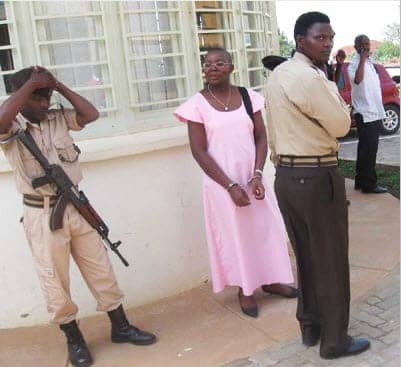
Opposition leader Victoire Ingabire Umuhoza is led from prison to court in handcuffs, wearing pink prison garb, with her head shaved by prison authorities

Her preventive detention order had expired during the Christmas holidays, but the judge ruled that her case had been transmitted to the court for the evidence stage thereafter. Ingabire remains in Kigali’s infamous 1930 maximum security prison. On Jan. 18, two days before the verdict, President Paul Kagame informed a press conference that Ingabire will face the laws up to the exhaustion of the process.
“Who is the judge strong enough to contradict him in Rwanda?” asked FDU’s spokesperson Sixbert Musangamfura, writing from exile in Finland. “Only God.”
Jan. 16 was the anniversary of Ingabire’s return to Rwanda to attempt to run for president against incumbent and staunch U.S. ally Paul Kagame. She was arrested in April and charged with “genocide ideology,” a speech crime unique to Rwanda, which means disagreeing with the received history of Rwanda’s epic 1994 massacres known as the Rwanda Genocide and/or disagreeing with the Rwandan government. She was then confined to Rwanda’s capital, Kigali, and her party was not allowed to register or register her candidacy. On Oct. 14, she was arrested again and she has remained incarcerated since.
Bernard Ntaganda, another Rwandan presidential candidate who might have had a chance to win had he been allowed to run, also remains in Kigali’s 1930 maximum security prison while a judge considers the prosecution’s plea that he be sentenced to more than 10 years in prison.
San Francisco writer Ann Garrison writes for the San Francisco Bay View, Global Research, Colored Opinions, Black Star News, the Newsline EA (East Africa) and her own blog, Ann Garrison, and produces for AfrobeatRadio on WBAI-NYC, Weekend News on KPFA and her own YouTube Channel, AnnieGetYourGang. She can be reached at ann@afrobeatcom. This story first appeared on Digital Journal.

Victoire Ingabire Umuhoza in Rwanda: Year one of the struggle for democracy and dignity

by Eugene Ndahayo, Chair of the Support Committee for FDU-Inkingi
Brussels – It’s already a year ago when Victoire Ingabire Umuhoza, chairperson of the United Democratic Forces, FDU-Inkingi, knelt down for the first time and kissed her homeland that she had left 16 years before.

It’s been a year of achievements, dedication and courage – a real struggle for democracy, for freedom, for the right to life and personal security, the right of association, freedom of expression, for political rights. The iron fist of the dictatorship has been challenged.
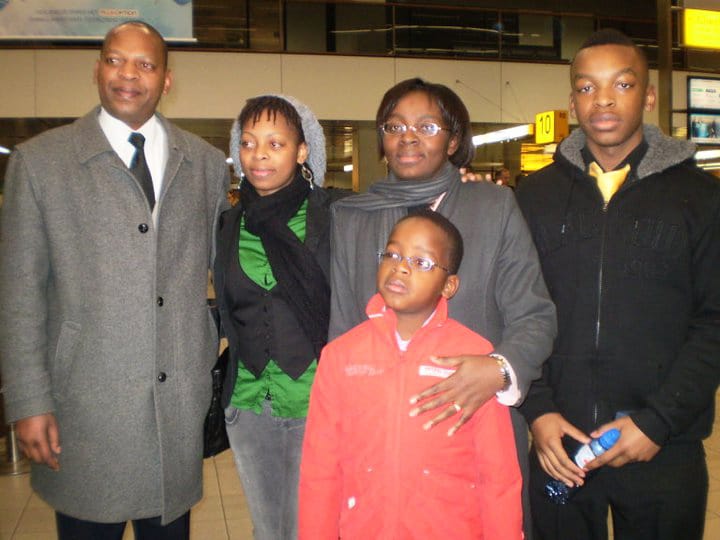
Victoire Ingabire Umuhoza, leader of Rwanda’s FDU-Inkingi coalition of opposition political parties, stands with her family prior to leaving Brussels for her return to Rwanda to run for president: from left, her husband, Lin Muyizere, their daughter, Raissa Ujeneza, Victoire, their younger son, Rist Shimwa, and their older son, Remy Ndizeye Niyigena


It’s been a year of solidarity with Rwandans in the country for the right of remembrance for all victims of the Rwandan genocide and other crimes against humanity, for all victims’ rights, for all the voiceless, for the rehabilitation of second class citizens. It’s been a real struggle for equal access, equal opportunities for all the children of our homeland.
It’s been a wrestling against an unfair justice that has deprived Rwandans of the right to a defense of one’s choice and the right to due process. The controversial “Gacaca” justice parody has thrown hundreds of thousands of litigants into humiliating community service with no hope of return.
It’s been a year of solidarity with the people of Congo (DRC) facing the consequences of military invasions responsible of over 5 million victims and the plundering of the country’s natural resources. Since 1990, the whole region has been engulfed in endless turmoil.
The Rwandan president, praised by some people and some partisan media to be a champion, a super star, a development success story, believed himself to be politically invincible.
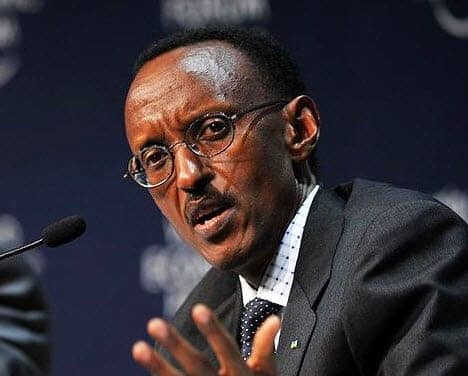
 Rwandan President Paul Kagame was sworn in for another seven-year term after the explosive Aug. 26 leak of a U.N. report documenting genocidal massacres of Rwandan Hutu refugees and Congolese Hutus by his army in the Democratic Republic of Congo

By her presence in Rwanda, Victoire Ingabire Umuhoza has brought to light the true dimensions of the dictatorship: a totalitarian regime monopolized by a handful of military and ethnocentric militants who, by the means of political police and a sprawling network of secret services, has an upper hand over all public institutions, the judicial and civil society.
In just one year, the regime has accumulated political errors and serious violations of human rights:
- Assassination of André Kagwa Rwisereka, deputy chair of the Democratic Green Party of Rwanda, on July 13, 2010

- Assassination of the journalist Jean-Léonard Rugambage, editor of Umuvugizi newspaper, on June 24, 2010 - An attempt against the life of Gen. Kayumba Nyamwasa on June 19, 2010
- Kidnapping and arrest of Deogratias Mushayidi, chair of PDP-Imanzi on March 3, 2010
- Arrest of Victoire Ingabire Umuhoza, chair of FDU-Inkingi on April 21, 2010; she was bailed out, placed under house arrest the next day and rearrested on Oct. 14, 2010
- Arrest of Professor Peter Erlinder, a U.S. attorney, defense lawyer for Victoire Ingabire Umuhoza, on June 17; he was bailed out after several weeks
- Arrest of Bernard Ntaganda, chair of PS-Imberakuri on June 24, 2010
- Arrest and detention of journalists Agnes Uwimana Nkusi and Saidati Mukakibibiof the Umurabyo newspaper, on July 8-10, 2010
- Arrest of a dozen of party leaders of FDU-Inkingi and PS-Imberakuri on June 24, 2010, who were then released on bail
- Arrest of Theogene Muhayeyezu, Rwandan lawyer for FDU-Inkingi, on June 24, 2010; he was released 15 days later
- Rigged presidential elections on Aug. 9, 2010, with total exclusion of the opposition
- Arrest of several high-ranking officers in the Rwandan Army: Gen. Charles Muhire, Maj. Gen. Karenzi Karake, Col. Rugigana Ngabo etc.
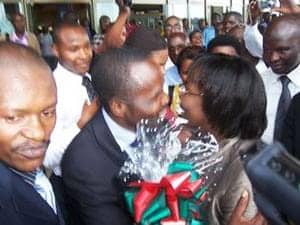
Bernard Ntaganda, founder and presidential candidate of Rwanda’s Parti Social-Imberakuri, greets Victoire at the Kigali Airport on her return to Rwanda Jan. 17, 2010. Rwandan police arrested him on June 24 after he called for a protest of the opposition’s exclusion from the election, saying, “Silence is acceptance.” 

- Publication on Oct. 1, 2010, of the U.N. Mapping Report on war crimes, crimes against humanity and a possible genocide committed in Congo mainly by the Rwandan army
Yes, in less than a year, the superstar Paul Kagame has faded from the limelight! The touted and self-portrayed “African new generation leader” is merely a tyrant to avoid.
His apologists are confused and on the brink of losing credibility. How do they justify the total sealing off of political space, assassinations, arbitrary arrests and detentions of democracy leaders? How do they explain the landslide Stalin-style election score of 93 percent?
And gradually the economic miracle of sustained growth is appearing to be the result of an unfortunate combination of a criminal economy, unbalanced, uneven and sorry. The Congolese blood minerals and other natural resources have contributed to the miracle. The gap caused by uneven national income distribution is very deep. According to the U.N. Development Program reports, 10 percent of Rwandans own over 50 percent of the national wealth, while 50 percent own less than 10 percent of the national wealth.
That is the record of a year of achievements of our chairperson, a record of FDU-Inkingi. Together with all our supporters, we are proud.
Our leader has been held in a maximum security prison since Oct. 14, 2010. We all keep in our minds her words, just a few days after she returned to our homeland:
“I believe in the political project that I share with my colleagues in this struggle, I love my country and all its inhabitants and I know I am not alone in this and Rwandans from all social classes, ethnic backgrounds and generations are with us. It is my source of strength and an oath that I would never betray. I will not waver in my dedication as I promised my colleagues and friends. I know and I have thoroughly thought about it, the regime may persecute me, imprison me. Let me say in conclusion that I am ready to face and endure all the difficulties and obstacles in my way until the final victory. And in case the regime attempts to take my life, I trust you shall continue from where I will fall.”
In prison, where she is incarcerated, the morale of our Chairperson Victoire Ingabire is high. She is free in her mind and soul. Not because of her innocence and belief that the justice system will set her free. No, she does not believe at all in the dictator’s justice. She saw how his judiciary works: trumped up accusations, fake witnesses, witness preparation and rehearsals, lack of independence, interference and orders taken from the State House.
No, she is simply strong because she is courageous and trusts that we shall empower the momentum of the wind of freedom and the seeds of democracy she already sowed.
It is the correctness of her political struggle that will set her free. It is the faith in our political project, it is our ability to organize, it is the strength and impact of our current and future political rationale and alliances that will set her free.
Thus, our determination, our consistency in the political struggle shall overcome the dictatorship and its international backers or lobbying organizations.
Together, we will set free the chairperson of FDU-Inkingi and, beyond that, we will set free our people.
To learn more, visit http://www.fdu-rwanda.org/and look for Victoire Ingabire Umuhoza and FDU-Inkingi on Facebook.
Enhanced by Zemanta