Africa Great Lakes Democracy Watch


Welcome to
Africa Great Lakes Democracy Watch Blog. Our objective is to promote the institutions of democracy,social justice,Human Rights,Peace, Freedom of Expression, and Respect to humanity in Rwanda,Uganda,DR Congo, Burundi,Sudan, Tanzania, Kenya,Ethiopia, and Somalia. We strongly believe that Africa will develop if only our presidents stop being rulers of men and become leaders of citizens. We support Breaking the Silence Campaign for DR Congo since we believe the democracy in Rwanda means peace in DRC. Follow this link to learn more about the origin of the war in both Rwanda and DR Congo:http://www.rwandadocumentsproject.net/gsdl/cgi-bin/library


Thursday, August 5, 2010

Pre-election attacks on Rwandan politicians and journalists condemned

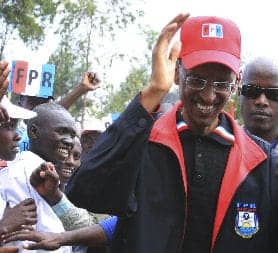
Paul Kagame, President and leader of the Rwandan Patriotic Front
© APGraphicsBank

5 August 2010
Amnesty International has condemned attacks on politicians and journalists in the run-up to the presidential election on August 9 and calls on the government to ensure the poll is held in an atmosphere where Rwandans can freely express their views.
 
The murder of a journalist and an opposition politician – both critical of the ruling Rwandan Patriotic Front (RPF) - in late June and mid-July has created a climate of repression likely to inhibit freedom of expression ahead of the vote, the organisation said.

“In recent months killings, arrests and the closure of newspapers and broadcasters has reinforced a climate of fear,” said Amnesty International’s Africa Programme Deputy Director, Tawanda Hondora. “The Rwandan government must ensure that investigations into the killings are thorough and reinstate closed media outlets.”

On 14 July, André Kagwa Rwisereka, the vice president of the opposition Democratic Green Party, was found dead in Butare, southern Rwanda. Amnesty International has obtained photographs that show that his head was severed from his body.
 
Rwisereka, who left the RPF to create the Green Party, had reportedly been concerned for his security in the weeks before his murder. Other Green Party members said they had also received threats .  

Investigations into Rwisereka’s death continue, but insufficient evidence has been gathered to press charges, according to the Prosecution.  

None of the main opposition parties are able to stand in Monday’s elections. The Democratic Green Party of Rwanda and FDU-Inkingi have been obstructed from holding the meetings required to register their parties.

The only new opposition party to secure registration – PS-Imberakuri – was unable to stand after the party’s leader, Bernard Ntaganda, was arrested on June 24. Ntaganda was charged with “genocide ideology” and “divisionism” under vague laws, ostensibly used to restrict hate speech, but often used to silence legitimate dissent.

Opposition leader, Victoire Ingabire, has still not been brought to trial on charges of “genocide ideology”, “minimising the genocide”, “divisionism” and “collaborating with a terrorist group” following her arrest in April. In May, the Prosecution said that investigations may take up to a year, ruling out a trial before the elections.

“Until an independent enquiry into Rwisereka’s murder reveals the true circumstances surrounding his death, Rwandans will fear that it was linked to his opposition activities,” said Tawanda Hondora. “They may be reluctant to express themselves as a result.”

Jean-Leonard Rugambage, a journalist working for the Umuvugizi newspaper, was shot dead on June 24 outside his home in the capital, Kigali.  Rugambage had been investigating the shooting in South Africa of the exiled former general, Kayumba Nyamwasa. On the day of his murder, Umuvugizi published a story alleging that Rwandan intelligence officials were linked to Nyamwasa’s shooting.  

Two suspects have been arrested for Rugambage’s murder and are currently awaiting trial.

Rwandan media critical of the government has effectively been dismantled in the run-up to elections. In late July, the Rwandan High Media Council, a regulatory body close to the ruling party, banned some 30 media outlets arguing they failed to adhere to a 2009 media law. The law restricts media freedom.

Agnes Nkusi Uwimana, the editor of the Urubayo newspaper, was arrested in July and charged with “genocide ideology”.  Two other newspaper editors fled Rwanda in recent months after their papers were suspended and they received repeated threats.

The United Nations, the European Union, the United States, France and Spain have already publicly expressed concerns about the deteriorating human rights situation in Rwanda ahead of the election. Amnesty International calls on other countries to also express their concerns.

“No country should be a silent witness to pre-electoral repression”, said Tawanda Hondora.  “Speaking out about violations is the best way to ensure that the next Rwandan administration respects human rights.”
Enhanced by Zemanta

The West should not be silent when efficient leaders, such as Rwanda’s, squash the opposition

Rwanda and other aid darlings

Efficiency versus freedom
THE differences between tiny Rwanda and the rest of Africa are immediately palpable even to the most casual visitor. The discarded plastic bottles and bags that pollute almost every other country on the continent are nowhere to be seen: the government has banned them. The tarred roads are usually in good shape; speed limits are actually enforced, by smart traffic police who fill out paperwork in exchange for a statutory fine rather than shaking you down for a bribe. Transparency International, an anti-corruption watchdog, rates Rwanda as one of the more honest countries in Africa. The World Bank says it is the fastest-improving as a place to do business. Hotels in the capital, Kigali, brim with Westerners attending conferences. Paul Kagame (above), the president who has overseen all this, is a darling of the aid-giving world. Western governments and prominent religious leaders have hailed him as the sort of man in whom to put their faith—and money.
Considering that Rwanda witnessed one of the most appalling waves of barbarity in history just 16 years ago, when around 800,000 people were hacked to death in three months, the efficiency is extraordinary. So much has gone admirably right in terms of development. But a lot is going depressingly wrong in politics. Mr Kagame has become more ruthless and authoritarian. In the run-up to the election on August 9th the opposition has suffered grievously. So where should the balance between development and freedom lie? Can democracy be shoved aside in the battle against poverty? And what should outsiders do to tilt the balance back?
The dilemma is not exclusive to Rwanda. The West has long sought leaders, such as Mr Kagame, who can be relied on to spend aid money well. Ethiopia’s Meles Zenawi, Uganda’s Yoweri Museveni and even, for a time, Nigeria’s Olusegun Obasanjo have been singled out for favoured treatment. Their countries have been graced with aid cash, debt forgiveness and political support. The West’s selective generosity has been prompted by various motives: guilt over past colonial wrongs; genuine altruism; and domestic self-interest that enabled left-of-centre parties to display their moral credentials abroad while reluctantly accepting the triumph of capitalism at home.
In Rwanda this has been taken to an extreme. Western guilt, which Mr Kagame has cleverly exploited, has been deeply felt. In 1994 the United States, the UN and Europe stood idly by as the genocide exploded. Since he took over a decade ago, Mr Kagame has happily presented himself as a development model for the whole continent, looking to Singapore rather than neighbouring Congo, a country far richer in resources whose people remain sunk in poverty as politicians feud and loot. In an effort to foster a sense of national unity and purpose, Mr Kagame has tried to abolish ethnic division between the Tutsi minority (to which he belongs) and the Hutu majority, whose members committed the genocide, by legislating their names out of the lexicon. Anyone challenging his “one Rwanda” policy, where Tutsis and Hutus no longer exist, can be jailed for “divisionism”.
The run-up to the election has been particularly ugly. The charge of divisionism has been used to swat criticism. Critical newspapers have been closed down, a reporter from one of them shot dead outside his home. Victoire Ingabire, head of an opposition party that has been barred from registering for the poll, has been charged with genocide denial and put under house arrest. Another opposition leader has been accused of terrorism. And the deputy head of a third party has been killed. The government denies involvement in all this and no solid evidence contradicts it (see article). But newspapers favouring Mr Kagame now describe his critics as “cockroaches” and “traitors”, the same insults that Hutu extremists used to egg on the massacre of Tutsis and moderate Hutus in 1994.

It mustn’t be either/or
Messrs Kagame, Meles and Museveni have all improved their countries’ lot. But election time invariably shows up the flaws in their model. All three leaders are growing more autocratic the longer they cling to office. The West has invested too much, financially and emotionally, in a select handful of charismatic aid darlings. Too often the aid lobbies have cheered them on, loth to acknowledge the flaws in people they need to prove that aid works. Too seldom has anybody promoted the more boring business of helping to build and reform institutions.
Withdrawing aid would be a blunt tool and, at any rate in the short run, would hamper the battle against poverty. But in the longer run, material development will suffer if authoritarian habits turn into tyranny. Those in the West who rightly praise Mr Kagame for his achievements in development must also loudly lambast him for his loathsome and needless tendency to intolerance.
Enhanced by Zemanta

Rwanda's Savior Has Become a Monster

Ruth Wedgwood

The Decapitated Body of the Rwandan Opposition Leader
If you’re a betting person, here’s a safe bet: On August 9, the balloting in the east African state of Rwanda will give world-famous military leader Paul Kagame yet another seven-year term as president. The astonishing margin of victory will impress even the modern grand viziers of Central Asia. The outcome is quite easy to predict, when no other candidates are allowed to campaign.

Given this and much else besides, it’s time Washington began to create some distance from a man who has earned his reputation as a de facto despot who terrorizes critics and does not shrink from political violence.
Kagame revels in his fame as the strategist who led a Tutsi invasion force from Uganda in 1994, pushing back the Hutu army and Hutu militia, though not before they perpetrated a shocking genocidal slaughter of hundreds of thousands of the country’s Tutsi minority, as well as moderate Hutu. Washington, reeling from Somalia and fearing another Black Hawk Down, refused to intervene. Madeline Albright was directed to inform the U.N. Security Council that, no, we would not reconstitute the U.N. peacekeeping force in Rwanda, and, further, the United States would veto any resolution that authorized other countries to do so. It was the season of peacekeeping misadventures, and the Clinton White House decided, as one former National Security Council official recalls, that it could not afford to intervene both in Haiti and Rwanda. Presidential Decision Directive 25, drafted by Richard Clarke as a white paper for peacekeeping, morphed into an excuse to “just say no.”

For the last 15 years, Kagame has at every turn invoked these memories to shoehorn the West into a nearly reflexive support for his government. Even Bill Clinton came back to apologize. Kagame has become a fixture at the United Nations in New York, regaling delegations in the Indonesian Lounge, extolling his vision of benevolent autocracy, claiming to admire Singapore as his model for economic growth and insisting that he and only he can keep Rwanda’s torn society knitted together.
In truth, the Rwandan leader presides over nothing more than hollow democracy. He has attacked and exiled any and all viable political opponents. The local press, as well as international journalists, have been bludgeoned and harassed. The regime uses the Stalinist crime of “divisionism” as a pretext to silence and prosecute any critic who dares question its policies or the state sanctioned version of the 1994 conflict.
Unsurprisingly, the intimidation extends to international institutions. President Clinton supported the effort to create an international war crimes tribunal to mete out justice for perpetrators and victims alike. The U.N. court was tasked to investigate the behavior of both sides in the 1994 conflict, operating from a neutral perch in Tanzania. Prosecutors decided first to take on the crimes of the prior Hutu government and militia, since the scale of its violence was larger and the cooperation of Kigali was necessary to obtain witnesses from Rwanda. A decade later, with numerous convictions under its belt and dozens of Hutu defendants still on trial, the U.N. tribunal turned to smaller-scale allegations against the Tutsi invasion force, Kagame’s Rwandan Patriotic Front—including alleged massacres of civilians in the northeast and northwest of the country, as well as attacks on mostly Hutu refugee camps.

At this point, the Bush Administration decided, unwisely, to pull the plug—repudiating the Hague prosecutor who planned to bring the cases, and insisting that the RPF cases could be entrusted to Kagame’s national courts as part of a “completion strategy.” Needless to say, that was the last of the investigations.
This was unfortunate, and not just for history’s sake. The West’s failure to address Tutsi violations of the laws of war has allowed Kagame to conclude, justifiably, that he can do nearly anything with impunity.

He certainly hasn’t been intimidated by the observation of the U.N. Human Rights Committee in May 2009 that it was “concerned at the large number of persons, including women and children, reported to have been killed from 1994 onwards in the course of operations by the Rwanda Patriotic Army, and at the limited number of cases reported to have resulted in prosecution and punishment by the Rwandan courts.”
Nor has there been any penalty for Kagame's destructive expedition into the Eastern Congo. The cross-border intervention gave the regime access to minerals ripe for extraction and valued in the hundreds of millions of dollars. Millions of civilians have been killed in the Eastern Congo conflict, and while Kagame was not the only culprit, his troops hardly quelled the violence.

At the same time, Kagame’s domestic critics have met with unfortunate fates. An outspoken political rival was recently shot and wounded in South Africa. A prominent newspaper editor was gunned down at the end of June, and the deputy president of the Democratic Green party was decapitated in July. Public meetings of rival parties have been banned. Kagame felt audacious enough to jail and threaten a 10-20 year sentence against an American lawyer and law professor–-who hails from former Supreme Court Chief Justice Warren Burger’s alma mater in Minnesota—when he went to Rwanda to consult with one of Kagame’s political rivals.
Other smash-mouth ironies abound in this muzzled state. In 2007, President Kagame offered to contribute 3000 Rwandan troops to the peacekeeping force in Darfur, but only if his former chief of military intelligence, Emmanuel Karenzi Karake, was brought on as deputy U.N. force commander for the entire mission. Though Karake’s earlier career was dogged by unresolved allegations of atrocities against civilians in the northwest and northeast regions of Rwanda, the State Department’s Africa desk reportedly vouched for Karake and he got his appointment. In the middle of the mission, a Spanish court indicted Karake for war crimes, and still, he was reappointed to a second term. (Karake has now apparently broken with Kagame; he was arrested in April on "serious charges of immoral conduct.")

Even Rwanda’s celebrated “gacaca” process—sending accused genocidaires to be tried and sentenced in local settings, rather than molder without trial in inconceivably overcrowded prisons—has not lived up to its reputation. The U.N. Human Rights Committee recently noted the “lack of legal training for judges and reports of corruption” in the Gacaca courts—along with impairment of “the rights of defence” even “in cases where sentences of up to 30 years’ imprisonment may be handed down.”

In promoting humanitarian and democratic ends abroad, the Obama administration initially got off to a slow start. The ideals of Eleanor Roosevelt took a back seat to the desire to be “not Bush.”
But the record has lately improved. With this new moral realism, the Obama team ought to take a close and critical look at its erstwhile friend in Africa. He is not what he seems.
Ruth Wedgwood is a visiting fellow at the Hoover Institution and a professor of international law at the Johns Hopkins School of Advanced International Studies.

Rwandan Celebs Meddy and The Ben Escaped the Country

image
L-R : Meddy ; The BenLocal celebs: Meddy, The Ben go missing
By Linda Mbabazi

LOCAL artists and Salax Award winners, Meddy and The Ben have reportedly escaped the country for greener pastures overseas.
Meddy (Medard Ngabo) and The Ben (Ben Mugisha) left the country for the United States of America on July 2, after being invited by the Rwandan International Network Association. They were expected to return on July 28.  
According to an email from Fidelis Mironko, the 1st Secretary at the Rwandan Embassy in Washington, the duo dissappeared after the RINA event, in the US capital.
“The President of RINA (Yohani Kayinamura) initially told me that they (singers) went to Boston to pursue a record deal and that they would return home after. I asked to contact them directly but was told that they don’t have any phones,” the email reads in part, “Right now I’m working with some Rwandans in Boston to see if they can get the singers’ contacts. So far nothing has materialized yet but will continue to find ways to contact them.”
It’s apparent that the singers, who wish to seek fortune abroad, have sank into hot water, because Interpol in collaboration with the Rwandan Embassy in Washington, are busy looking for them, and promised to deport them as soon as they are found. They are both believed to have crossed to Canada.
As their local fans and artists become disillusioned, Lauren Thecle Makuza, the Advisor to the Minister of Sports and Culture has debunked, saying that the singers’ illegal act will not stop the Ministry from supporting local artists, but will instead become more vigilant to this cause. 
“We’re really disappointed with those two artists,” Makuza said. “They had created a name for themselves in the country’s music industry and had earned massive fan bases, then why escape…?”

"We should also not ignore the current concerns of the insecurity many people in Rwanda want to escape the country because living in Rwanda now is like living in a burning hell. These artists are not escaping Rwanda for little concerns but the whole broad issue of less freedom of expression and darker days they  predict. I managed to speak to some other Rwandans in the country are expressing the same concerns because majority of able Rwandans are freeing the country to the neighboring countries such as Uganda,Kenya, and Tanzania.  Instead of interpol rushing to hunt them and deport them back to that country where people have been being butchered day and night and others are in the house arrest they should allow them time to express their fears.
Ends
Enhanced by Zemanta

Rwandan President Vows to Crush Troublemakers Ahead of Monday's Vote

President Paul Kagame of RwandaImage via Wikipedia
Exiled newspaper editor Jean Bosco Gasasira says President Kagame has decided to silence all independent voices.

Rwandan President Paul Kagame has warned that he will crush any attempt to destabilize his regime with just three more days before Monday's presidential election.
The president was responding to his former intelligence chief Patrick Karegeya who earlier this week called for an uprising against Mr. Kagame.
Jean Bosco Gasasira, the exiled editor of the Umuvugizi newspaper in Rwanda said he’s not surprised at the turn of events in Rwanda ahead of Monday’s vote. “This is not a surprise of a person like President Kagame who has proved to be a dictator and who has opted to silence all independent voices in Rwanda. President Kagame in this same year, in front of the parliament, said he was going to use a Hammer to kill a fly. What he was meaning was killing [the] opposition,” he said.
Gasasira said former Rwandan intelligence chief Patrick Karegeya’s call for an uprising against President Kagame is proof that the Rwandan leader is losing support among his once trusted allies.
“I told you this that Patrick Karegeya was once a part of Kagame; he was his advisor. But [the] time has come whereby people who are independent are now seeing Kagame as someone impossible, and they are now crossing to another part. That’s why you see he [Kagame] is not going to tolerate them; he is not going to tolerate generals; he is not going to tolerate bishops; he can’t tolerate Human Rights Watch; he can’t tolerate anyone, even to an extent of shooting journalists to death because of an article,” Gasasira said.
A number of senior army officers have been arrested in recent months. One of them, Faustin Kayumba Nyamwash, narrowly survived an assassination attempt in South Africa in June.
Opposition leader Victoire Ingabire, who is under house arrest and banned from participating in Monday’s election, Wednesday accused the international community of turning a blind eye to the crisis in Rwanda.
Gasasira said Ingabire was right in her criticism of the international community.
“Definitely what the opposition candidate is saying is correct because the U.N. secretary-general was saying he needs more investigation. But we as Rwandans are asking ourselves, what sort of investigation does he need? The journalist was shot dead, killed in cold blood; the way he arrested a U.S. lawyer accusing him of genocide ideology. Unfortunately he is doing this when the biggest donors like U.K., like U.S., like Netherlands and most especially the European Union when all those voices are quiet. For sure we are asking what is behind this because people are dying,” Gasasira said.
Rwanda’s Media High Council earlier this year suspended Umuvugizi and Umuseso for six months on the grounds the two weekly newspapers violated Rwanda’s media laws and incited public order.
In June Umuvugizi deputy editor Jean-Leonard Rugambage was shot and killed outside his home in Kigali.
Last week the same Media High Council banned some 30 media organizations for not complying with the council’s rules.


Enhanced by Zemanta

Wednesday, August 4, 2010

Paul Kagamé promet "la guerre à ceux qui veulent la guerre"

L’atmosphère entourant la campagne présidentielle devient chaque jour plus pesante. Suite à l’appel au soulèvement émis par le colonel en exil Patrick Karegeya, le président rwandais Paul Kagamé a fermement mis en garde contre toute tentative de déstabilisation. 
Paul Kagamé menace. « Ceux qui veulent la guerre, ils auront la guerre. Et ils le regretteront », a-t-il prévenu, lors d'un meeting mardi près de Kigali pour la campagne de la présidentielle du 9 août.
Paul Kagamé faisait apparemment référence à des déclarations du colonel Patrick Karegeya, ex-chef des services de renseignements extérieurs aujourd'hui en exil, qui, dans un article du bi-hebdomadaire ougandais The Observer paru la veille, avait appelé les Rwandais à se « soulever » contre la « dictature » de Kagamé.
« Personne ne viendra sauver les Rwandais de la dictature de Kagamé, et il n'est plus temps de se croiser les mains », a déclaré Karegeya. « De toute évidence, certains y perdront leur vie mais ceux qui mourront auront perdu leur vie pour une juste cause, et je suis prêt à soutenir les Rwandais qui veulent combattre la dictature de Paul Kagamé », a-t-il ajouté.
« Cet appel est une déclaration criminelle qui ne peut pas être prise à la légère », a réagi dans la presse le porte-parole de l'armée rwandaise, le colonel Jill Rutaremara. « Rien ne permettra [à M. Karegeya, NDLR] de couvrir ses crimes et de stopper le cours de la justice », a-t-il renchéri.
Compagnons de lutte
Le colonel Karegeya est un ancien compagnon de lutte de Paul Kagamé au sein du Front patriotique rwandais (FPR). Tout puissant chef des services de renseignements extérieurs, cet officier de haut rang a fui le Rwanda en 2007 et trouvé refuge en Afrique du Sud, où s'est également exilé depuis mars l'ancien chef d'état-major de l'armée, le général Faustin Kayumba Nyamwasa.
Celui-ci a été victime le 19 juin d'une tentative de meurtre devant son domicile de Johannesburg, pour laquelle l'Afrique du Sud a mis en cause des « agents » agissant pour un « pays étranger », sans autre précision. Kigali a démenti toute implication.
« Karegeya, comme son complice fugitif Kayumba Nyamwasa, est un criminel qui a choisi la voie de la violence et qui est réclamé par la justice de son pays (...) », a accusé le porte-parole de l'armée. (Avec AFP)
 
Enhanced by Zemanta

Funny Rwandan Politicians-Mushikiwabo now blames diaspora foes for killing critics

Rwanda believes foreign-based opposition behind deaths * Says negative press risks overshadowing true story * Proactive PR strategy essential, foreign minister says By Peter Apps, Political Risk Correspondent LONDON Aug 4 (Reuters) - Foreign-based dissidents trying to damage Rwanda's reputation may be behind recent killings of opposition and media figures that sparked worldwide criticism, its foreign minister said on Wednesday. Human rights groups and others accuse President Paul Kagame of clamping down on dissent ahead of an August general election. They also point to the closure of two newspapers, the arrest of activists and the fact some opposition parties are barred from running. That has the potential to worry foreign investors who have been increasingly attracted to Rwanda in recent years, drawn by potential growth in agriculture, infrastructure, solar, gas and hydropower generation as well as services and technology. Two high profile killings of a journalist critical of the government and an opposition leader as well as the shooting of a dissident general in South Africa drew global media attention. "It is unfortunate because it is not the real story of Rwanda," Foreign Minister Louise Mushikiwabo told Reuters on a visit to London. "We believe it is simply to do with the election. It will go away after the election. It is not a long-term problem," she said in an interview arranged by a Western public relations firm hired to burnish the central African state's image. Asked who might be behind the killings and other isolated acts of violence, Mushikiwabo said they were still being investigated but pointed to rogue elements abroad possibly linked to the 1994 genocide. "I think it's mainly outside the country," she said. "There are people who have fallen out with the government and have their own agenda. There is a diaspora element -- some of them involved in the genocide." Rwanda's genocide experience, in which politicians and broadcasters whipped up tensions leading to mass slaughter, meant it had to be particularly careful with what it allowed media outlets and others to do, she said. LOOKING EAST, HIRING PR FIRM "We cannot allow the media or others to encourage violence," she said. "But our security and intelligence agencies are very good and very much on top of the problem." Rwanda has been heavily dependent on Western and multilateral aid that until last year made up more than 50 percent of its budget. This had come down to 40 percent in the upcoming financial year as new investments came in. These included Chinese and Korean projects as well as hotel projects with Dubai's troubled state-linked Dubai World, which had been scaled back in the last year. Mushikiwabo said there were no signs yet of Western countries cutting aid commitments to Rwanda because of financial difficulties at home, but she was keenly aware of the shift in power to emerging nations. Rwanda was opening embassies in Singapore, Abu Dhabi and elsewhere and doubling its New Delhi diplomatic staff. "There's no doubt the money is in the East," she said. "It's a new challenge and one we have to adapt to. It's totally different to five years ago." But Rwanda also takes its reputation in Western capitals very seriously. Like several other nations, it has contracted a Western PR consultancy to help. The interview in London was offered up swiftly after a story on rule of law in Rwanda that made reference to investor concerns [ID:nLDE66R14A]. "I think it's necessary to do business these days," said Mushikiwabo, who herself once worked in the PR industry. "But we have a saying: "just because a woman wears make-up doesn't mean that she wasn't good-looking to begin with"." (editing by Paul Taylor)

Dutch government helping Kagame rig election?


by H. Vincent Harris
Paul Kagame

Dutch Foreign Affairs Minister Maxime Verhagen recently answered questions (Google translated) in Parliament concerning Rwanda’s election. (These answers were published online in Dutch on July 30, 2010.) The rush transcript shows that the Dutch government refutes claims by the Rwandan opposition parties of Victoire Ingabire Umuhoza, Frank Habineza and Bernard Ntaganda that the process so far has been rigged and since July the Dutch government is apparently co-presiding over the Rwandan National Electoral Commission.
The translated answer by Maxime Verhagen which specifically refutes an important claim by the Permanent Consultative Council of Opposition Parties states:
“The claim of the PCC that the independence of the National Electoral Commission (NEC) would only be guaranteed through the participation of opposition is not shared by me. The PCC ‘falls over’ the fact that the chairman of the NEC is a member of the RPF [Rwandan Patriotic Front, Kagame's army and party]. Neutrality, however, is effectively monitored by the co-chair, a donor (The Netherlands). The Netherlands since July 2010 as acting co-chairman of the NEC is co-responsible for setting the agenda and for bringing specific topics to the table. The NEC is directly involved in the process for the adjustment of the electoral law and also responsible for the electoral process. The NEC shall also ensure fairness of the campaign, for example, by checking that the media focus on the current four candidates is distributed evenly. The registration of the presidential candidates was also done at the NEC.”
On Frank Habineza, Maxime Verhagen states that the Rwandan Green Party (my translation) “wanted to participate without fulfilling all conditions, which is participating without holding a founding meeting. This is considered contrary to the Rwandan Constitution.”
That statement totally ignores the fact that the Rwandan government has made it impossible, through Kafkaesque measures, for the Green Party to hold such a meeting.
The fact that the Dutch government is now a member of the Rwandan NEC merits serious discussion. Has anyone in the world ever seen a foreign government be part of a National Electoral Commission?
To learn how Kagame rigged the 2003 elections, read here.
H. Vincent Harris lives in Belgium, where he explores the impact of migrants on democratic development both at home and abroad at Colored Opinions, where the initial version of this story first appeared.
Enhanced by Zemanta

KENYA REFORMISTS SCORE A RARE AFRICAN POLITICAL VICTORY; HOW, AND WHY?

By Charles Onyango Obbo
Daily Nation Photo
It is shortly after 2 am in Nairobi, and it is time to call the referendum for the “Yes” (Green) side in the referendum that took place yesterday. The “Yes” side has 4,112,900 (66.8%)and the “No” side has 2,040,700 (33.2%). There are just under 3m votes to be announced, and even if the “No” side took 75% of it, it will not overturn the result.
So President Mwai Kibaki and Prime Minister Raila Odinga, who were leading the “Yes” side can turn off the lights, kiss their wives goodbye, and wake up to take a sweet victory to the bank.
The new Kenya constitution has the most progressive bill of rights in Africa, a notch better than even South Africa’s. But the referendum outcome is significant for greater reasons in Africa.
In December 2002, Kenya became the country – and so far only – country in the wider Eastern Africa in which an opposition defeated a ruling party at democratic elections.
The constitution change today represents the FIRST TIME that a group of reformists have actually managed this kind of reform through a civil political process. Everywhere else in Africa, radicals and reformists (and I use these words cautiously here) have only changed constitution after they seized power through a military coup (Jerry Rawlings in Ghana, Thomas Sankara in Bourkina Faso, etc), or through an armed rebellion (Yoweri Museveni in Uganda, the ANC in South Africa, SWAPO in Namibia, Meles Zenawi in Ethiopia, the list is endless).
The question is why Kenya? That is a story I will venture to tell another day, but you clever Facebookers are welcome to take a stab at it.

Enhanced by Zemanta

STATEMENT TO RWANDANS BY FORMER PRIME MINISTER TWAGIRAMUNGU

Dear compatriots,
You read several press releases that I recently issued as well as other communications in English, French and Kinyarwanda languages by which I urged Rwandans of the voting age to boycott the August 9, 2010 presidential elections in Rwanda .
This is an important call upon you by all lovers of democracy with the objective to show to General Paul Kagame that we can no longer tolerate his criminal authoritarian regime. Abstention from voting remains the only efficient means by peaceful citizens to reject the candidate of the Rwandan Patriotic Front (RPF).

We shall abstain from voting to demonstrate to the World our rejection of a dictatorial regime that denies us all freedoms in our country. Contrary to RPF’s methods, we shall not resort to violence, destruction or murder. Our unchanging claim is that we need democracy; we refuse persecution, arbitrary detention, torture and murder at our gate.

The strongest reason why we shall abstain from August 9 election is that we got to the point where we are just fed up with a notoriously criminal President who is seeking to be forcibly renewed in his functions. Definitely General Kagame’s re-election means the status quo where opposition is pushed aside and even assassinated as is currently the case in Rwanda . General Kagame is well aware that he cannot stand in front of Rwandans and say he has clean hands: he knows better than whoever that his hands are blood-maculated as evidenced below:

General Kagame confessed to have assassinated two Presidents: Juvenal Habyarimana of Rwanda and Cyprian Ntaryamira of Burundi. The current President of Rwanda is quoted as explaining to journalist Stephen Sackur of BBC during HARD TALK SHOW on December 7, 2006 why he [General Kagame] had killed Habyarimana : “[LAUGHING] but of course Habyarimana, having been on the other side that I was fighting, it was possible that he could easily die”. [End of quotation].

There is overwhelming evidence that it is General Kagame who assassinated flagship leaders who were seen as the hope of Rwanda : Mr. Félicien Gatabazi, Mr. Emmanuel Gapyisi and Mr. Seth Sendashonga. Those prominent politicians were followed by many other victims of Kagame’s cruelty including Colonel Augustine Cyiza, Dr. Léonard Hitimana and Mr. Assiel Kabera.

General Kagame is proud of his criminal assaults against innocent civilians as this is frequently noted in his speech. Addressing the Rwandan Parliament, General Kagame said: “Whatever I promise I deliver. I promised to repatriate refugees from Congo and I dit it. Those who refused to return, I shelled them and killed them.” Still, before the Parliament, General Kagame was full of praise about himself saying how he would use, if necessary, a hummer to kill a fly. We cannot forget President Kagame promising, while in a meeting in Bwisige in 2003, to “grind some people like maize”, meaning he would kill them. To demonstrate his “milling capacity”, President Paul Kagame killed the above mentioned Colonel Cyiza and Dr. Hitimana.

Also to demonstrate he can kill flies, he sent his death squads in South Africa to hound and assassinate General Faustin Kayumba Nyamwasa. The latter survived the attack, which is not the case for journalist Jean-Léonard Rugambage and the Vice-President of the Democratic Green Party of Rwanda Andrew Kagwa Rwisereka. Diversion by General Kagame and his Foreign Affairs Minister Louise Mushikiwabo to deny responsibility in the above mentioned murders and assassination attempt cannot work against damning evidences.

Apart from the many crimes committed against Rwandans and Westerners following which he is now under two international arrest warrants, General Kagame does not deserve re-election because of war crimes and looting he committed against the neighboring Democratic Republic of Congo for his personal gains. He is seeking re-election in order to enjoy eternally presidential immunity.

We have no reason why to re-elect General Kagame on August 9, 2010 because:

a) He does not guarantee people’s security nor peace of mind. With Kagame, there is no hope for tomorrow.

b) Kagame proved incompetent as regards to solving Rwandan refugee problem. He seems to ignore the same refugee problem was the origin of the 1990 RPF war that culminated in the 1994 genocide in Rwanda . Instead, Kagame is forcing more and more Rwandans to exile.

c) General Kagame will not end the ethnic conflict in Rwanda as he continues to exacerbate it under false pretention that he stopped “the genocide of the Tutsi” while he is dehuminizing the Hutu.

As long as we are not allowed to live peacefully in our country, President Kagame’s claims that he has brougth development progress will be meangless. Dictatorship cannot be conducive to progress while citizens live in permanent fear. We prefer to be poor and free than rich under the captivity of a notorious killer. Such richness is anyway doomed and leads only to destruction.

Rwandans cannot afford to trade all the lives that were sacrificed on different altars (in Rwanda as well as in the rainy forestes of the DRC) for electricity, computers, methane gas, Coltan and mansions in Kigali . There is nothing worth all the sacrifices we have made, and we did not make them to turn ourselves stateless, live in conflicts and lose our freedoms. We did not fight previous dictatorships and make sacrifices to put in place Kagame’s harsher dictatorship. Our claim is clear and irrevocable: Modern Leadership, Social cohesion and freedoms in our country Rwanda .

Dear compatriots,

This is time join hands and speak up, without fear, against the criminal ruler who is seeking re-election in Rwanda .

Signed in Brussels , on July 30, 2010

Faustin Twagiramungu

Former Prime Minister of Rwanda

Candidate at 2003 Presidential Election

Tel: 0032 473 210 512 begin_of_the_skype_highlighting              0032 473 210 512      end_of_the_skype_highlighting