By
It might seem a bit surprising to see Samantha Power on the National Security Council and working with Secretary of State Hillary Clinton, who Power famously called a “monster” during the 2008 presidential campaign. But this was a heat-of-battle bit of name-calling, not a designation based on any difference in outlook. Both women are hardliners, along with their colleague Susan Rice, and the three together have constituted a regrettable women’s caucus in favor of a military solution to the conflict in Libya.
In her 2002 book A Problem From Hell: America and the Age of Genocide, Power called for greater U.S. intervention to prevent major human rights violations and genocide. She never suggests that this might require LESS intervention (e.g., Vietnam; the “sanctions of mass destruction” in Iraq) or reduced support for killers (e.g., Guatemala, El Salvador, Chile, Israel). She also finds that we inappropriately “just stood by” and failed to intervene in cases where we actually gave positive support to the mass murderers (e.g., Indonesia in East Timor; Kagame and Musaveni in Rwanda and the Congo)
But while ignoring U.S. and client state bloodbaths Power did focus with great passion on genocides or alleged genocides carried out by U.S. targets. This huge bias carried her to the Carr Center for Human Rights and a professorship at Harvard, a Pulitzer Prize, generous media access, and now to a high level position in the administration of the Nobel Peace Prize president. It all fits!
For more information see the following piece, an excerpt of an article which originally appeared ZNET
The cruise missile left also adheres closely to the party line on genocide, which is why its members thrive in the New York Times and other establishment vehicles. This is true of Paul Berman, Michael Ignatieff and David Rieff, but I will focus here on Power, who is currently the expert of choice on the subject in the mainstream media (and even in The Nation and on the Bill Moyers show).
Power never departs from the selectivity dictated by the establishment party line. That requires, first and foremost, simply ignoring cases of direct U.S. or U.S.-sponsored (or otherwise approved) genocide. Thus the Vietnam War, in which millions were directly killed by U.S. forces, does not show up in Power’s index or text. Guatemala, where there was a mass killing of as many as 100,000 Mayan Indians between 1978 and 1985, in what Amnesty International called “A Government Program of Political Murder,” but by a government installed and supported by the United States, also does not show up in Power’s index. Cambodia is of course included, but only for the second phase of the genocide—the first phase, from 1969-1975, in which the United States dropped some 500,000 tons of bombs on the Cambodian countryside and killed vast numbers, she fails to mention. On the Khmer Rouge genocide, Power says they killed 2 million, a figure widely cited after Jean Lacouture gave that number; his subsequent admission that this number was invented had no effect on its use, and it suits Power’s purpose.
A major U.S.-encouraged and supported genocide occurred in Indonesia in 1965-66 in which over 700,000 people were murdered. This genocide is not mentioned by Power and the names Indonesia and Suharto do not appear in her index. She also fails to mention West Papua, where Indonesia’s 40 years of murderous occupation would constitute genocide under her criteria, if carried out under different auspices. Power does refer to East Timor, with extreme brevity, saying that, “In 1975, when its ally, the oil-producing, anti-Communist Indonesia, invaded East Timor, killing between 100,000 and 200,000 civilians, the United States looked away” (146-7). That exhausts her treatment of the subject, although the killings in East Timor involved a larger fraction of the population than in Cambodia, and the numbers killed were probably larger than the grand total for Bosnia and Kosovo, to which she devotes a large fraction of her book. She also misrepresents the U.S. role—it did not “look away,” it gave its approval, protected the aggression from any effective UN response (in his autobiography, then U.S. Ambassador to the UN Daniel Patrick Moynihan bragged about his effectiveness in protecting Indonesia from any UN action), and greatly increased its arms aid to Indonesia, thereby facilitating the genocide.
Power engages in a similar suppression and failure to recognize the U.S. role in her treatment of genocide in Iraq. She attends carefully and at length to Saddam Hussein’s use of chemical warfare and killing of Kurds at Halabja and elsewhere, and she does discuss the U.S. failure to oppose and take any action against Saddam Hussein at this juncture. But she does not mention the diplomatic rapprochement with Saddam in the midst of his war with Iran in 1983, the active U.S. logistical support of Saddam during that war, and the U.S. approval of sales and transfers of chemical and biological weapons during the period in which he was using chemical weapons against the Kurds. She also doesn’t mention the active efforts by the United States and Britain to block UN actions that might have obstructed Saddam’s killings.
The killing of over a million Iraqis via the “sanctions of mass destruction,” more than were killed by all the weapons of mass destruction in history, according to John and Karl Mueller (“Sanctions of Mass Destruction,” Foreign Affairs, May/June 1999), was one of major genocides of the post-World War 2 era. It is unmentioned by Power. Again, the correlation between exclusion, U.S. responsibility, and the view that such killings were, in Madeleine Albright’s words, “worth it” from the standpoint of U.S. interests, is clear. There is a similar political basis for Power’s failure to include Israel’s low-intensity genocide of the Palestinians and South Africa’s “destructive engagement” with the frontline states in the 1980s, the latter with a death toll greatly exceeding all the deaths in the Balkan wars of the 1990s. Neither Israel nor South Africa, both “constructively engaged” by the United States, show up in Power’s index.
Power’s conclusion is that the U.S. policy toward genocide has been very imperfect and needs reorientation, less opportunism, and greater vigor. For Power, the United States is the solution, not the problem. These conclusions and policy recommendations rest heavily on her spectacular bias in case selection: She simply bypasses those that are ideologically inconvenient, where the United States has arguably committed genocide (Vietnam, Cambodia 1969-75, Iraq 1991-2003), or has given genocidal processes positive support (Indonesia, West Papua, East Timor, Guatemala, Israel, and South Africa). Incorporating them into an analysis would lead to sharply different conclusions and policy agendas, such as calling upon the United States to simply stop doing it, or urging stronger global opposition to U.S. aggression and support of genocide, and proposing a much needed revolutionary change within the United States to remove the roots of its imperialistic and genocidal thrust. But the actual huge bias, nicely leavened by admissions of imperfections and need for improvement in U.S. policy, readily explains why Power is loved by the New York Times and won a Pulitzer prize for her masterpiece of evasion and apologetics for “our” genocides and call for a more aggressive pursuit of “theirs.”
Edward Herman is professor emeritus of finance at the Wharton School, University of Pennsylvania. He’s written on economics, political economy, foreign policy, and media analysis in such books as The Myth of the Liberal Media: An Edward Herman Reader and Manufacturing Consent (with Noam Chomsky).

Showing posts with label EDWARD S HERMON. Show all posts
Showing posts with label EDWARD S HERMON. Show all posts
Friday, June 10, 2011

Wednesday, April 27, 2011
The Politics of Genocide How Victims of the Rwandan Become Guilty
Noam Chomsky Edward S. Herman
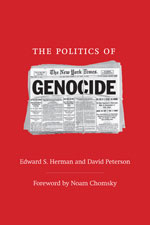
In this impressive book, Edward S. Herman and David Peterson examine the uses and abuses of the word “genocide.” They argue persuasively that the label is highly politicized and that in the United States it is used by the government, journalists, and academics to brand as evil those nations and political movements that in one way or another interfere with the imperial interests of U.S. capitalism. Thus the word “genocide” is seldom applied when the perpetrators are U.S. allies (or even the United States itself), while it is used almost indiscriminately when murders are committed or are alleged to have been committed by enemies of the United States and U.S. business interests. One set of rules applies to cases such as U.S. aggression in Vietnam, Israeli oppression of Palestinians, Indonesian slaughter of so-called communists and the people of East Timor, U.S. bombings in Serbia and Kosovo, the U.S. war of “liberation” in Iraq, and mass murders committed by U.S. allies in Rwanda and the Republic of Congo. Another set applies to cases such as Serbian aggression in Kosovo and Bosnia, killings carried out by U.S. enemies in Rwanda and Darfur, Saddam Hussein, any and all actions by Iran, and a host of others.
With its careful and voluminous documentation, close reading of the U.S. media and political and scholarly writing on the subject, and clear and incisive charts, The Politics of Genocide is both a damning condemnation and stunning exposé of a deeply rooted and effective system of propaganda aimed at deceiving the population while promoting the expansion of a cruel and heartless imperial system.In this brilliant exposé of great power’s lethal industry of lies, Edward Herman and David Peterson defend the right of us all to a truthful historical memory.
Why so much talk in recent years about ‘genocide’ as a major threat? Perhaps because, while extremely rare, genocide represents an intentional evil in comparison to which the far more frequent massacres committed by ‘our’ side fade into innocent blunders. Herman and Peterson describe the double standards used to distinguish evil ‘genocide’ from the slaughter wrought by the United States and its allies as mere collateral damage.
Destined to become a grim classic, The Politics of Genocide is an antidote to the stultifying doublethink of U.S. news media. The authors document a baseline of purposed journalism so subservient to power that it has routinely perpetuated ‘the normalization of anything the U.S. government chose to do in the realm of foreign policy, regardless of its brutality and criminality.’ Concise and devastating, this book turns the media wallpaper inside-out, debunking the most sacred conceits while showing us the intellectual and moral rot of Washington’s political structures. Herman and Peterson will make readers yearn for a political culture that embraces a single standard of human rights instead of selectively wielding such words as ‘massacre’ and ‘genocide.’ In the end, we’re left with an enhanced understanding of what ‘responsibility to protect’ really means—and how far we have to go before the lofty rhetoric of U.S. foreign policy resembles its realities.
The authors brilliantly expose the policy of double standards that is at the root of the ‘politics of genocide.’ The well-documented case studies reveal the largely hypocritical nature of today’s establishment discourse on global justice. The book is a must-read for today’s self-declared ‘humanitarian’ intellectuals who are blind vis-à-vis a political agenda that has corrupted the project of international criminal justice.
The Politics of Genocide presents careful research to dismantle the hideous notion that there are worthy and unworthy victims of genocide. The authors help us understand how U.S. ‘exceptionalism’ has brutally and lethally punished people. This book will help readers stop accepting what Dorothy Day referred to as ‘this filthy, rotten system.
Herman and Peterson convincingly demonstrate the U.S./NATO imperial designs lurking behind claims of ‘humanitarian intervention;’ the selective prosecutions carried out by all international criminal tribunals to date; and the calculated use of emotionally-laden accusations of ‘genocide.’ At a deeper level, this book presents a challenge to Western media and human rights activists to recognize the ‘impunity for the powerful’ regime that they have assisted in creating, through uncritical acceptance of the ‘human rights’ narrative promulgated by U.S. foreign-policy elites. It is an enormous contribution to the ongoing foreign policy/human rights discussion.
Edward Herman and David Peterson are genuine independent thinkers, who relentlessly expose unwanted realities behind some of the largest atrocities of our times. They dissect the shameful distortions behind the favored narratives about massacres, ranging from the infamous to those scarcely known to the outside world. Their work is a valuable corrective to the ideologically sanitized output of those who manipulate genocide and its variants to serve the interests of power.
A riveting and penetrating study of how genocide is invented and manipulated by the state-media nexus. Decisively exposes the yawning gap between Washington’s rhetoric and practice. Cuts through the minefields of shibboleths and propaganda. Meticulously researched and documented, The Politics of Genocide stands to endure as a classic.
Though an impassioned and modern lexicon centered on accusations of genocide, massacres, and human rights abuses has become the lingua franca of the U.S. political and media elite, David Peterson and Edward Herman forcefully debunk any notion that such word-mongering signals an actual shift in Washington’s imperial agenda. Rather, in their clearly argued and carefully delivered blow against establishment double standards in portraying ‘their’ versus ‘our’ atrocities, the authors systematically unmask the government and media’s supposedly newfound humanitarian concerns as new bottles for old wine. In doing so, The Politics of Genocide lucidly exposes those who exploit the victims of atrocities everywhere for U.S. reasons of state—regrettably, no small category. It deserves to be widely read.
Why so much talk in recent years about ‘genocide’ as a major threat? Perhaps because, while extremely rare, genocide represents an intentional evil in comparison to which the far more frequent massacres committed by ‘our’ side fade into innocent blunders. Herman and Peterson describe the double standards used to distinguish evil ‘genocide’ from the slaughter wrought by the United States and its allies as mere collateral damage.
Destined to become a grim classic, The Politics of Genocide is an antidote to the stultifying doublethink of U.S. news media. The authors document a baseline of purposed journalism so subservient to power that it has routinely perpetuated ‘the normalization of anything the U.S. government chose to do in the realm of foreign policy, regardless of its brutality and criminality.’ Concise and devastating, this book turns the media wallpaper inside-out, debunking the most sacred conceits while showing us the intellectual and moral rot of Washington’s political structures. Herman and Peterson will make readers yearn for a political culture that embraces a single standard of human rights instead of selectively wielding such words as ‘massacre’ and ‘genocide.’ In the end, we’re left with an enhanced understanding of what ‘responsibility to protect’ really means—and how far we have to go before the lofty rhetoric of U.S. foreign policy resembles its realities.
The authors brilliantly expose the policy of double standards that is at the root of the ‘politics of genocide.’ The well-documented case studies reveal the largely hypocritical nature of today’s establishment discourse on global justice. The book is a must-read for today’s self-declared ‘humanitarian’ intellectuals who are blind vis-à-vis a political agenda that has corrupted the project of international criminal justice.
The Politics of Genocide presents careful research to dismantle the hideous notion that there are worthy and unworthy victims of genocide. The authors help us understand how U.S. ‘exceptionalism’ has brutally and lethally punished people. This book will help readers stop accepting what Dorothy Day referred to as ‘this filthy, rotten system.
Herman and Peterson convincingly demonstrate the U.S./NATO imperial designs lurking behind claims of ‘humanitarian intervention;’ the selective prosecutions carried out by all international criminal tribunals to date; and the calculated use of emotionally-laden accusations of ‘genocide.’ At a deeper level, this book presents a challenge to Western media and human rights activists to recognize the ‘impunity for the powerful’ regime that they have assisted in creating, through uncritical acceptance of the ‘human rights’ narrative promulgated by U.S. foreign-policy elites. It is an enormous contribution to the ongoing foreign policy/human rights discussion.
Edward Herman and David Peterson are genuine independent thinkers, who relentlessly expose unwanted realities behind some of the largest atrocities of our times. They dissect the shameful distortions behind the favored narratives about massacres, ranging from the infamous to those scarcely known to the outside world. Their work is a valuable corrective to the ideologically sanitized output of those who manipulate genocide and its variants to serve the interests of power.
A riveting and penetrating study of how genocide is invented and manipulated by the state-media nexus. Decisively exposes the yawning gap between Washington’s rhetoric and practice. Cuts through the minefields of shibboleths and propaganda. Meticulously researched and documented, The Politics of Genocide stands to endure as a classic.
Though an impassioned and modern lexicon centered on accusations of genocide, massacres, and human rights abuses has become the lingua franca of the U.S. political and media elite, David Peterson and Edward Herman forcefully debunk any notion that such word-mongering signals an actual shift in Washington’s imperial agenda. Rather, in their clearly argued and carefully delivered blow against establishment double standards in portraying ‘their’ versus ‘our’ atrocities, the authors systematically unmask the government and media’s supposedly newfound humanitarian concerns as new bottles for old wine. In doing so, The Politics of Genocide lucidly exposes those who exploit the victims of atrocities everywhere for U.S. reasons of state—regrettably, no small category. It deserves to be widely read.

Subscribe to:
Posts (Atom)