Africa Great Lakes Democracy Watch


Welcome to
Africa Great Lakes Democracy Watch Blog. Our objective is to promote the institutions of democracy,social justice,Human Rights,Peace, Freedom of Expression, and Respect to humanity in Rwanda,Uganda,DR Congo, Burundi,Sudan, Tanzania, Kenya,Ethiopia, and Somalia. We strongly believe that Africa will develop if only our presidents stop being rulers of men and become leaders of citizens. We support Breaking the Silence Campaign for DR Congo since we believe the democracy in Rwanda means peace in DRC. Follow this link to learn more about the origin of the war in both Rwanda and DR Congo:http://www.rwandadocumentsproject.net/gsdl/cgi-bin/library


Showing posts with label africa democracy. Show all posts

Sunday, September 5, 2010

Burundi Arbitrarily Imprisons Editor on Treason Charge

Jean-Claude Kavumbagu, editor of the online newspaper Net Press

Burundi Arbitrarily Imprisons Editor on Treason Charge

“We call for his release and the withdrawal of the charges against him” - Reporters Without Borders
Jean-Claude Kavumbagu, editor of the online newspaper Net Press

(PORTLAND, Ore.) - Reporters Without Borders (RSF) calls for the immediate release of Jean-Claude Kavumbagu, editor of the online newspaper Net Press, Kavumbagu has been detained since July 17on the charge of treason.
RSF told Salem-news.com “Kavumbagu has been unjustly held for the past six weeks pending trial on a treason charge that is baseless. Pre-trial detention is supposed to be an exception. He should not be in detention when his trial starts. We urge the judges to reach an equitable decision”.
Kavumbagu published an article July 12 about the possibility of Burundi being the next target for a terrorist attack by the Somali Islamist group Al-Shabaab. Link to the article He was then arrested while on his way to work on 17 July.
After being questioned for two hours, he was placed in detention in Bujumbura’s Mpimba prison. He was questioned again several day later, and again reprimanded to prison.
Kavumbagu never received a summons to appear in the deputy prosecutor’s office for an investigation, he was also not given an opportunity to be accompanied by a lawyer during his first interrogation. Kavumbagu is being held on a charge of treason, if convicted he could be sentenced to life imprisonment.

“This is the fifth time he has been arrested in 14 years of working as a journalist. There is absolutely no justification for the charge in the offending article, which just raises what could be a real problem for Burundi.” RSF told Salem-News.com.
Kavumbagu’s lawyer, Gabriel Sinarinzi, told RSF: “What he is alleged to have done does not constitute an act of treason. According to article 570 of the criminal code, an act of treason can only be committed in war time and Burundi is not at war.” Sinarinzi added: “Our client’s arrest and placement in provisional detention are arbitrary and illegal measures that violate the rules of criminal procedure. Provisional detention is meant to be used above all to prevent any disturbance of public order. But there have been no security incidents since the article’s publication that could justify such a summary arrest.”
September 2008, Kavumbagu was jailed on a charge of defaming the president, he spent six months in prison before being acquitted March 2009.
Kavumbagu appeared in court yesterday, for a hearing on the legality of his imprisonment, the court said it would issue its ruling tomorrow.
“We call for his release and the withdrawal of the charges against him,” RSF demanded.
________________________
Alysha Atma spends many hours working on projects that support and benefit the beleaguered people of African nations who spend way too much time off the western media's radar. This writer explains that she is a culmination of all her experiences, most importantly knowledge she says, and all that she still needs to learn; lessons of love, laughter and the extraordinary giving of both young and old. She says she has the enormous fortune of learning from the best; every person around her, and the amazing strength and fortitude of those she has never met but will always strive to listen to. "I continue to work and write because I believe in the power of community and the power of one, both contradictory to each other and yet can move together in a very powerful way. I feel a responsibility to use my place, freedoms and connections here in the US to stand up and yell for those who need my voice and actions. I have seen such strength in my fellow humans that I cannot even begin to comprehend, they have traveled distances, have gone without food, water, shelter and safety for days and weeks at a time. I have a responsibility as a fellow human to put our common humanity before anything else. Everyone deserves to look towards tomorrow, to dream of a safe future and to have a peaceful present." You can write to Alysha Atma at: alysha.atma@gmail.com
*Source: Reporters without Borders

Saturday, September 4, 2010

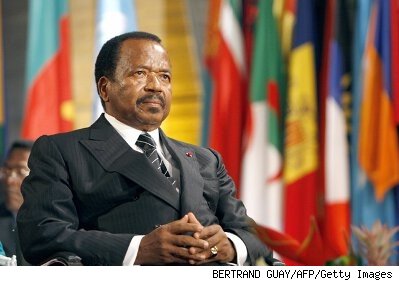
Biya, Cameroon’s President since 1982, fires security chiefs, following rumours of foiled coup


Guay-afp-getty

Biya, Cameroon’s President since 1982, fires security chiefs, following rumours of foiled coup
Special to USAfrica, USAfricaonline.com and CLASSmagazine, Houston
Following rumours of a foiled, attempted military coup in the west African country of Cameroon, its long ruling President Paul Biya has sacked a top police chief and the head of internal security in decrees issued by the presidency.
Paul-Biya-president-cameroon-
USAfricaonline.com notes that Biya who rose as a technocrat in Cameroon’s bureaucracy was born Paul Barthélemy Biya’a bi Mvondo on February 13, 1933, and has remained the maximum ruler via controversial elections since November 6, 1982. The country has, since 1958, been dominated by two individuals: the man who picked Biya, former President Ahmadu Ahidjo, a French-speaking Muslim and Biya, an English-speaking Christian.
In terms of prominent personnel changes, Biya picked Martin Mbarga Nguele as the new police chief, replacing Emmanuel Edou, who got the top cop post in July 2009.
Eko Eko Leopold Maxine  is the new head of Cameroon’s DGRE intelligence agency, following the firing of the controversial agent  Jean Marie Obelabout. Jean ordered the arrest and torture (at DGRE headquarters) of a Cameroon journalist Bibi Ngota who later died in a Yaounde prison almost 5 months ago in April 2010.
The opposition parties have made strong calls for free and fair elections, transparency and press freedom. By Chido Nwangwu, USAfricaonline.com
Popularity: 5% [?]

Monday, August 2, 2010

Colonialism and the 'scramble for Africa'

By Catriona Davies, for CNN
STORY HIGHLIGHTS
  • Africa was carved up among several European countries at the Berlin Conference in 1884-5
  • It emerged then that Africa had mineral and agricultural wealth available for exploitation
  • Historian Gareth Austin said colonies were cheap for British and French taxpayers
Editor's note: This year 17 African nations mark 50 years of independence from their former colonial rulers. Eight of those countries celebrate their anniversary in August, they include Benin, Ivory Coast and Gabon. CNN.com is marking this major milestone with special coverage in August looking at the continent's past, present and future.
(CNN) -- The wave of Independence across Africa in the 1950s and 1960s brought to the end around 75 years of colonial rule by Britain, France, Belgium, Spain, Portugal and -- until World War I -- Germany.
Before 1880, Europeans had only made small incursions into Africa, with forts and trading posts mainly around the coast, according to Richard Dowden, director of the Royal African Society in Britain.
The interior until then remained largely inaccessible to Europeans because of disease and difficulty of travel.
"Then the new unified Germany began to flex its muscles. It saw Britain and France ruling the world and wanted to compete for its 'place in the sun'. Its explorers were beginning to penetrate the continent," Dowden told CNN.
When the explorer Henry Morton Stanley -- who had already rescued David Livingstone -- set out on another rescue mission, King Leopold of Belgium asked him to claim land along the Congo River for Belgium.

 
Nations marking 50 years of independence
"This was a vast grab from little old Belgium, which upset Britain and France," said Dowden. "Britain already had India and didn't really want Africa too, but felt they should have it if everyone else was."
In 1884-5, the Berlin Conference was called to carve up Africa between Britain, France, Belgium, Spain, Portugal and Germany.
"They didn't want to be seen to be fighting amongst themselves, because then Africans would realize that white men could be killed," said Dowden. "Instead they drew lines on a map of places they had never been to, with no regards for existing kingdoms, geography or the people that lived there.
"They believed they were bringing civilization to 'savage people'. They introduced Christianity, trade, education, justice and a good deal of looting and forced labor."
It was beginning to emerge that Africa had mineral and agricultural wealth, which the Europeans were keen to exploit.
Because India had fought for its independence, Africa wanted to fight too.
--Richard Dowden, Royal African Society director

RELATED TOPICS
  • Africa
  • World War I
  • Sudan
Another justification among the European powers was to 'liberate' Africans from Arab slave traders, who had continued to operate after slavery was abolished in Europe.
The Europeans met little resistance from Africans once their vast military might -- including newly-developed machine guns - became clear.
Dowden said that in a single day's battle for Sudan, 10,800 Sudanese were killed, compared with 48 British soldiers.
Over the decades that followed, each colonial power ruled in its own style.
Dr. Gareth Austin, a historian at the London School of Economics, pointed out that colonies were intended to be cheap for British and French taxpayers and in many cases collected more in taxes from the colonies than they spent.
"The British doctrine was that each colony should be fiscally self-supporting. Thus, any growth in government expenditure was supposed to be financed from higher revenues," he wrote in his article African Economic Development and Colonial Legacies, in the journal Revue Internationale de Politique de Développement.
He added that surpluses made by West African farmers were held in forced savings in British government bonds, helping the British economy to recover from its post-war shortages.
Dowden said France believed in the "Frenchification" of Africa and invested in instilling its language and culture into the people.
African leaders were able to become government ministers representing their colonies in France.
"This would have been unthinkable in Britain, who did not want to mix with Africans," said Dowden. "Britain used indirect rule to control people through their own tribal leaders. They were amazingly brutal in putting down any rebellion."
Dr. Austin said that, despite these differences, there were more similarities than differences in styles of colonial rule.
After WWI, Germany's colonies were divided between Britain and France to administer on behalf of the League of Nations.
The end of colonialism came about after India's independence from Britain.
"Because India had fought for its independence, Africa wanted to fight too," said Dowden. "Britain was completely broke after World War II and couldn't invest in its colonies. It found it easier to walk away than to start wars all over Africa to hold on to them," he added.
"In contrast with the start of colonization, independence was mostly non-violent, with some exceptions," Dowden continued. "France also gave independence to its colonies but only on its own terms, with French troops and administrators remaining in place for many years.
"Portugal resisted independence and kept its colonies until much later."

Thursday, July 29, 2010

Will Obama Administration Screw Africa, Like All The Rest?

President ObamaImage by Wondermonkey2k via Flickr
Policy Adrift As Administration Sides With Africa's Enemies--The Corrupt Leaders
Black Star editorial calls upon Obama Administration not to screw Africa and to redeem Africa policy

There comes a moment in a lifetime when one has an opportunity to break with the bad old ways in order to open a great new future.
That moment is still at hand for President Barack Obama with respect to U.S. relations with the African continent. His decisions could free millions of Africans from bondage -- the one imposed for decades now by African dictators often with Western collusion-- save millions of lives in avoided bloodshed, and help unleash the great reservoir wherein Africa's vast potential has been condemned.
President Obama started that journey last August in Accra, Ghana. He vowed he would help Africans discard the bad old ways. Yet today, the U.S. seems fully vested in that terrible type of past relationship with African countries--assisting and abetting genocidal regimes.
Rather than becoming a friend of Africans --the millions of ordinary Africans who yearn for democracy-- the U.S. is again acting like an enemy of Africa by embracing tyrannical regimes.
In Accra last August, Obama had said gone were the days of the African strongman. Yes, Africa had been exploited, it's growth stunted and there had never been a tradition of democratic governance due to colonial rule, Obama noted. True as these historical injustices had been, African countries could no longer use them as excuses, he added.

Not because they were not legitimate grievances; but because the world's compassion had dissipated and the approach would yield no fruits.
Now, Africans had to seize the day--the new generation of Africans; the young; the women; the entrepreneurs; the scientists; and, in other words, the next generation-- in order to create a new destiny.
The Big Men had had their days.
In a globalized economy, with investment choices, who --apart from the corrupt Western multi nationals that finance genocide in Congo, via Rwanda and Uganda-- would want to sink funds in environments dominated by corruption and embezzlement?
The true Africa --the Africa which remains merely "potential" -- could only be unleashed through regular and established transfer of political power; transparency; the rule of law; and, accountability. An American president was finally inviting the African continent to join the global community.
African countries --and the leadership-- would no longer be evaluated based on a lower standard. It was the end of paternalism and an end to coddling dictators who served U.S. interests while brutalizing their African countrywomen and men while spiriting billions of dollars of embezzled funds abroad.
And all of Africa --except the dictators and their acolytes-- welcomed President Obama's Accra, Ghana speech.
But the speech remains rosy words in the sky.
President Obama has the choice of either doing the right thing, or pulling another Bill Clinton on Africa. The former U.S. President, instead of conditioning U.S. financial and military assistance to African countries based on, to what extent the leadership embraced democratization and the rule of law, simply created, out of thin air, "a new breed of African leaders."
Clinton knew the leaders --Paul Kagame in Rwanda, Yoweri Museveni in Uganda, and Meles Zenawi in Ethiopia-- represented the antithesis of democratization and the rule of law. Yet, Clinton simply coined a phrase that the imbecilic corporate media embraced and suddenly all was good.
Millions of lost African lives later, these bad old leaders still run the show in these African countries, with U.S. financial and military assistance. Rwanda is on the verge of holding a bogus presidential "election" with the opposition political parties' leaders either exiled, under house arrest, or six feet under: And it seems that the U.S. is preparing to recognize the outcome of the "election."
This is abominable and harkens to the days when here in the United States, elections used to be held in the Southern States while Black voters were either barred from voting, being lynched, being "disappeared," or showered with water cannons.
Ethiopia has already held its sham elections that have been recognized by the United States. The Ethiopian regime has sold itself as a frontline state against expansion of Islamism in the Horn of Africa. Ethiopia's army was permitted to commit war crimes in Somalia during its U.S.-backed occupation.
Zenawi has a blank check -- business as usual.
In Uganda a genocidal dictator, General Museveni, who also happens to be a racist -- he once told The Atlantic Monthly Magazine that Black people who were captured into slavery were "stupid" -- has similarly prostituted his country's army to serve as policeman on behalf of the United States, in Somalia. Notwithstanding the fact that the same Uganda army had been found liable by the International Court of Justice (ICJ) in 2005 for what amounts to war crimes and crimes against humanity in the Democratic Republic of Congo. The court awarded Congo $10 billion in compensation, of which a dime has yet to be paid.
http://www.icj-cij.org/docket/files/116/10455.pdf

So, an army that had committed terrorism in Congo was sent to keep the peace in Somalia? Even by the contemptuous double standards reserved only for Africa this was exceedingly obnoxious. No wonder most African countries refused to join this charade which has been disguised as an "African Union" force.

Now, lo and behold, Uganda's soldiers in Somalia are reportedly indiscriminately shelling civilian areas in Mogadishu, the Somali capital. Also look for General Museveni to use the recent terrorist bombings in Kampala, reportedly by al-Shabab, the Somali militants, as justification to crush domestic pressure from pro-democracy forces heading into the presidential election of 2011.

The United States once again --in its narrow quest to satisfy strictly U.S. interests-- is on the wrong side of history in Africa.
It's true that President Obama inherited the U.S. Africa policy --hypocrisy: aiding and abetting genocidal dictators while calling them "allies"-- from George W. Bush, who in turn inherited the policy from Bill Clinton.
But this is now Obama time.
The African continent -- victimized and brutalized by foreign powers and never allowed to fulfill its own destiny for centuries-- deserves better. What better way than to start this transformation under the watch of a leader who traces his lineage directly to central Africa.
So, will President Obama deliver on his own Accra Speech or will he pull another Bill Clinton against Africa?
President Obama still has time to answer this question.


"Speaking Truth To Empower.
Enhanced by Zemanta

Monday, July 26, 2010

US to seize money stolen from Africans


President Museveni joins some of the 23 heads of state who are in Kampala for the AU summit. PHOTO BY STEPHEN WANDERA. 
By Angelo Izama  (email the author)

Munyonyo
The United States will not provide a safe haven for money stolen from Africa by its corrupt leaders, US President Barack Obama said yesterday. Addressing at least 23 African leaders attending the African Union summit in Munyonyo, Obama’s Secretary General Eric Holder said Washington would seize money stolen by corrupt leaders and hidden in America and the West.
Mr Holder is part of the American delegation to the Kampala summit led by Mr Johnnie Carson- America’s top diplomat on Africa. In a wide ranging speech which touched on the terror attacks and America’s help to Uganda in Somalia, Mr Holder delivered a stinger on the touchy issue of corruption.
The Kleptocracy recovery effort, he said, would target large-scale corruption perpetrated by foreign nationals. “I have assembled a team of prosecutors [to deal exclusively with this]” he said adding that the US was also willing to support the development of African judiciaries to deal with the monster of corruption. International cooperation over money leaving national treasuries and entering tax havens and western banks- has long been a sticking issue.
The United Nations in 2005 pioneered the Convention Against Corruption- that sought to cast a wider net against criminality across borders. Many African leaders have long been accused of personal extravagance at the expense of their populations- whose excesses like that of former Congolese leader- Mobutu Sese Seko have become legend. Governments in Africa- including Uganda, which lose close to Shs500 billion million in corruption each year, have also been accused of cosmetic attempts at fighting the vice.
Money recovered
For countries like Nigeria however, authorities worked with Switzerland to recover some money stolen by Gen. Sani Abacha. He was accused of stealing £3 billion from government coffers. While the move is a good initiative, it will require a more global effort to solve the problem.
Yesterday Mr Holder, however, promised more support for the African Union force in Somalia saying America was bound “not only by friendship and partnership but loss from the July 11 terrorist attacks in Kampala that also claimed the life of a US citizen.
At least 76 people were killed in the twin attacks at the Kyadondo Rugby grounds in Lugogo and the Ethiopian Village Bar and Restaurant in Kabalagala. Mr Holder said AU forces were making “heroic contributions” on the ground in Somalia and described attempts to justify the attacks as ‘unambiguously shameful”.
Enhanced by Zemanta

Saturday, July 17, 2010

US lawmakers crack down on Congo mineral trade

Published by AP

WASHINGTON – Congress is cracking down on companies dealing in minerals that fuel violence in Congo.
The legislation requires companies doing business in Congo and neighboring countries to disclose the origin of any minerals they trade in as specifically as possible. The requirement applies to any company listed on a U.S. stock exchange.
The legislation specifies four minerals believed to be funding the conflict, including gold and tin ore. It would give the U.S. secretary of state the ability to expand the list.
The legislation is part of a broad financial regulation bill passed Thursday. President Barack Obama is expected to sign the legislation into law in a matter of days.
U.S. officials and rights groups say armed militias in eastern Congo are forcing villagers to extract the minerals. They say profits are used to purchase weapons and extend the cycle of violence that has ravaged the region for more than a decade.
Democrat Howard Berman of California, the chairman of the House Foreign Affairs Committee, called the legislation "a vital tool for alleviating the pain and suffering experienced by the people of the Democratic Republic of the Congo.

Monday, July 5, 2010

“Did Nyamwasa fall on his own sword?” by Nkwazi Mhango


By ASABAGNA

Recent attempt on the life of diplomat-turned former Rwandan Chief of Staff, Lt-Gen. Faustin Kayumba Nyamwasa, in Johannesburg, dented Rwandan reputation a great deal more. When did it all began? Fall-out and now attempt on lives of compatriots! When cronyism and nepotism ceased to pay back. The rosy bed became thorny and ridiculously messy.

Kigali regime distanced itself from the killings despite the allegations by Nyamwasa that they were behind it. But again, many are still asking, what did words by Kagame that he shall crush all flies (Nyamwasa and the likes) meant in the first place? On this Nyamwasa said: “In parliament he called us ‘flies’ whom he will crush with a hammer; with [the magazine] Jeune Afrique he called me a ‘traitor’.” These allegations were repeated by Nyamwasa’s wife on the wake of shooting. Stalking, silencing and killing dissidents is a cowardly-perfected weapon that used to be used by chicken-hearted stinking dictators but not reformers.

This, apart from denting Kagame’s reputation, makes it difficult for him to recapture his mojo. To do it, he needs miracles thanks to the fact that the victims who accuse him of all bad things used to be a ton of his closest allies. The only way out of this is true reconciliation and introduction of true democracy based on the will and choice of the people, not rulers.

Caught between the devil and the deep blue sea, many are commiserating with the general whilst detractors are openly saying he’s fallen on his own sword thanks to being a powerful player behind the making of the current regime.

Remember Nyamwasa is among indicted top RPF officials in Spain and France for the role he played prior and during the genocide, not to mention robbery in DRC. Before the fall-out he was a highly regarded as a hero by the Kigali he helped to make. Sadly though, now it has turned against him.

His corruption allegations against his former arch-foe-turned-buddy and compatriot to whom he was a consigliore, Paul Kagame, are also damning. Unfortunately when Nyamwasa alleged that Kagame is corrupt through and through, Kagame did not deny it. Instead, the regime in Kigali offered light answers just the same way it did after being alleged it were behind the attempt on Nyamwasa. And this is not the first time for such allegations on Kagame’s hard-nosiness to surface from his inner sanctum. Apart from this making allegations likely credible, it is seen as friendship gone sour thanks to Kagame‘s desire to lead other by the nose.

What’s more, in May, Nyamwasa was quoted as thus: “I would wish to illustrate my point as follows, Firstly since President Kagame likes to talk about accountability to institutions, I would expect him to have appeared before Parliament to account for owning two XR Executive Jets which he hires to himself and makes at least two trips to America a month to receive fictitious honours, doctorates for himself and his wife or visiting his children.”

The minimum cost for each trip is close to $1 million. The two aircraft were bought by government money and registered in the names of a pseudo company. He should appear before the Ombudsman together with his adviser and an embassy official to explain where they got $100 million to buy the two executive aircrafts. The minister of finance should tell Parliament why the government should service privately-owned aircraft. Does this reflect zero tolerance of corruption which the President constantly enforces? [The Rwandan government says it leases the jets from a private company.

Ironically, apart from fighting alongside Kagame as they tried to topple the former regime, he thus has Kagame’s secrets right under his nose. And this is likely to go wide inside Kagame’s unknown. Mark my words, history is likely to make such allegations more credible than anything else. If you want to know who Nelson Mandela truly is, ask Winnie his ex-wife.

Surprisingly, when I wrote that Rwanda needs true and real reconciliation, I was branded a genocide denier. But looking at this fissure in the fall-out among Kagame and his inner sanctum, one will concur with me that what we’re told is reconciliation in Rwanda is but a hoax. How can Kagame be able to reconcile with his arch enemies (Hutus he has branded killers) and fail to do the same with his inner circle? Many are arguing this: shall it not be arrested and addressed is likely to rock the boat altogether.

This can be evidenced upon examining what the opposition sees as a cooked case the Hutu opposition leader, Victoire Ingabire, is facing. If this is not sorted out nicely, chances are some chauvinistic politicians are likely to capitalize on it and say Ingabire is harassed for the fear that majority Hutus are likely to vote for her and pull down Kagame, just like the blacks did in South African in post-apartheid elections by voting Mandela. If there would have been true reconciliation such views would not add up. This means tribalism and tribal hatred are still rampant in the core of Rwandan society.

Many political scientists believe that the majority Hutus that are unfairly, purposely and collectively referred to as genocidiares, cannot forgive this sin. What complicates things some analysts argue, is the fact that whatever the current regime says is taken wholesomely, even where it is not supposed to. Those trying to put sense into it are referred to as genocide deniers. Who is right? It is for history to tell just soon and what is going on in Rwanda is but the beginning. For nothing is forever except God.

When Ingabire and others asked the regime and those that sympathize with it to rethink about the status of genocide, she was referred to as a genocide denier and advocate of genocide ideology. There is no genocide ideology but misunderstanding of others’ feelings and views of what transpired in Rwanda in 1994. No sane mind can deny the occurrence of genocide.

After all what was categorized by international community as genocide is genocide against Tutsis and moderate Hutus, but not the current so-called genocide against Tutsi. Why are they ignoring the Hutus who were killed simply because they did not support the extermination of others? Is this fair for those that lost their lives for the love of others?

Though this might be seen as a bitter pill to swallow, it’d make more sense for Kagame to take Mandela’s path, retiring before being immersed into dirt as it’s has started to seem. This is the only safe, mature and heroic take that can put Rwanda’s genocide ghost to rest. It sounds nice for Kagame to retire after 16 years he’s been in power. Those wrongly or otherwise thinking he’s afraid, thanks to the mess he’s sitting on, will be put to shame by this move shall Kagame give it a nod, even a try. Comparably, Kagame’s stay in power has already exceeded any two term allowed in many constitutions in the world. If he were the president of US, he’d have already served four-four-year terms, whilst three-five-year terms and a year if in neighbouring Tanzania, or two-seven-year terms plus two years if it were France.

Zimbabwean strong man Robert Mugabe, even the Ugandan one, are in a cul-de-sac for not reading the signs of time. When a people you rule say they’re tired of you, the best thing to do is retire forthwith. And verily, there won’t be any winner in this abracadabra of attack, counter attack and denials, not to mention attempted murders by Kagame and his inner sanctum. Instead, many dirtiest linens will be put in the agora. This will surely open a Pandora’s box for the country whose stability is delicate.

Verily, Nyamwasa fell on his own sword. This reminds me of Olivia Isil’s words that when a loose cannon flogs a dead horse, there’s the devil to pay. And shall this standoff live on, chances are many secrets will be unearthed for the detriment of protagonists and their cabal.

Nkwazi Mhango is a Tanzanian living in Canada. He writes regularly for “The African Executive” and also has a blog entitled “Free Thinking Unabii”. He is a regular contributor to AfroSpear.

Sunday, July 4, 2010

Re-writing the History of the Rwandan Genocide

Re-writing the History of the Rwandan Genocide
That Halo Over Romeo Dalliare's Head Has More Than One Hole in It!

By ROBIN PHILPOT

When International Criminal Tribunal prosecutor Carla Del Ponte learned from a Canadian newspaper in 2000 that the Rwandan Patriotic Front and its leader Paul Kagame were prime suspects in the April 6, 1994, assassination of the presidents of Rwanda and Burundi, she reportedly said: "If it is the RPF that shot down the plane, the history of genocide must be rewritten".

Hopefully others will be as candid as Ms Del Ponte as more and more information surfaces on events in Rwanda in the early 90s. First on that list should be retired Canadian general and former UN peacekeeper in Rwanda Romeo Dallaire. However, Dallaire may find it hard to swallow his pride after enjoying such a massive PR campaign organized for him ever since his 600-page book appeared in October 2003 (Shake Hands with the Devil, The failure of Humanity in Rwanda, Random House Canada).

Dallaire toured Canada, parts of the US, Belgium, France, Tanzania, where he witnessed for the prosecution at the ICTR, and Rwanda, where he joined Paul Kagame for commemorations in Kigali. He appeared on all the right programs, with the right people, and his verge-of-tears attitude protected him from the tough questions that reporters should have been asking him. One of his Canadian government handlers justified the enormous security for Dallaire in Tanzania by describing him as Canada's "national treasure". He is now being touted as the future Governor General of Canada.

The saintly halo carefully placed over his head has also prompted Michael Ignatieff to invite him to be a fellow of Harvard's Carr Center for Human Rights Policy, where paradoxically he will specialize in "conflict resolution". Ignatieff probably sees the appointment as a way to cover his own conflict-inflicting support of the US invasion and occupation of Iraq.

Romeo Dallaire supposedly told all in his book. However, since so many people in influential positions have been bluntly contradicting Dallaire, it's time he and his ghostwriters sat down and rewrote the book. These include former the Chief of the 1994 United Nations Mission in Rwanda the Cameroonian diplomat Jacques-Roger Booh-Booh--Dallaire was only in charge of the military component ­, UN Secretary General Boutros Boutros-Ghali, the French anti-terrorist judge Jean-Louis Bruguière, Colonel Luc Marchal, the Belgian commander of UN troops in Kigali who worked under Dallaire and many more. If we accept as true half what these people have said, either most of the information in Dallaire's book can no longer be taken seriously or the book as whole should be rejected as base propaganda.
Jacques-Roger Booh-Booh was the UN Secretary General's Special Representative in Rwanda, and therefore in charge of the mission in Rwanda.

An experienced diplomat having served as Cameroon's Ambassador to France and to the former USSR, Booh-Booh was also very familiar with African politics, unlike Dallaire who admits not knowing that Rwanda was in Africa when he was appointed in 1993. Since the Rwandan tragedy, Booh-Booh has remained silent and respected the neutrality that comes with his position. (Dallaire of course never respected the obligation of neutrality). Booh-Booh broke that silence in April in an interview with the French-language monthly Africa International.

When asked to react to criticisms leveled by Dallaire, Booh-Booh replied that General Dallaire never accepted the fact that he was only a military officer reporting to the civilian authority appointed by the UN Secretary General, and that he has been inconsolable ever since because he never obtained Booh-Booh's job though he tried very hard. In the field, according to Booh-Booh, Dallaire abandoned his military responsibilities to do politics, though that was not his job, and he violated the principle of neutrality by becoming the objective ally of the RPF. Moreover, Dallaire's "duplicity" was widely known in UN mission circles. Booh-Booh adds that "from a strictly military standpoint, UNAMIR controlled absolutely nothing under Dallaire's command", citing as an example his total failure to rid Kigali of arms and militias.

Booh-Booh's comments about Dallaire's political involvement in Rwanda raise important questions, especially in light of Boutros-Ghali's statements during the 10th anniversary commemorations.

Boutros-Ghali, who told me in a 2002 interview that the Rwandan genocide was 100 percent American responsibility, also told the French daily Libération that one of the UN's problems in Rwanda was that "the Department of Peacekeeping Operations [headed by Kofi Annan at the time] was very much infiltrated by the American authorities. Since the we [the UN] lacked money, we recruited officers who were on their own government's payroll."

This statement should be considered together with Dallaire's candid boasts in his book that he violated fundamental rules of a peacekeeping mission by going over the head of the mission chief, Booh-Booh, and communicating directly to the DPKO leaders Kofi Annan and Maurice Baril at UN headquarters.

Can Dallaire's intense--and unsuccessful--involvement in Rwandan politics and his pro-RPF stance be explained by the fact that he was receiving instructions directly from US or pro-US people in the UN's peacekeeping operations department? This is very plausible since we know that from the early 1990s the United States, along with Great Britain, was openly challenging France in French-speaking Africa, and particularly in Zaire (now the Democratic Republic of Congo). The English-speaking Rwandan Patriotic Front, based as it was in Uganda, was perceived as a means to accomplish that end.

On the other hand, Boutros-Ghali, whom Madeleine Albright nicknamed "Frenchie", was perceived as an obstacle, as undoubtedly was the head of the UN mission in Rwanda, Jacques-Roger Booh-Booh. Soon after the Rwandan tragedy, the US unceremoniously dumped Boutros-Ghali--Albright vetoed renewal of his mandate--and installed Kofi Annan, thereby further advancing their strategy in French-speaking Africa.

Add to this the fact that Dallaire was chosen for the position in 1993 mainly because the United States demanded a French-speaking military commander, and ideally anti-French. Obviously that excluded a French national. Anybody who follows Canadian politics knows that that type of military person can be found in Ottawa, where distrust and dislike of France are at the heart of all foreign policy.

These links help explain both Kofi Annan's and Romeo Dallaire's silence regarding the shooting down of the plane carrying the presidents of Rwanda and Burundi--both have persisted in calling that SAM missile attack an "accident" or a "crash", and Kofi Annan's reaction regarding the plane's Black Box following the Bruguière revelations was frankly insulting. All information, all research and all investigations, and especially Judge Bruguière's, now point to Paul Kagame and the Rwandan Patriotic Front. If and when France issues international arrest warrants for the perpetrators of that crime, Kofi Annan and Romeo Dallaire will have a lot of questions to answer.

Another example of Romeo Dallaire naysayers is Colonel Luc Marchal who led the UN troops in Kigali. Unlike Dallaire who tours the world to defend Paul Kagame and the RPF, Marchal is very critical of both. "I am personally very convinced in the RPF's implication in the Rwandan tragedy", writes Marchal in a 1998 letter, "because I too had been fooled by their smart propaganda during the Arusha negotiations [in 1993]. Once I was in Kigali, the gulf that separated what was said and what was really happening became obvious. In fact the RPF movement is totalitarian and it crushes absolutely everything in its way." He also pointed out in a 2003 interview that the shooting down of President Habyarimana's plane would have required months to plan and carry out, and that the rapid deployment of RPF troops in Kigali and in the North on April 7, 1994 would also have required months to prepare. Marchal leaves no doubt that he suspects the RPF of committing that crime and considers it to be crucial to understanding what happened after.

In a much more honest book about the Rwandan events published in 2001, Marchal also clearly implicates the United States in the 10-year cover-up of the April 6, 1994, terrorist attack that triggered the terrible massacres. "Who is powerful enough to have prevented a real international inquiry from casting light upon the events that occurred when President Habyarimana was flying home from a regional summit in Dar Es-Salaam?"

Robin Philpot is a Montreal writer. His book Ça ne s'est pas passé comme ça à Kigali (That's not what happened in Rwanda) will soon appear in English. Robin Philpot can be reached at rphilpot@sympatico.ca


Weekend Edition Features for May 8 / 9, 2004

Friday, July 2, 2010

Pour un criminel comme « Paul KAGAME » : Joseph KABILA a retardé pour plus 2 heures le défilé de la fête de cinquantenaire au Congo !


Pour un criminel comme « Paul KAGAME » : Joseph KABILA a retardé pour plus 2 heures le défilé de la fête de cinquantenaire au Congo !
01/07/2010 11:04:00

KongoTimes!
Font size: Decrease font Enlarge font
image Paul KAGAME et Roberto MUGABE le 30 Juin 2010 à la fête de cinquantenaire au Congo !

Qui dirige la RDC ? Joseph KABILA ou Paul KAGAME ? Les Congolais ont été scandalisés d’apprendre que Joseph "Kabila" a fait retarder de deux heures le démarrage du défilé jusqu’à l’arrivée de Paul Kagame dont l’avion accusait un retard de deux heures.

Mardi 29 juin, les Congolais avaient appris avec stupeur la venue à Kinshasa des présidents ougandais et rwandais pour assister à la parade militaire organisée le mercredi 30 juin dans le cadre de la commémoration des festivités du cinquantième anniversaire. Les mêmes Congolais ont été scandalisés d’apprendre que Joseph Kabila a fait retarder de deux heures le démarrage du défilé jusqu’à l’arrivée de Paul Kagame dont l’avion accusait un retard de deux heures. Des personnalités congolaises contactées par la rédaction de Congoindependant n’ont pas trouvé des mots assez durs pour pourfendre cet «aveu de subordination» de Joseph Kabila à l’égard de son homologue rwandais.

Il y a des signes qui ne trompent pas ! Dans son ouvrage «Epistémologie structuraliste et comparée, le professeur Kapumba Akenda écrivait notamment : «Les symboles n’ont aucune identité autonome. Ils ne s’approprient leur identité que dans leur référence à un autre élément qu’ils représentent…Dans l’usage quotidien des mots ou des signes, ce n’est pas la forme phonétique ou graphique qui nous intéresse, mais ce à quoi ils se rapportent, c’est-à-dire leur signification…»

Prévues à 9heures, mercredi 30 juin, la parade militaire organisée dans le cadre des festivités commémoratives du cinquantenaire de l’indépendance du Congo a accusé deux heures de retard chrono. Alors que la radio télévision publique belge francophone (RTBF) stigmatisait «l’arrivée en retard de certains chefs d’Etat» sans d’autres précisions, la télévision commerciale RTL TVI, elle, n’a pas usé de la langue de bois en désignant le «coupable». A savoir que «les festivités» ont été retardées «parce qu’on attendait l’arrivée de Paul Kagame». Ce dernier a snobé les autres chefs d’Etat présents dont le Roi Albert II en arrivant avec un retard de deux heures. C’est seulement après que le défilé a pu commencer. Un comble.
Message subliminal

Ce fait peut paraître banal pour les esprits non habitués à interpréter les signes et gestes des hommes. En matière protocolaire, toute personne invitée à une cérémonie doit s’imposer un devoir de ponctualité pour être à l’heure au rendez-vous. C’est un signe de courtoisie autant qu’une marque de respect envers ses hôtes et surtout envers les autres invités. Alors que tous les autres convives étaient arrivés à l’heure pour rejoindre les gradins érigés sur le boulevard Triomphal, l’homme fort de Kigali, lui, prenait son temps. Pour des raisons qui ne sont connues que de lui seul, il s’est arrangé pour arriver en retard. Pire, pendant l’allocution prononcée par Kabila, le satrape rwandais feuilletait distraitement un magazine. Comment interpréter ce geste ? Du mépris ? Une chose paraît sûre : ce geste n’est ni innocent, ni anodin. Le retard de Kagame constitue un message. L’indifférence affichée par le maître de Kigali pendant que son homologue congolais lisait son speech suggère que sa présence n’avait de sens que pour montrer qu’il est au-dessus de «Joseph» et il est capable de le faire marcher même pendant les moments importants et symboliques qui caractérisent et déterminent la vie de son pays. Faire attendre le début des événements, c’est une façon de faire rapporter l’attention sur sa personne.
Réactions

Les réactions n’ont pas tardé mercredi soir. «C’est un défi que Joseph Kabila a lancé à la population congolaise en invitant Paul Kagame et Yoweri Museveni à Kinshasa, commente un universitaire congolais. La RD Congo a été occupée par les armées de l’Ouganda et du Rwanda. Il est clair que Kabila a passé par pertes et profits tous les crimes commis par les soldats ougandais et rwandais.» Un des organisateurs de la manifestation de Bruxelles ne va pas par quatre chemins : «Je suis écoeuré. Kabila vient de démontrer qu’il n’est qu’une marionnette et que le véritable chef de l’Etat congolais est Paul Kagame.» Un étudiant congolais d’enchaîner : «L’assassin revient toujours sur le lieu du crime. La présence de Kagame à Kinshasa est une insulte à la mémoire des victimes des crimes commis par des troupes rwandaises au Congo.» Dernier ambassadeur du Zaïre à Bruxelles, Jean-Pierre Kimbulu Moyanso wa Lokwa qualifie la présence du leader rwandais à Kinshasa d’«inopportune». Au motif que la population congolaise n’a pas encore pansé ses plaies psychologiques suite aux événements décrits précédemment. «En retardant le démarrage du défilé, souligne l’ancien diplomate, Kabila vient de donner la preuve qu’il n’a jamais été qu’une marionnette au service de Kagame.» Joint au téléphone, mercredi soir à Kinshasa, l’UDPS Valentin Mubake Numbi donne sa lecture : «C’est depuis un an que Kigali et Kinshasa affichent au grand jour les relations entretenues en coulisses au plan économique, politique et militaire. Ce n’est pas étonnant de voir Kagame à Kinshasa. Vous le savez comme quoi que le pouvoir rwandais fait face à des difficultés internes. Le général rwandais Kayumba Nyamwasa a été victime d’un attentat en Afrique du Sud. Selon son épouse, le commando a été recruté par les dirigeants rwandais. Kigali a intérêt à se montrer conciliant avec ses voisins»

Selon des sources à Kinshasa, Kabila "a franchi le rubicon" après avoir "testé à maintes reprises la capacité d’indignation des Congolais". A en croire une source bien informée, le Rwanda de Paul Kagame est devenu le "protecteur" du chef de l’Etat congolais. D’où les voyages incessants du général James Kabarebe en RD Congo. Il semble que deux mille soldats de l’armée rwandaise sont basés dans la province du Bas-Congo. A Mbandaka, c’est un général rwandais, Janvier Mayanga, qui dirige la région militaire. Selon des témoins, des militaires rwandais ont été déployés à Kinshasa en prévision du défilé du 30 juin.

En arrivant mercredi en retard à la cérémonie prévue sur le boulevard Triomphal, Kagame a voulu envoyer un message «subliminal» aux Congolais en général et aux Kinois en particulier. Ce message se décline comme suit : "Me voici. Je suis là dans votre capitale. Moi qui vous ai envahi, fais tuer vos frères et sœurs, piller vos richesses. Je suis là et je continue à vous diriger par personne interposée à qui je donne des ordres." Faustin Kwakwa/Issa Djema/B.A.W
Pour un criminel et un assassin comme Paul KAGAME, la cérémonie a été retardé pour plus de deux heures

Thursday, July 1, 2010

Opening the Secret Files on Lumumba's Murder


Opening the Secret Files on Lumumba's Murder

By Stephen R. Weissman


In his latest film, "Minority Report," director Steven Spielberg portrays a policy of "preemptive action" gone wild in the year 2054. But we don't have to peer into the future to see what harm faulty intelligence and the loss of our moral compass can do. U.S. policies during the Cold War furnish many tragic examples. One was U.S. complicity in the overthrow and murder of Congolese Prime Minister Patrice Lumumba.

Forty-one years ago, Lumumba, the only leader ever democratically elected in Congo, was delivered to his enemies, tortured and summarily executed. Since then, his country has been looted by the U.S.-supported regime of Mobutu Sese Seko and wracked by regional and civil war.

The conventional explanation of Lumumba's death has been that he was murdered by Congolese rivals after earlier U.S. attempts to kill him, including a plot to inject toxins into his food or toothpaste, failed. In 1975, the U.S. Senate's "Church Committee" probed CIA assassination plots and concluded there was "no evidence of CIA involvement in bringing about the death of Lumumba."

Not so. I have obtained classified U.S. government documents, including a chronology of covert actions approved by a National Security Council (NSC) subgroup, that reveal U.S. involvement in -- and significant responsibility for -- the death of Lumumba, who was mistakenly seen by the Eisenhower administration as an African Fidel Castro. The documents show that the key Congolese leaders who brought about Lumumba's downfall were players in "Project Wizard," a CIA covert action program. Hundreds of thousands of dollars and military equipment were channeled to these officials, who informed their CIA paymasters three days in advance of their plan to send Lumumba into the clutches of his worst enemies. Other new details: The U.S. authorized payments to then-President Joseph Kasavubu four days before he ousted Lumumba, furnished Army strongman Mobutu with money and arms to fight pro-Lumumba forces, helped select and finance an anti-Lumumba government, and barely three weeks after his death authorized new funds for the people who arranged Lumumba's murder.

Moreover, these documents show that the plans and payments were approved by the highest levels of the Eisenhower administration, either the NSC or its "Special Group," consisting of the national security adviser, CIA director, undersecretary of state for political affairs, and deputy defense secretary.

These facts are four decades old, but are worth unearthing for two reasons. First, Congo (known for years as Zaire) is still struggling to establish democracy and stability. By facing up to its past role in undermining Congo's fledgling democracy, the United States might yet contribute to Congo's future. Second, the U.S. performance in Congo is relevant to our struggle against terrorism. It shows what can happen when, in the quest for national security, we abandon the democratic principles and rule of law we are fighting to defend.

In February, Belgium, the former colonial power in Congo, issued a thousand-page report that acknowledged "an irrefutable portion of responsibility in the events that led to the death of Lumumba." Unlike Belgium, the United States has admitted no such moral responsibility. Over the years, scholars (including myself) and journalists have written that American policy played a major role in the ouster and assassination of Lumumba. But the full story remained hidden in U.S. documents, which, like those I have examined, are still classified despite the end of the Cold War, the end of the Mobutu regime and Belgium's confession.

Here's what they tell us that, until now, we didn't know, or didn't know for certain:ï In August 1960, the CIA established Project Wizard. Congo had been independent only a month, and Lumumba, a passionate nationalist, had become prime minister, with a plurality of seats in the parliament. But U.S. presidential candidate John F. Kennedy was vowing to meet "the communist challenge" and Eisenhower's NSC was worried that Lumumba would tilt toward the Soviets.

The U.S. documents show that over the next few months, the CIA worked with and made payments to eight top Congolese -- including President Kasavubu, Mobutu (then army chief of staff), Foreign Minister Justin Bomboko, top finance aide Albert Ndele, Senate President Joseph Ileo and labor leader Cyrille Adoula -- who all played roles in Lumumba's downfall.

The CIA joined Belgium in a plan, detailed in the Belgian report, for Ileo and Adoula to engineer a no-confidence vote in Lumumba's government, which would be followed by union-led demonstrations, the resignations of cabinet ministers (organized by Ndele) and Kasavubu's dismissal of Lumumba.

ï On Sept. 1, the NSC's Special Group authorized CIA payments to Kasavubu, the U.S. documents say. On Sept. 5, Kasavubu fired Lumumba in a decree of dubious legality. However, Kasavubu and his new prime minister, Ileo, proved lethargic over the following week as Lumumba rallied supporters. So Mobutu seized power on Sept. 14. He kept Kasavubu as president and established a temporary "College of Commissioners" to replace the disbanded government.

ï The CIA financed the College and influenced the selection of commissioners. The College was dominated by two Project Wizard participants: Bomboko, its president, and Ndele, its vice-president. Another CIA ally, Lumumba party dissident Victor Nendaka, was appointed chief of the security police.

ï On Oct. 27, the NSC Special Group approved $250,000 for the CIA to win parliamentary support for a Mobutu government. However, when legislators balked at approving any prime minister other than Lumumba, the parliament remained closed. The CIA money went to Mobutu personally and the commissioners.

ï On Nov. 20, the Special Group authorized the CIA to provide arms, ammunition, sabotage materials and training to Mobutu's military in the event it had to resist pro-Lumumba forces.

The full extent of what one U.S. document calls the "intimate" relationship between the CIA and Congolese leaders was absent from the Church Committee report. The only covert action (apart from the assassination plots) the committee discussed was the August 1960 effort to promote labor opposition and a no-confidence vote in the Senate.How did Lumumba die? After being ousted Sept. 5, Lumumba rallied support in parliament and the international community. When Mobutu took over, U.N. troops protected Lumumba, but soon confined him to his residence. Lumumba escaped on Nov. 27. Days later he was captured by Mobutu's troops, beaten and arrested.

What happened next is clearer thanks to the Belgian report and the classified U.S. documents. As early as Christmas Eve 1960, College of Commissioners' president Bomboko offered to hand Lumumba over to two secessionist leaders who had vowed to kill him. One declined and nothing happened until mid-January 1961, when the central government's political and military position deteriorated and troops guarding Lumumba (then jailed on a military base near the capital) mutinied. CIA and other Western officials feared a Lumumba comeback.

On Jan. 14, the commissioners asked Kasavubu to move Lumumba to a "surer place." There was "no doubt," the Belgian inquiry concluded, that Mobutu agreed. Kasavubu told security chief Nendaka to transfer Lumumba to one of the secessionist strongholds. On Jan. 17, Nendaka sent Lumumba to the Katanga region. That night, Lumumba and two colleagues were tortured and executed in the presence of members of the Katangan government. No official announcement was made for four weeks.

What did the U.S. government tell its Congolese clients during the last three days of Lumumba's life? The Church Committee reported that a Congolese "government leader" advised the CIA's Congo station chief, Larry Devlin, on Jan. 14 that Lumumba was to be sent to "the home territory" of his "sworn enemy." Yet, according to the Church Committee and declassified documents, neither the CIA nor the U.S. embassy tried to save the former prime minister.

The CIA may not have exercised robotic control over its covert political action agents, but the failure of Devlin or the U.S. embassy to question the plans for Lumumba could only be seen by the Congolese as consent. After all, secret CIA programs had enabled this group to achieve political power, and the CIA had worked from August through November 1960 to assassinate or abduct Lumumba.

Here, the classified U.S. chronology provides an important postscript. On Feb. 11, 1961, with U.S. reports from Congo strongly indicating Lumumba was dead, the Special Group authorized $500,000 for political action, troop payments and military equipment, largely to the people who had arranged Lumumba's murder.

Devlin has sought to distance himself from Lumumba's death. While the CIA was in close contact with the Congolese officials involved, Devlin told the Church Committee that those officials "were not acting under CIA instructions if and when they did this." In a recent phone conversation with Devlin, I posed the issue of U.S. responsibility for Lumumba's death. He acknowledged that, "It was important to [these] cooperating leaders what the U.S. government thought." But he said he did "not recall" receiving advance word of Lumumba's transfer. Devlin added that even if he had objected, "That would not have stopped them from doing it."

By evading its share of moral responsibility for Lumumba's fate, the United States blurs African and American history and sidesteps the need to make reparation for yesterday's misdeeds through today's policy. In 1997, after the Mobutu regime fell, the Congolese democratic opposition pleaded in vain for American and international support. Since then, as many as 3 million lives have been lost as a result of civil and regional war. The United States has not supported a strong U.N. peacekeeping force or fostered a democratic transition. The collapse in late April 2002 of negotiations between Congolese factions threatens to reignite the smoldering conflict or ratify the partition of the country.

Our government's actions four decades ago in Congo also have special meaning after the tragedy of Sept. 11. They warn that even as we justly defend our land and our people against terrorists, we must avoid the excessive fear and zeal that lead to destructive intervention betraying our most fundamental principles.

Stephen Weissman is author of "A Culture of Deference; Congress's Failure of Leadership in Foreign Policy" (Basic Books). He was staff director of the U.S. House of Representatives subcommittee on Africa from 1986 to 1991.

© 2002 The Washington Post Company

Wednesday, June 30, 2010

Somali Islamists clash with Kurdish Muslims in Helsinki amusement park over Hijab

Somali Islamists clash with Kurdish Muslims in Helsinki amusement park over Hijab
Share
Today at 5:59pm

June 7, 2010

Disturbance in Helsinki highlights tensions between Somali fundamentalists and Kurdish Liberal Muslims

YLE.fi, Helsinki

Representatives of two immigrant minorities believed to have been involved in Sunday’s group fight at Linnanmäki have sharply condemned the melee. The incident has highlighted tensions that sometimes emerge between Somalis and Kurds in Finland. Some Somalis have taken issue with the dress and habits of Kurds, who are often fairly relaxed in their interpretation of Islam.

Dozens of young people with immigrant backgrounds took part in Sunday’s melee – mainly Somalis and Kurds. Kurds have said that there have been tensions between the groups before, because some of the Somalis, many of whom are devout Muslims, have been known to chide Kurds for their more worldly dress and behaviour.

A woman, interviewed by the late-edition newspaper Ilta-Sanomat, said that one of Sunday’s fights started with an argument over the use of head scarves. According to the 25-year-old woman, the Somalis denounced Kurdish women for not wearing scarves.

Kurds interviewed by YLE were not surprised to hear about tensions with the Somalis. They say that some Somalis have previously taken issue with the habits of secularised Muslims. One Kurdish woman spoke of an incident in which a Somali took issue with listening to music at a Finnish language course.

“When I was on a Finnish language course, we had the same problem. One Somali prevented us from listening to music, saying that it is banned under Islamic law.” The woman did not want her name mentioned, because she did not want to hurt the feelings of her Somali colleagues.

Friendship Society Condemns Violence

Sabah Abbas Ali, Chairman of the Finnish-Kurdish Friendship Society
Sabah Abbas Ali, the chair of the Finnish-Kurdish Friendship Society, says that there have been similar cases before.

“Unfortunately, this is not unique. What happened at Linnanmäki has happened before.”
Ali mentions a case at a public swimming pool in Vuosaari, where a bikini worn by a Kurdish woman sparked a conflict. Ali is occasionally told of cases in which a devout Muslim will take issue with the dress or activities of a worldlier Kurd.

“Both sides have behaved badly,” Ali said, commenting on Sunday’s news. Ali is quick to add that not all Somalis in Finland take issue with the religious habits of other Muslims, adding that he has close Somali friends himself.

"More about Self-Esteem than Scarves"

Youth worker Mohamed Xadar Mukhtar Abdi, himself of a Somali background, is surprised at the experiences reported by Kurds.

“Muslim girls have been friends with each other even though some wear scarves and others do not. I think that they have gotten along quite well in spite of this.”

Abdi believes that Sunday’s events were more about self-esteem and adherence to a group than about head scarves. He noted that stupid ideas tend to prevail in large groups. “If two people do not understand each other, then naturally, friends and groups of friends will come to the aid of their own.”
YLE

Tuesday, June 29, 2010

Kenya Prime Minister Raila Odinga 'has head operation'


Kenya's Prime Minister Raila Odinga has had an operation to remove fluid on the brain, doctors say, after initial reports he had been hospitalised for exhaustion.

Neurosurgeon Oluoch Olunya, who carried out the operation, said he was recovering in the Nairobi Hospital.

"I'd like to assure the country he is actually well," he said.

The BBC's Peter Greste in Nairobi says Mr Odinga, 65, has been one of Kenya's most energetic politicians.

In recent months, he has been campaigning particularly hard to win support for a new constitution, with no questions about his physical fitness.
RAILA ODINGA - THE STORY SO FAR
Continue reading the main story

* Prime minister since 2008
* Joined power-sharing government in deal to end violence after saying he was robbed in 2007 poll
* Son of Kenya's first vice-president
* Ethnic Luo
* Joined and left numerous different political formations

Odinga: Kenya's king-maker

So our correspondent says Tuesday's statement from his press spokesman came as something of a surprise.

He had said Mr Odinga, was fit to work but had been advised to rest.

Mr Olunya said the prime minister had checked himself into hospital on Monday afternoon, complaining of a headache and fatigue.

He said there had been a build-up of pressure, which was relieved when some fluid was removed through a small opening in the skull.

Mr Olunya said the pressure might have been caused by him hitting his head while in a car three weeks ago.

"He is sitting comfortably in his room," he told journalists, adding that the prime minister should be fit to leave hospital in five days' time.
Shaky coalition

Until now, most of the questions about the health of Kenya's political leaders have been directed at President Mwai Kibaki, our correspondent says.

He disappeared from public view shortly after he was first elected in 2002, and rumours persisted that he had suffered a stroke.

His staff, however, consistently denied he had suffered anything beyond minor health issues.

Mr Odinga has been prime minister since 2008 under a deal brokered to end months of violence after his supporters claimed he had been cheated of victory by allies of President Kibaki.

The coalition government remains shaky but both men are campaigning in favour of the new constitution ahead of a referendum due in August.

One Five Year Presidential Term for Rwandan and African Political Leadership


One Five Year Presidential Term for Rwandan and African Political Leadership
June 28, 2010 · Leave a Comment

The purpose of political leadership or otherwise is to guide, provide solutions to problems, represent your people, work with others and find broader common grounds that will improve people lives.

In the case of failure of a leader in performing any of these roles, there should be institutional frameworks to stop the person from going astray. Such platforms should be independent from the leader’s influence. In July 2009 Barack Obama outlined in Accra that Africa needed strong institutions and not strong personalities.

People get what they deserve. If we Africans want democracy we can have it. We have to ask ourselves how much we want it, the sacrifices we are willing to make to have it. It is usually said that there is no democracy without development, or no development without democracy, but in my opinion you can have both.

August 9th, 2010 is officially the date for the Rwandan presidential elections. Paul Kagame, the incumbent president, has been in power for 16 years. He has been ruling the RPF since 1990 and his rebel movement has been leading the country from July 1994.

Change is natural. Even the air we breathe changes continuously. The dynamics of natural rules are such that by not conforming to them, there are enormous damages and harm that are caused or inflicted to immediate surroundings or society, and in a nation context, to citizens. And for leaders, no citizen would want to be in a situation where they get hurt by a political leadership which doesn’t follow the rules of nature.

A multiparty political system is the solution to this situation. There is no development without competition – between or within parties, regions, countries, or sectors of an economy or society. Such competition can be beneficial to everyone only if the rules are fair for every body. In order to develop and apply a competitive and fair political platform, we as citizens have an important role to play.

Let’s make sure our political leaders have only one five year presidential term. If their political party program is still valid after that period let’s get that party to give us another candidate for the following five years. Internal competition within the party would be beneficial to overall dynamics and outcomes of change for the country.

Let’s not give to our political leaders the tools to emulate rebel movements. Elevating these rebels into platforms of leadership does nothing but destroy the rights of citizens who are left to become victims of the vendettas of these frustrated personalities.

Let’s stand up as one and get what we want and deserve: leaders who care about us, leaders who are accountable to us, leaders we can replace when we see they are failing us.

Saturday, June 12, 2010

Rwanda takes its media persecution online

Persecution of independent newspapers extended to online versions

Published on 11 June 2010
In the same country

26 April 2010 - Editor of bi-monthly acquitted on appeal

14 April 2010 - Two leading independent weeklies suspended for six months

23 February 2010 - Court sentences three journalists to imprisonment

Reporters Without Borders reiterates its concern about the harassment of independent newspapers in Rwanda after learning that access to the Umuvugizi news website has been blocked in Rwanda since 3 June on the orders of the Media High Council.

Umuvugizi editor Jean Bosco Gasasira launched the website on 21 April, one week after the Media High Council suspended the print version of his fortnightly newspaper for six months on 13 April. The weekly Umuseso was suspended at the same time.

The executive secretary of the Media High Council, which regulates the media under the supervision of the president’s office, had announced that the Umuvugizi website would be blocked shortly after its launch, arguing that banned newspapers were also banned online.

“The censorship of these newspapers, whether they appear online or in print form, constitutes a crude act of manipulation in the run-up to the presidential election scheduled for 9 August,” Reporters Without Borders said.

“President Paul Kagame’s government, which had already deployed a large arsenal of measures to gag the press, has set a disturbing precedent by blocking this website,” the press freedom organisation added. “The regime has shown it is able to innovate in order to pursue its long-standing obsession about controlling news and information.”

Gasasira told Reporters Without Borders: “Blocking Umuvugizi’s website very clearly shows that President Kagame does not want independent media in Rwanda and will not allow his own people to express views or publish independent news reports by means of journalism.”

He said he thought the site was blocked as a result of an article portraying Kagame as one of the world’s most corrupt dictators and contrasting his acquisition of two jets for 100 million dollars with the fact that 60 per cent of the government’s budget comes from foreign donations while the population is hit by poverty and AIDS.

When the Media High Council suspended Umuseso and Umuvugizi in April, it accused them of “inciting insubordination in the army and police regarding orders from superiors,” publishing “information that endangers public order,” rumour mongering, defamation and invasion of privacy. But it did not cite any articles to support these charges.

Gasasira set up the website after moving to Uganda because he was being harassed and was getting threatening letters in Rwanda. The website is being blocked inside Rwanda by Internet Service Providers such as MTN and Rwandatel, but it is still accessible outside the country.

Last year, Gasasira was convicted on charges of defamation and invasion of privacy. He was also attacked and beaten unconscious.

Rwanda has the fourth lowest ranking in Africa in the Reporters Without Borders press freedom index while President Kagame is on the Reporters Without Borders list of “Predators of Press Freedom.